Thursday, 9 January 2020

Digital (DEC) PDP-11

Well-appointed PDP-11 at TNMOC, Bletchley
Launched January 1970

The Digital PDP-11 is a computer you may not have heard of, but it was hugely influential in terms of hardware and even more so in the software that it helped to create.

Digital Equipment Corporation (typically known as DEC or Digital) was founded in 1957, first tinkering with electronics for laboratory environments and then producing a full computer system in 1959 with the PDP-1 minicomputer. Other models followed and DEC grew quickly through the 1960s with a wide range of new products including the very successful PDP-8.

The term “minicomputer” is rarely used these days, and by modern standard there was nothing mini about them. Often house in racks and sometimes filling a small room, minicomputers were shrunk down versions of the huge mainframe computers that tended to require their own building. Even as microcomputers became popular, minicomputers were much more powerful and made it easier for people to work collaboratively, these days their modern descendant would be a server. Typically you would access a minicomputer with a terminal such as a VT52.

Time and technology move on and by the late 1960s the computer industry started to settle on 8, 16 and 32 bit architecture (based on an 8-bit word size) where Digital was mostly producing 12, 18 and 36 bit machines (based on a 6-bit word size). In part this change happened because the computer industry was starting to standardise on the 7-bit ASCII character set.

In January 1970, DEC launched its first 16-bit minicomputer – the PDP-11. Combining the extensive experience of the company from the previous decade (both good and bad), the PDP-11 was a high usable and expandable system. A key feature of the PDP-11 was that it was relatively easy to program, especially when it came to using peripherals (initially on the Unibus bus and later Q-Bus). And peripherals were available from DEC in abundance, including disk drives, tapes drives, printers and terminals.

From the outset the PDP-11 was a huge success, starting with the original 11/20 and 11/15 models in 1970 and then developing along with advancing technologies to become smaller and more powerful, ending with the 11/93 and 11/94 in 1990 (which were in production until 1997). But PDP-11 systems ended up being squeezed into other “smart” peripherals too such as robot arms and when added to a terminal such as the VT100 they could make a compact desktop version (such as the VT103). DEC even tried to make a PDP-11 to compete with the IBM PC with the DEC Professional range.

Perhaps confusingly DEC had many operating systems for the PDP-11, notably RT-11. However the most famous OS that the PDP-11 is famous for is Unix – a platform that was developed at Bell Labs in response to the complex Multics OS. In fact, Unix was tied to the PDP-11 platform until 1978 when it was finally ported to a fairly obscure system called the Interdata 8/32.

Unix became an enormous success – it took a while – and today descendants and variants of that OS power smartphones, servers and personal computers worldwide. But the PDP-11 hardware too was hugely influential, directly inspiring 1970s processors such as the Motorola 68000 and Intel 8086.

DEC sold hundreds of thousands of PDP-11s while it was in production, making it possibly the most popular minicomputer ever made. The 32-bit DEC VAX launched in 1977 was meant to be the next logical step, however both the PDP-11 and VAX ended up being sold in parallel.

In terms of both software and hardware the PDP-11 was a hugely significant device, even if most people may never have seen one. Surprisingly it seems some are still in use, and there’s a brisk trade in parts and components on the second hard market.

Image credit: Loz Pycock via Flickr

Wednesday, 1 January 2020

Sinclair ZX80 (1980)

Sinclair ZX80
Launched January 1980

By the start of the 1980s, the microcomputer revolution had been in full swing for a few years. However, price remained a problem – generally speaking even basic systems could run into thousands of dollars or pounds when you added in all the bits and pieces you needed.

This meant that many people couldn’t afford to get involved in this new field, especially in the UK where disposable income at the end of the 1970s was quite small compared to the US. So, Clive Sinclair tackled the issue of affordability head-on to come up with a uniquely British computer that went on to spawn some even more successful offspring.

Sinclair had been dabbling in all sorts of high-tech gadgets for some years, and in 1978 had come up with a low-cost board computer called the MK14. This very simple little computer showed that there was a market for this type of device, so Sinclair’s firm – Science of Cambridge – set to work on something more usable, the Sinclair ZX80.

When it was launched in January 1980, the ZX80 came in ready-built form for a shade under £100. If you wanted to solder it together yourself you could save £20 on top of that. Then, all you would need was a TV, cassette recorder and a couple of cables to make a complete system.

Measuring 22 x 18cm it was about two-thirds of the size of an A4 sheet of paper – a fact that surprised many customers who bought one by mail order who expected it to be somewhat bigger. Despite the diminutive form factor, the ZX80 was an exceptionally elegant design. A blue-on-back membrane keyboard housed in a futuristic white case with “SINCLAIR ZX80” boldly emblazoned across it, the exterior design was the work of the late Rick Dickinson who went on to work on many other Sinclair projects.

Inside were just 21 chips including a Zilog Z80 compatible processor and 1KB of RAM. RAM could be extended to 16KB by using a “RAM Pack” that plugged into the edge connector on the back of the machine. There was no sound and the monochrome output only supported uppercase characters and some simple predefined block graphics. BASIC was built-in to the computer along with some pretty good documentation, so it was possible to get started on the ZX80 straight away and start doing some coding. As with a calculator, each key had many different functions – for example, almost all the BASIC keywords were generated by a single key press.

It had its flaws – primarily the way the display went blank when the computer was processing, and poor ventilation meant that the ZX80 was prone to overheating (the black slots that look like cooling vents are in fact merely cosmetic). However, Science of Cambridge sold around 100,000 units in a lifespan of just over a year and the machine was so popular that there were significant waiting lists.

The ZX81 followed in 1981, which was almost identical in overall architecture but had a lower chip count, more features and crucially was cheaper. In 1982 Sinclair launched the ZX Spectrum, and between them these inexpensive compact computers sold in their millions.

Despite selling so many machines, the ZX80 is a rare beast these days. Typical prices for a complete working system are around £600 or so, quite a bit more than it would have cost in real terms.  Alternatively you can buy a modern kit such as the Minstrel and assemble one yourself for much less.

Image credit: Rain Rabbit via Flickr
Attribution-NonCommercial 2.0 Generic (CC BY-NC 2.0)

Saturday, 28 December 2019

2019: things that didn’t quite make the cut

This year we’ve covered products debuting in 1959, 1969, 1979, 1989, 1999, 2004, 2009 and 2014. Here are a few of the things we missed.

It being Christmas and all a good place to start would be the Honeywell Kitchen Computer from 1969. Appearing in the Neiman Marcus Christmas Catalog of the same year, the so-called Kitchen Computer actually a Honeywell 316 minicomputer in a desktop case which was designed for laboratory environments, however the imaginative folks at Neiman Marcus thought the pedestal would make a great chopping board while the wife of the household used it to retrieve recipes. A great idea, but the Honeywell 316 was totally unsuited to that role and total sales of the Kitchen Computer were approximately nil, but the myth still persists even to this day.

Although a kitchen is a difficult and unwelcoming environment for a computer, GRiD Systems Corporation made computers that travelled into space. In 1989 they launched the GRiDPAD, the world’s first tablet computer. While not as friendly as a modern tablet, this MS-DOS machine sold relatively high numbers with a price ticket of about $3000 for one with software.


Honeywell 316 aka "Kitchen Computer" (1969) and GRiDPAD (1989)

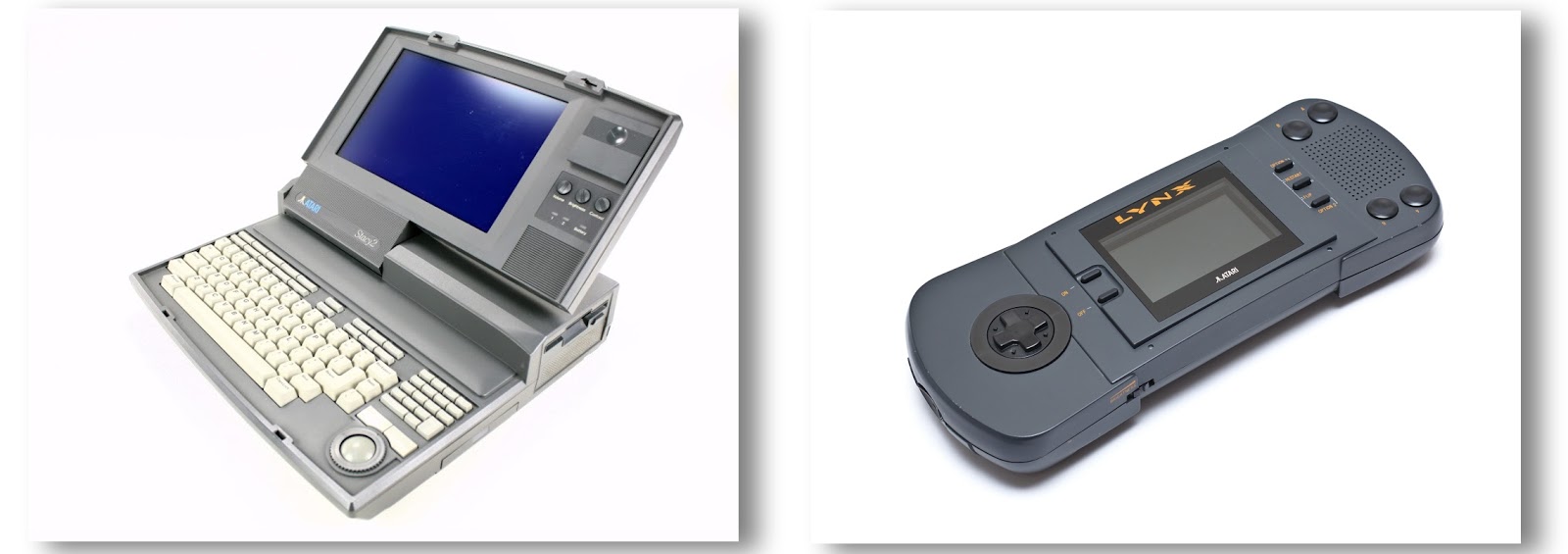
Atari too were experimenting with portable computing, and in 1989 they launched the Portfolio (that we already covered) plus the Atari Stacy and Atari Lynx. The Stacy (styled STacy by Atari) was a portable version of the Atari ST which had proved a hit in the mid-80s but was now fading. However, the Stacy found a successful niche with musicians who liked the portability and the excellent MIDI support, even though Atari gave up on making it battery powered quite late into development and ended up gluing the battery compartment shut. At the other end of the scale was the Atari Lynx was a handheld gaming platform that was advanced for its day but struggled against the Nintendo Gameboy... however even today the Lynx has its fans and now and again new games appear for it.

Atari Stacy (1989) and Atari Lynx (1989)
Like Atari, Zenith Data Systems had been a pioneer of early microcomputers and they too were keen to jump on board the portable computer bandwagon. The Zenith MinisPORT (launched in 1989) was one of the smallest DOS-compatible computers made to that date, and it featured a highly unusual 2” floppy disk drive in order to keep the size down.

Zenith MiniSPORT (1989)
Sega was another stalwart of the gaming industry, in 1989 they launched the Sega Mega Drive (also known as the Genesis) that proved to be a massive hit in Europe and North and South America – although officially replaced by the Sega Saturn in 1995 the popularity of the Mega Drive continued. 30 years later and Sega revisited the platform with the Sega Mega Drive Mini. Skip another generation from the Saturn and you get the 1999 Sega Dreamcast. The Dreamcast was an advanced machine with excellent 3D support, but it couldn’t compete against Sony’s Playstation 2 and it was Sega’s last mainstream games console.

Saga Mega Drive aka Genesis (1989) and Dreamcast (1989)

Back to 1989 again and we find a computing oddity in the SAM Coupé – an unusual machine that was compatible with the Sinclair ZX Spectrum with various enhancements such as a proper keyboard, floppy disk and more memory. It was a niche success against 16 and 32-bit rivals and it still has a dedicated following today. Don’t confuse the SAM Coupé with the Cozy Coupe though, this little plastic car for children was launched in 1979 and it would technically be one of the world’s best-selling cars if it was actually a real car.
--
SAM Coupé (1989) and Cozy Coupe (1979)


Looping round one last time to 1989, and Motorola launched their iconic MicroTAC series of phones. This flip-phone design was much more compact than the DynaTAC that preceded it, and many versions of the MicroTAC were made for all the disparate analogue and digital networks of the early 1990s. The design evolved over the years, and versions of the MicroTAC stayed in production until 1996. One of the MicroTAC’s spiritual successors might be the tiny Ericsson T28, the world’s smallest mobile phone when it was launched in 1999 weighing just 83 grams. Ultimately both the MicroTAC and T28 started a trend for mobile phones to be smaller and lighter, which is something we seem to have lost along the way..

Motorola MicroTAC (1989) and Ericsson T28 (1999)


That’s it for 2019. Next year we look to cover diverse topics such as the Acorn Atom, Epson MX-80, Squarial and Pac-Man plus many other things. See you on the other side!

Image credits

Honeywell 316: Scott Beale via Flickr
GRiDPAD: Association WDA via Flickr
Atari Stacy: Perfect Circuit Audio via Wikimedia Commons
Atari Lynx: Pete Slater via Flickr
Zenith MiniSPORT: Kris Davies via Wikimedia Commons
Sega Mega Drive: Barité Videojuegos via Flickr
Sega Dreamcast: Evan-Amos via Wikimedia Commons
SAM Coupé: Simon Owen via Wikimedia Commons
Cozy Coupe: Nick via Flickr
Motorola MicroTAC: Redrum0486 via Wikimedia Commons
Ericsson T28: The Norwegian Telecom Museum via Wikimedia Commons

Wednesday, 11 December 2019

Tangerine Microtan 65 (1979)

Tangerine Microtan 65
Introduced December 1979

As the 1970s drew to a close US computer manufacturers were dominating the market with fully-featured but expensive systems such as the Apple II and Atari 800. Where these systems were popular in the US market, British consumers had rather less to spend on these new-fangled machines and many hobbyists were tinkering with simple board computers such as the Acorn System 1 instead.

Although board computers were inexpensive, they were also very limited. Although it was usually possible to add a few peripherals, they still couldn’t do the sorts of things that the new American microcomputers could.

Into this market stepped the British-based Tangerine Computer Systems with the Microtan 65. This was a 6502-based single board computer with just 1Kb of RAM, 1Kb of ROM with a simple OS called the monitor, a video output and a hexadecimal keypad. But the system itself was highly expandable, with the first step being the TANEX expansion board that added a cassette and serial interface, plus the option of more RAM and up to five EPROMs.

However, expansion could go on and on with more boards for more memory, disk controllers, printers, better graphics and more. All of these could be slotted into a 19” rack-mountable case to make a microcomputer that could be used for business, home or scientific or engineering purposes. And although the price of all these components added up, you only needed to buy what you were going to use.

The result was a technically capable and scalable system that was successful enough for Tangerine to look at creating a follow-on model. Initially they looked at creating a CP/M compatible Z80-based machine that was developed for HH Electronics, named the HH Tiger. Despite an elegant design, the Tiger was not a success and is largely forgotten if it was even noticed at all.

Tangerine’s next hit was the Oric-1, another 6502 machine made very much in the mould of the very popular Sinclair ZX Spectrum. This machine and its successor – the Oric Atmos – proved very popular in the UK and some other European markets. But that is a story for another time.

Ultimately the Microtan 65 could have been the start of a huge revolution in personal computing, but it didn’t quite make it. Forty years later the Microtan 65 is a hard thing to find for collectors, but our research indicates that a well-specified system might cost you something in the region of £1500.

Image credit: Ian Dunster via Wikimedia Commons


Monday, 25 November 2019

Galaxian (1979)

Introduced November 1979

Galaxian was launched at a time when arcade games were becoming really popular – and profitable. Following the trail laid by 1978’s Space Invaders was Namco’s Galaxian. Despite there only being about a year and a half between these two products, Galaxian was a huge improvement.

Fundamentally the concept of the game was pretty similar to Space Invaders – the player controlled a spaceship at the bottom of the screen which could move left or right and fire. Arranged in neat rows at the top were hostile aliens that the player had to wipe out. But Galaxian was a much richer gaming experience.

The most obvious improvement that this game was in colour, unlike the monochrome Space Invaders that used plastic strips to give the *illusion* of colour. And instead of the aliens slowly shuffling their way across and down the screen, the enemies in Galaxian swooped down shooting, either singly or in a group. Combine that with simple but well-polished sound effects and it all added up to a game that made Space Invaders look primitive.

Inside was a Zilog Z80 processor which really was next-generation stuff compared to the old Intel 8080 in Space Invaders, plus of course electronics components were improving all the time which helped enormously. It wasn’t just hardware though, Galaxian was also efficiently coded to squeeze as much out of the hardware as it could.

Namco found that it had a huge hit on its hands, first in Japan and then in North America after partnering with Midway (who had previously partnered with Taito on Space Invaders). Galaxian went on to be one of the definitive arcade games of the early 1980s and it was eventually ported to many other platforms. The official follow-on – Galaga – was an even bigger hit, and Namco themselves continue on to this day having merged with Bandai in 2006 to create Bandai Namco.


Wednesday, 13 November 2019

Asteroids (1979)

Introduced November 1979

1979 was a landmark year for Atari – the launch of the popular 400 and 800 computers, the Lunar Lander arcade game and the continued success of the VCS games console meant that Atari was very much becoming a cornerstone technology company of the late 70s and early 80s.

Asteroids Gameplay (click to enlarge)
--
Asteroids Cabinet
The next step in the story was the Atari Asteroids arcade game. Based on the same basic hardware as Lunar Lander, Asteroids was a much more playable game. In case you’ve never seen any of the many versions of Asteroids that followed the 1979 classic, the basic idea is to blast large chunks of rocks into smaller chunks and then destroy them completely using a small spaceship that can move about the screen. Flying saucers will also appear and attempt to shoot the player to give it an extra degree of complexity. Although not strictly following the laws of physics, the game has a fair approximation which gives it an atypical gameplay for an arcade machine.

Like Lunar Lander, this was a vector graphics games powered by a 6502 with some rudimentary sounds hard-wired in. Although the controls were different (with five buttons to rotate left and right, fire, thrust and hyperspace).

The game was an enormous success, raking in tens of millions of dollars for both Atari and the arcade operators. Demand for the games was so great that Atari cannibalised some of their Lunar Lander boxes to meet it, and it became the most popular arcade machine in the world… for a while.

Sequels, spin-offs and clones followed on just about every console and computer system known to mankind. Forty years later it is still a popular game, although the days of CRT machines with vector graphics are long gone. If you want the original thing, they are pretty hard to come by and most of those available seem to be in the US with a price of $1500 or so for the classic cabinet version and around $500 for the cocktail table variant.

Image credits:
Michael F. via Flickr
killbox via Flickr

Sunday, 3 November 2019

Atari 400 / 800 (1979)

Atari 800 (1979)
Introduced November 1979

In the late 1970s the microcomputer revolution had been kicked off by the holy trinity of the PET, Apple II and TRS-80 which all launched in 1977. Then – as now – two years is a long time in technology and even those these computers well selling well in in 1979 there were better machines coming along.

Atari was an established player in the consumer electronics market since the early 1970s, but although they were eager to capitalise on the new microprocessors launching in the later part of that decade they had taken a different path with the Atari VCS (later called the 2600) launched at the same time as rivals were launching home computers instead.

The Atari VCS was a significant hit, however Atari’s own engineers though that it would have a very limited lifespan (although in fact it was in production in one form or another for 15 years). Development of an improved version based on the VCS architecture started immediately after the product was launched.

When the Atari 400 and 800 were launched two years later it turned out that the VCS had evolved into something very much more advanced. Based on the popular 6502 processor, both the 400 and 800 were fully-featured microcomputers much like the competition, but they also came with a convenient cartridge slot like a games console… which most of the competition did not.

During the design phase it was envisaged that the 400 and 800 would be quite different computers, but in the end they were fundamentally the same. The main differences were that the 400 had 16KB of RAM, a single cartridge slot and a membrane keyboard compared to the 800’s 48KB of RAM, two cartridge slots and a traditional mechanical keyboard.
Atari 400 showing cartridge slot (1979)

At launch the 800 was priced at $1000 with the 400 coming in at $550. Because you had to add a monitor plus some sort of storage (i.e. a cassette or disk drive) then it could add up to being quite an expensive system. However, the hardware was much more sophisticated than earlier rivals.

Featuring two graphics support chips (ANTIC and CTIA) plus another I/O chip that handled sound and everything else (POKEY) plus four joystick ports and a serial expansion bus, these 8-bit Ataris were easily more capable than the first-generation of microcomputers they were up against. They made excellent games machines, but they were also capable of doing everything that any other contemporary microcomputer would do.

FCC regulations of the time basically mandated that the whole computer be hidden inside a cast aluminium block, making the Atari 400 and 800 especially sturdy. These regulations also led to the development of a novel serial bus (called SIO) that allowed components to be daisy-chained to a single interface port on the computer itself. This solution was ahead of its time and is conceptually similar to the way USB peripherals work, but it had the disadvantage of making plug-in devices much more expensive.
Atari 130XE (1985)

Still, the advanced features of the device made the Atari 400 and 800 very popular, but high production costs meant that Atari made little – if any – profit from them at the beginning. A brutal price war in the early 1980s hit hard, but Atari fought on with the cheaper but more sleek "XL" line (notably the 600XL and 800XL). The 8-bit Atari range had an unexpected boost with the fall of the Iron Curtain in the late 1980s which led to huge sales success in these emerging markets due to the low-cost nature of these computers with even cheaper “XE” machines (the 65XE, 130XE and 800XE) plus a games console based directly on the same architecture (XEGS).

In all there were three generations of the Atari 800 and its siblings, with production lasting until 1992 – the same year that Atari finally pulled the VCS games console. The popular Atari ST – based on the Motorola 68000 – was launched in 1985, giving the company a new lease of life into the 1990s.

Today the Atari 800 is more readily available than the 400 for collectors, with prices varying between tens and hundreds of pounds depending on condition and peripherals. The later 800XL is much more common and tends to be cheaper. Alternatively various emulators are available if you want to try it that way instead.

Image credits:
Bilby via Wikimedia Commons
Rama & Musée Bolo via Wikimedia Commons
Multicherry via Wikimedia Commons