Sunday, 28 March 2021

Nintendo Game Boy Advance (2001)

Introduced March 2001

Nintendo had popularised handheld gaming, first with the simple but fun Game & Watch in 1980, then then Game Boy in 1990 and the Game Boy Color in 1998. By the early noughties, the technology for handheld devices was improving at a rapid rate – and it was into this market that the Game Boy Advance (or “GBA” for short) was born.

The original series of Game Boy devices used a weird Sharp CPU – the LR35902, which was a sort of cross between an Intel 8080 and a Zilog Z80. The new Game Boy Advance used a 32-bit ARM processor of the type that was eventually to become ubiquitous in handheld devices. The weird Sharp CPU was still there though, providing backwards compatibility with earlier Game Boy generations.


Game Boy Advance
Game Boy Advance


Unlike earlier versions, the control buttons were on either side of the 2.9” colour display. But it was the display itself that was divisive – it didn’t have a backlight and was difficult to see in a lot of lighting conditions. Although 2001-era displays weren’t as good as they are today, the Game Boy Advance was a disappointment. However, power requirements were low and the unit would run for up to 15 hours on two AA batteries.

Limitations aside, it was a very successful device with a wide variety of games, including all those written for earlier Game Boy devices plus a large number of others written just for this console. The GBA also came in a wide variety of colours and special editions to tempt people to buy more than one. Less commonly used were adapters and link cables for playing multiplayer games and watching videos.

Game Boy Advance SP
Game Boy Advance SP

Although it was a fundamentally good console, the poor screen held it back. In 2003 Nintendo launched the Game Boy Advance SP in a clamshell design with a front-light which improved matters, but a later revision in 2005 (the AGS-101) included a backlight and it finally made the GBA playable in all environments. The Nintendo DS effectively replaced the GBA and was compatible with most of its games, originally launched alongside the SP it eventually took over. Between all different models of the GBA, total sales were in excess of 80 million. If you want one today, prices vary significantly but an AGS-101 in good condition will start at around £150 but rarer variants can be much more expensive.
 

Image credits:
Evan-Amos via Wikimedia Commons – CC BY-SA 3.0
Evan-Amos via Wikimedia Commons – CC 0


Saturday, 20 March 2021

Nokia 8310 (2001)

Launched March 2001

Twenty years ago mobile phones were becoming very popular, no longer the plaything of yuppies or sales reps the early 2000s saw the beginning of a golden age of handset design. Although primitive by today’s standards, phones of this era were developing rapidly and the space of just a few years saw colour screens, cameras, Bluetooth, multimedia and packet data.

One feature that was highly prized was size – but unlike today when bigger phones are considered better, two decade ago the race was to make things smaller. Into this market came the Nokia 8310, an exquisitely designed but very tiny device that formed part of Nokia’s “perfect” 8000 series of high-end mobile phones.

Nokia 8310
Nokia 8310

Weighing just 84 grams, the 8310 had a brightly-lit monochrome display, but surprisingly it also packed in an FM radio and was the first Nokia phone to feature GPRS. One key feature was the swappable Xpress-on covers which allowed to customise your phone with whatever style you wanted. Some built-in games such as the popular Snake II and the must-have early noughties infra-red port rounded off the feature set. The thing would run for days on a single charge, as would most phones of the time.

It wasn’t cheap, retailing at £400 or so in the UK. This of course just made it rather more exclusive and more desirable, and it ended up being one of Nokia’s iconic designs of the time. These days they are pretty common, and if you want a no-frills retro 2G phone then you can get a good one for about £30 or so. 

Image credit: Nokia

Sunday, 14 March 2021

UNIVAC I (1951)

Introduced March 1951

The immediate post-war years saw the first viable commercial and scientific computers hitting the market, such as the LEO I and Ferranti Mark 1 in the UK and the UNIVAC I in the United States. These huge, heavy, power hungry, expensive and slow computers are very primitive by today’s standards, but they found their niche in corporations and laboratories.


UNIVAC I in use at the US Census Office


Rather like the British LEO I, the UNIVAC I was a business computer made up of around five thousand vacuum tubes, weighed about 8 tons and sucked in 125kW of electricity. Primary memory consisted of 1000 12-character words stored in mercury delay lines (similar to the LEO), but one novel feature the UNIVAC had was magnetic tape drives for secondary storage. These UNISERVO I drives were the first ever commercially available computer tape drives, and they used heavy nickel-plated phosphor bronze tapes. Other rival computers tended to use punched cards, and initially the UNIVAC I lacked this option.

It was an eye-wateringly expensive system, costing the equivalent of around $7 million in today’s money.  This tended to put it out of reach of many universities and into the realm of government departments and large corporations instead. Given the price and complexity of the UNIVAC I, they wouldn’t always go straight to the customer but would instead be used for a while as demonstrators.

UNIVAC I mercury delay line memory


Once such UNIVAC I was bound for the US Atomic Energy Commission, but took a detour to detour to CBS to help predict the results of the 1952 US Presidential Election. Programmed by the legendary computing pioneer Grace Hopper, the UNIVAC had a complex model built up of data from past elections. With a sample of 5.5% of the vote, the UNIVAC came up with a prediction – out of the two candidates of Dwight D Eisenhower and Adlai Stevenson, Eisenhower would win in a landslide. The problem was that the UNIVAC’s prediction was completely at odds with pollsters who were predicting a win for Stevenson. So the UNIVAC’s analysis was downplayed by CBS.

Even if you don’t follow US presidential elections of the 1950s, you’ve probably heard of President Eisenhower and not President Stevenson.. that’s because the UNIVAC turned out to be accurate and Eisenhower did indeed beat Stevenson, by a similar margin to the computer’s prediction. Eisenhower might have won the vote, but the UNIVAC won when it came to the star of the election night count. 


Grace Hopper working on a UNIVAC I console


Demand for UNIVAC machines boomed… but Remington Rand were struggling to build them. So ironically, it was rivals IBM who actually benefitted with their IBM 701 mainframe and its successors as they could build them in the quantity customers wanted. As for Remington Rand, they were taken over by Sperry in 1955 which in turn merged with Burroughs to create Unisys in 1986. Unisys is still around today, and it still makes computer hardware such as the Intel-based ClearPath Forward systems among a muddle of consultancy services and resold products.

Although the UNIVAC I was only a moderate success in sales terms, it is socially significant for its role in the Presidential Election where it offered a glimpse into the future of computing, only seven years after the end of the Second World War. It’s astonishing to think that all this was still more than a quarter of a century before the launch of micros such as the Apple II

Image credits:
U.S. Census Bureau via Wikimedia Commons – Public Domain
Tiia Monto via Wikimedia Commons - CC BY-SA 3.0
Smithsonian Institution via Wikimedia Commons - CC BY 2.0


Saturday, 6 March 2021

Sinclair ZX81 (1981)

Launched March 1981

By early 1981 the microcomputer revolution was well underway, with plenty of options available for people wanting to dip their toe into this new high-tech world. The problem with most of these options was that they were expensive.

In the US, the Commodore VIC-20 was leading the charge on behalf of low-cost computing, but in the UK there had been an even cheaper and more basic computer launched in 1980 in the shape of the Sinclair ZX80 which had been a modest success. But it was Sinclair’s next computer – in the shape of the Sinclair ZX81 – that became the ground-breaking machine that found its way into more than a million homes.

Sinclair ZX81
Sinclair ZX81


On paper, the ZX81 was just a minor upgrade to the ZX80. But crucially, Sinclair had redesigned the electronics completely – where the ZX80 had 21 mostly off-the-shelf chips, the ZX81 had just 4. The difference was a custom-built ULA designed and built by computing pioneers Ferranti. This made the whole design simpler, and critically cheaper. A fully-assembled version cost just under £70, compared to £100 for the ZX80. If you were a real cheapskate you could buy a kit for just £49.95 and assemble it yourself.

The ZX81 was a simple but clever system. Smaller than a sheet of paper, the ZX81 boasted a reasonably powerful Z80 CPU clocked at 3.25MHz but only had a tiny 1Kb of RAM as standard. A truly terrible membrane keyboard also came with all the ZX81 BASIC functions pre-printed onto the keys, making it easier to learn how to program the thing. All you needed was a domestic TV and a cassette player so you could save and load programs, and you’d be away. In a strictly limited sense.

Text was a 32 column by 24 line affair, or a limited 64 x 48 pixel graphics display. There was no colour or sound, and anything displayed on the screen ate into the tiny amount of RAM. Also, the limited hardware meant that the ZX81 had to use a fair chunk of processor cycles to update the image which slowed it down..  you could speed things up by using FAST mode which prioritised speed over the display, which would white out when the computer was thinking.

On the back of the ZX81 was a simple edge connector, which most owners used to attach a notoriously wobbly 16Kb RAM pack, but Sinclair also sold a tiny printer that output onto silver paper. But the edge connector could be used for more, and a small cottage industry sprang up making everything from replacement keyboards, sound generators and even disk interfaces. A wide range of decent quality software appeared on tape, and a number of magazines produced printed BASIC programs that the user could laboriously key in and debug.

It was a good-looking system, designed by Rick Dickinson who had a long association with Sinclair. The comprehensive manual also featured gorgeous cover art by sci-fi artist John Harris. The fabulous design didn’t always make up for variable build quality, but certainly the unboxing experience was something a bit special.

Typical ZX81 configuration with cassette recorder, monochrome TV and manual


Despite its flaws, the ZX81 was a hugely popular system – especially in the UK. However, an attempt to break through into the US market in partnership with Timex (who assembled the ZX81) met with limited success. A number of other clones – some licenced, some illegal – followed in worldwide markets. Enthusiasts continue to develop hardware and software for the ZX81 even today.

The profits from the ZX81 were substantial, putting Sinclair in an excellent position to develop their next machine, the ZX Spectrum. More importantly, the ZX81 introduced millions of people to computers and programming and helped to make those fields popular in the markets the ZX81 succeeded. Today the ZX81 is quite collectable with a thriving trade in software and add-ons, prices for ones in excellent condition can exceed £100 but there are bargains if you hunt around. 

Image credits:
Science Museum Group
- CC BY 4.0
Mike Cattell via Wikimedia Commons - CC BY 2.0


Sunday, 21 February 2021

Quantel Paintbox (1981)

Introduced 1981

If you watched TV during the 1980s and 1990s then you’ll probably be familiar with the work of the Quantel Paintbox, even if you don’t know it. A high-end computer system aimed at providing professional graphics for television studios, the Paintbox propelled graphics from being either painstaking or amateurish to the easy-to-use and slick presentations we see today.

Quantel was a British electronics company founded in the 1970s, early expertise in both digital and video technologies led to the creation of the Paintbox in 1981. Put simply, the original Paintbox was a true-colour digital graphics system that was years ahead of its rivals. The primary interface was a massive touch-sensitive digital tablet, but the clever end was a rack-mountable computer based on the Motorola 68000 processor but with a mass of custom-designed computer hardware to handle everything, including a massive 14" hard disk for storage. All of this was designed and built in Newbury, England.

Quantel Paintbox
Quantel Paintbox


Designed from the point of view of the digital artist, the Paintbox was both easy to use and very powerful. But all of this came at a cost - £120,000 in 1980, equivalent to about half a million pounds today. But for most established TV production companies of the time, price was not a barrier.

It wasn’t just TV, artists such as David Hockney used the Paintbox and it played a role in Dire Strait’s famous video for “Money for Nothing”, and it found its way onto eighties album covers. But on TV it was everywhere – title sequences, weather forcecasts, maps, captions… it defined the look of late 1980s television.

Buoyed by success, Quantel’s range grew to include digital libraries, animation systems and a host of other related technologies. All of this expertise made Quantel the go-to company for digital production, and despite cheaper systems such as the Video Toaster nipping at their heels it seemed that Quantel had the market sewn up. But by the early 2000s competition was becoming fiercer, and it was becoming possible to do digital editing on off-the-shelf computer systems. Quantel’s market share slipped, and they merged with rivals Snell & Wilcox, were then acquired by Belden and finally spun out into the Grass Valley company – still serving the same market, and still with an office in Newbury. The Grass Valley Rio system is the modern descendant of those 80s and 90s Quantel systems.

Image credit:
Martin Deutsch via Flickr - CC BY-NC-ND 2.0


Monday, 15 February 2021

Defender (1981)

Introduced February 1981

The Golden Age of Arcade Machines really started in 1978 with Space Invaders, an addictive game built on simple hardware. But technology was pushing ahead at a pace, and the same sort of hardware that was finding itself into microcomputers of the era was also finding its way into the arcades.

Defender is a case in point – the first arcade game from pinball masters Williams, the Defender machine used the relatively new Motorola 6809 CPU and a 16 colour monitor with a 320 x 256 pixel resolution, with a second Motorola CPU (this time a more basic 6800) handling the sound. Of course, powerful hardware is one thing, but good gameplay is even more important.

Defender

Thematically, Defender was a sort of cross between Space Invaders and Asteroids. The player controls a small spaceship which is tasked with protecting humans on a barren planetoid from hostile aliens. The ship can move left and right, causing the screen to scroll with it, or up and down to the top of the screen. The play area wraps around from left to right, and is displayed on a mini-map at the top of the screen. Aliens will either try to kidnap and mutate the humans, or will attack the player’s ship directly. Compared to other shoot-‘em-up space games, Defender allows the player a large degree of mobility and they can develop their own strategies.

However, the game was notoriously difficult to play. The controls consisted of an up/down joystick, a thrust button, reverse button, fire button, smart bomb button and away from all the others was the emergency hyperspace. Pressing “thrust” would make the ship accelerate in the direction it was pointing (left or right), keeping the button pressed down make it go faster and faster until usually you smacked into an alien invade. Slowing down required the use of the reverse button and then reverse thrust. While trying to do this, invariably you would need to shoot at stuff and keep an eye on the minimap. Newbies would die very quickly – and this being an arcade game, they’d need to put in more money to try again.

----

Ergonomics? What's that? Defender's notoriously difficult control panel

The Defender game itself had been subject to a prolonged period of development difficulties (although the Motorola EXORciser used to develop it is a whole rabbit-hole by itself), and had taken up a considerable amount of time and money at Williams. When it finally hit the arcades in 1981 it was unpopular at first, most likely due to the difficult gameplay. But as people got used to it, Defender became more popular.. and eventually turned into a massive hit. Williams shipped nearly 60,000 arcade machines which brought in more than $1 billion of revenue.

The humble 8-bit 6809 CPU was pushed right to the end of its performance with the game – indeed, it could often suffer from lag when there was too much going on. But it made a good candidate for conversion to the growing market of micros and consoles which were also expanding in capabilities at the time, with a variety of official and unofficial ports available for almost every system that could keep up with the demands of the game.

Defender demonstrated that video games could be more complex than the simple format inspired by Space Invaders, although not many games would succeed if they were as unforgiving to newbies. But other side-scrolling games followed, including Scramble which hit the arcades later the same year. Today Defender machines are quite collectable today assuming you have the space and.. errr.. about £7000 or so.

Image credits:
Matt Grommes – CC BY-SA 2.0
Rob DiCaterino via Flickr - CC BY 2.0


Wednesday, 10 February 2021

LEO I and Ferranti Mark 1 (1951)

Introduced February 1951

The years immediately after the end of the Second World War saw huge advances in the use of electronics and the development of early computers. By 1951, these machines were becoming practical – albeit in strictly limited scenarios – and February 1951 saw both the world’s first public demonstration of the LEO I and the delivery of the first Ferranti Mark 1 computers.

Both computer systems were British designed and built, they used vacuum tubes and masses of discrete components such as diodes and resistors, housed in huge boxes weighing several tons that sucked in electricity at a phenomenal rate. Primitive by today’s standards, the Ferranti Mark 1 and LEO I was early examples of successful commercial computers.

The computers had different markets, the Ferranti was aimed at scientists and engineers but the LEO was the world’s first dedicated business computer.

LEO Computer name plate

“LEO” stood for “Lyons Electronic Office”, and it was a computer originally designed for the J Lyons company in the UK. Lyons at that time was a massive business of food manufacturing, tea shops and other hospitality businesses spread throughout the country. Almost every town had a Lyons Tea Shop, making them the post-war equivalent of Costa Coffee or Starbuck today – and they had a huge number of customers and staff to support them, requiring a steady and uninterrupted supply of food to keep everything going.

It was a massive logistical enterprise, and Lyons managed it very successfully. Indeed, Lyons successful management of logistics led to the British government giving them the contract to run a large munitions factory called ROF Elstow during World War II. Logistics was the key to the Lyons business, and this led to their interest in the developing world of computers.

The LEO I was designed to help with that. Inspired largely by the EDSAC computer developed at the University of Cambridge, the LEO I started with the mundane task of bakery valuations before moving on to inventory management and payroll. Lyons even started doing payroll for other companies, and there was demand for LEO I systems from other large companies in the UK.
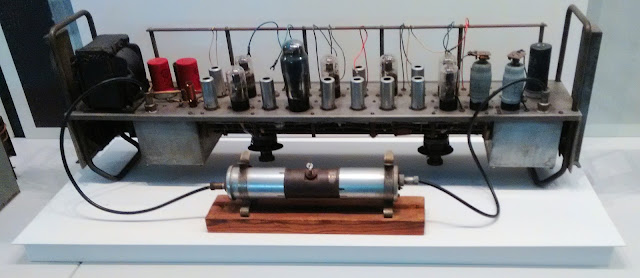

LEO I Mercury Delay Line Storage Unit

A few years later, the successful computer division was spun out as LEO Computers leading to the LEO II and LEO III which used more modern technology. In the 1960s, LEO Computers were merged into English Electric, then International Computers and Tabulators (ICT) and eventually found their way into ICL which itself was taken over by Fujitsu in 2002. The J Lyons company also faded away, by the 1960s the tea shops were losing money and despite a merger with Allied Breweries in the late 1970s, the profitable parts of the company were sold off but the Lyons name lives on under different owners.

The Ferranti Mark 1 had a different lineage – essentially a commercialised version of the Manchester Mark 1 developed at the University of Manchester. Ferranti themselves were a more traditional electrical engineering and electronics company, working in diverse markets such as defence, power systems and home appliances. Their experience in electronics in World War II made them an obvious choice to collaborate with the Manchester project.

Although both computers used vacuum tubes, they had very different forms of memory – the LEO used acoustic mercury delay lines and the Ferranti used a CRT called a Williams Tube. These technologies were only marginally viable even in 1951 and neither technology made it to the end of the decade. Data storage for both systems included the rather more long-lasting solutions of paper tape and punched cards.

Several generations of improved computers came after the Mark 1, but Ferranti wasn’t competitive in the business computer market so eventual sold that off to ICT (who became ICL), concentrating instead on industrial and military applications. Development of these computers continued into the 1980s, alongside Ferranti’s successful semiconductor business.

Ferranti Mark 1 Logic Door

But where J Lyons faded away, Ferranti’s end was more sudden and dramatic. A takeover of a US firm called International Signal and Control (ISC) in 1987 was a disaster – although ISC looked like a good fit, it turned out that the books that Ferranti had inspected were false and instead of ISC being a profitable and above-board defence contractor, its real business was in illegal arms sales which were often made at the behest of the US government. These illegal contracts stopped as soon as ISC because British-owned leading to a massive black hole in Ferranti’s accounts. By 1993 it was all over, Ferranti collapsed and the viable business units were bought out by competitors.

It’s a familiar story of course, early innovators fall by the wayside and then disappear. Not every company can become an IBM or Apple, but in the case of Lyons and Ferranti rather more was lost along the way. 

Image credits:
Ferranti Mark 1 Logic Door - Science Museum Group – CC BY 4.0
LEO Computer Name Plate - Science Museum Group – CC BY 4.0
LEO I Mercury Delay Line - Rhys Jones via Flickr – CC BY-NC 2.0