Saturday, 11 February 2017

Cambridge Z88 (1987)

Launched February 1987

Launched in February 1987, the Cambridge Computer Z88 (usually just called the "Cambridge Z88") was a Sinclair by any other name. A compact, A4-sized ultraportable computer, the Z88 was a design success even if it didn't quite become the big seller that was hoped.

In 1986, Clive Sinclair had sold the rights to the Sinclair name and product line-up (primarily consisting of the ZX Spectrum) to Amstrad. However, his company still existed under a different name and the Z88 was the product of long running research to produce a portable computer.

As was typical for a high-profile 1980s product, the Z88 was announced a long time before it was available in quantity. First demonstrated in February 1987, it didn't really get to market in any quantity until 1988. And unlike previous Sinclair machines, the Z88 was something of a niche device targeting customers who wanted to do things on the move rather than sitting at a desk.

Measuring 294 x 210 x 21mm the Z88 was the same size and weights as a pad of around 200 sheets of A4 paper. Most of the front of the Z88 was taken up by a large rubbery keyboard, and at the top was an 8-line 640 x 64 pixel STN LCD screen which was very advanced for its time. Underneath, the Z88 had a Z80 CPU running at 3.3MHz with 32K of RAM and it could store data on either volatile RAM cards or an EPROM card which wouldn't lose data when the machine was powered off. The Z88 was powered by four AA batteries which could give up to 20 hours use.

The operating system was called Oz, and the Z88 came with BBC Basic, a terminal emulator, a word processor / spreadsheet application and some personal information management tools. Applications could be suspended and resumed, giving the Z88 a limited multitasking ability. New applications could be added through the EPROM slot, and data could be transferred to and from the Z88 using a serial cable.

The Z88 found a particular niche as a note-taker. The large keyboard was effectively silent (unless the optional click was turned on), and the long battery life and readable screen certainly helped here too. But since the Z88 was a fully-featured 8-bit computer it could do many other things too.

The Z88 became a bit of a cult machine, with after market upgrades to allow Flash memory storage and more RAM becoming available. Accessories and add-ons are still available as well. On the second-hand market the prices for the Z88 vary on condition and accessories, with UK prices ranging from around £50 to £130.

In the end, the Z88 was probably too far ahead of its time. These days we are all used to carrying a computer about in our pocket, but thirty years ago it was a novelty. This was the last computer project from Sinclair's own company and although a variety of other projects were started at a later date they could never repeat the success that Sinclair had in the 1970s and 1980s.

Neonode N2 (2007)

Launched February 2007

Ten years ago, touchscreen phones were just beginning to become popular consumer devices. But for many, high-end touchscreen phones such as the HTC TyTN and forthcoming Apple iPhone were just too BIG and didn’t really fit into the mid-noughties trend of smaller being better. Neonode, however, had other ideas and wanted to make a touchscreen phone that was as small as possible.

In fact, Neonode’s line-up of handsets weren’t touchscreens in the traditional sense, but instead used an invisible grid of light beams to determine what part of the screen the user was touching. Launching first with the Neonode N1 shipping in 2005, 2007 saw the even smaller Neonode N2 with a tiny 2” 176 x 220 pixel display in a package weighing a diminutive 70 grams.

Unlike the rival LG PRADA, the N2 was actually a Windows smartphone of sorts, running Windows CE 6.0 which really made it a PDA with phone features added on. The operating system came on a memory card, so knowledgeable users could tweak it if they wanted to. Otherwise the features were basic but pretty standard – quad-band GSM, Bluetooth, a 2 megapixel camera and a multimedia player were all included.

Priced at around €450, it wasn’t exactly cheap but then a SIM-free iPhone (if you could get it) would later come in at around €1000. Reviewers loved it, but it wasn’t really a commercial success selling a few tens of thousands of units. Low sales figures meant that Neonode had some turbulent times, but it still exists today selling its own particular type of touchscreen technology.

In the end, consumers wanted bigger touchscreens and not smaller ones, with current displays typically being between 5 to 5.5" on high-end phones. However, Sony did try to make mini Android smartphones with some success. If you want something similar today you would have to hunt around, but the Posh Micro X S240 is currently the smallest smartphone on the market.

The Neonode N2 today is quite collectible with typical prices for a good example being €115 or more, and there do seem to be a few on sale at any given time.

Image source: Neonode

Monday, 6 February 2017

Motorola RIZR Z8, KRZR K3, MOTO Q8 and Q9 (2007)

Announced February 2007

In 2007, Motorola's strategy seemed to be a "throw it at the wall and see what sticks" approach. To this end, we saw several very different devices being launched by Motorola ten years ago. The most notable were a range of handsets falling under the Motorola RIZR, KRZR and MOTO Q names.

Technically perhaps the most interesting was the Motorola RIZR Z8 (sometimes called the MOTO Z8). A curved slider phone running the Symbian operating system with the UIQ interface, the Z8 was one of those Symbian phones that tried to out-do Nokia on its own turf. It was an unusual device even within Motorola's own line-up, but in fact much of the development of this had come from ex-Sendo staffers from the UK who had been absorbed into Motorola back in 2005. In the end, the Z8 probably didn't get the market push that it deserved but it was an interesting and quirky design in its own right.

Rather more predictable was the Motorola KRZR K3 feature phone. Motorola had been pushing the RAZR concept since 2004. Although it had enjoyed success, by 2007 customers were looking for something else. But this didn't stop Motorola trying again.. and the KRZR K3 was in essence a 3G version of the K1 launched in 2006. Although the K1 was probably the ultimate flip phone in terms of hardware design, both these KRZR phones belongs to a previous generation of devices and they could not follow the hugged success of the original RAZR V3.

Motorola RIZR Z8 and KRZR K3
As well as Symbian, Motorola was a leading provider of Windows devices. The Motorola MOTO Q8 and Q9 (also called the Q 9h) were BlackBerry-style devices with a physical QWERTY keyboard, lacking a touchscreen. One was a 3.5G device, the other was limited to EDGE. These devices continued the tradition of the modestly success MOTO Q series of smartphones, but ultimately physical keyboards were on the way out.

asda
Motorola MOTO Q8 and Q9
Despite these efforts, Motorola started to go into sharp decline, and in a few years the iPhone and Android devices led to a collapse in sales that nearly took out the company. Motorola wasn't the first company that misjudged the future and it certainly wasn't the last either.

Image credits: Motorola


Monday, 23 January 2017

You can have it all. Just not in one device. Nokia N800, N93i, 6131 NFC (2007)

Announced January 2007

Take a modern smartphone. What sort of things would you expect to find? A big, hi-resolution touchscreen? Tick. A brilliant still and video camera? Tick. Fast cellular data and WiFi? Tick? A powerful operating system? Tick. Lots of applications? Tick. Stylish design? Tick. And.. errr.. NFC? Well yes.. that's a tick too.

It might surprise you that in the same month that Apple launched its fledgling and frankly deeply flawed original iPhone, Nokia also launched a set of products with those features that we just mentioned. But not all in one device.

As with other manufacturers, Nokia seemed to be wrong-footed by Apple's move. Where Apple came up with a single model with as many features as they could manage, Nokia spread the technology over three different products. You couldn't have everything in the one device.

The Nokia N93i (a more polished version of the 2006 N93) was a Symbian smartphone with a remarkable camera. This 3.2 megapixel unit had a 3X optical zoom, Carl Zeiss optics and could record VGA resolution video at 30 fps. Because this was a Symbian phone then there were lots of applications available to download, and it also came with 3G and WiFi support, expandable memory, an FM radio and a TV output port. OK, it didn't have 3.5G or GPS, but the N95 (launched the previous September) did.. and that had a 5 megapixel camera too.

Nokia N93i


Nokia N800
Then there was the Nokia N800, a compact Internet Tablet running the powerful Linux-based Maemo operating system. Maemo had all the technical potential that we today associate with iOS and Android. Compared to the iPhone, the N800 had a much bigger and sharper screen, more flexibility when it came to software but it was much bulkier and it couldn't make phone calls. The N800 wasn't a huge success, but it did beat the conceptually similar iPad to market by three years.

The third device was the Nokia 6131 NFC, which certainly didn't look like much but was the first commercially available handset to have NFC built in. Ten years ago, nobody really had a solid idea about how the technology could be used, but Nokia built the thing anyway because it had to start somewhere. The 6131 NFC was a plain old feature phone, so it was limited in what it could do. Nokia ploughed a lonely furrow with a number of NFC handsets until Samsung launched the first Android device with NFC, the Nexus S, in late 2010.

Nokia 6131 NFC
All of these technologies were pretty exciting, but Nokia being Nokia meant that you had to buy three different devices to have them all.. four if you wanted 3.5G and GPS support. So why not put everything in the same device? Was it simply that it would end up looking like a brick?

At the beginning of 2007, Nokia completely dominated the mobile phone industry to the extent that there wasn't any real competition, so Nokia took the rather novel approach of competing with itself instead. Different groups would come up with different handsets with different technologies, which was all very interesting.. but ultimately it prevented Nokia from making the killer "all-in-one" device that it would need to fight off the iPhone and then Android in the late noughties.

Today, the Nokia N93i seems to be the most desirable with prices for unlocked models in good condition ranging between approximately €150 to €350. Prices for the N800 vary widely from a few euro to €300 for an unused one. The 6131 NFC is the rarest of the bunch and also the cheapest, with €30 or so being typical. All three are technologically quite interesting though - and imaging what 2007 would have been like if Nokia had actually made a viable product combining all of those features.

Monday, 16 January 2017

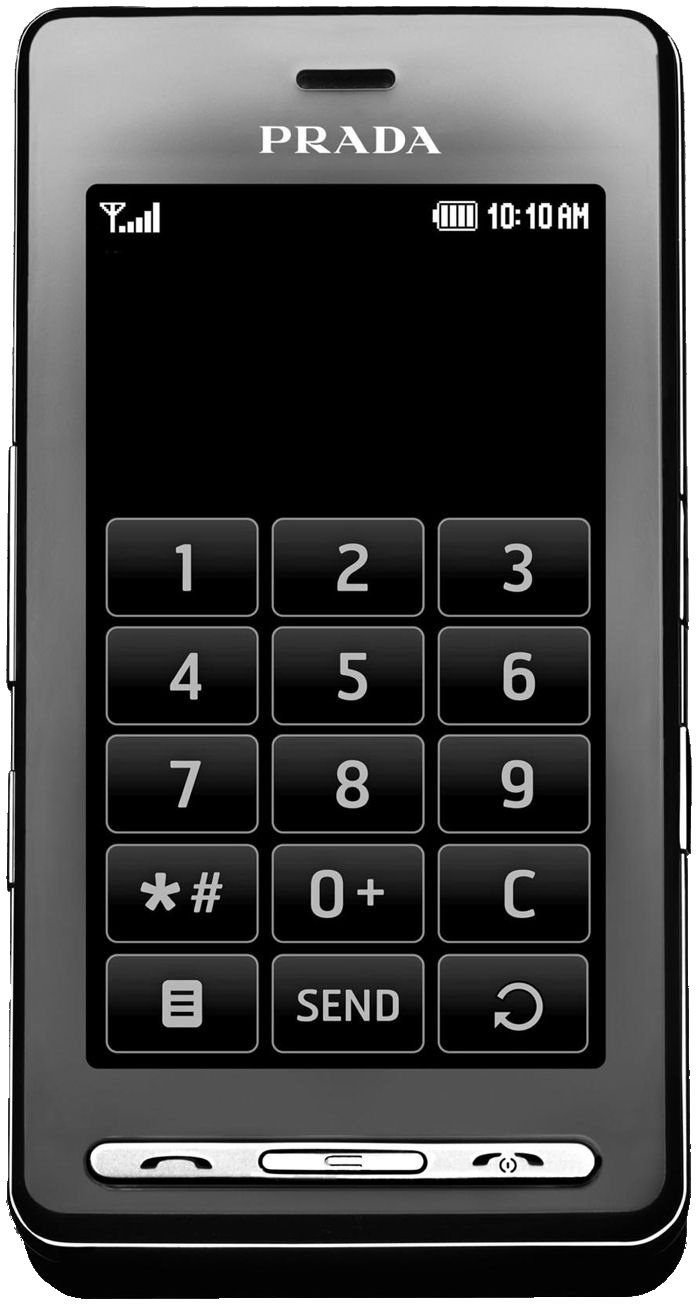
LG PRADA - the era of the iPhone killer (2007)

LG KE850 PRADA
Launched January 2007

The launch of the original Apple iPhone in early January sent shockwaves through the industry. Even with all its flaws, the iPhone was clearly a more polished device than anything on the market and the massive consumer interest in it indicated that touchscreen devices could well be the next big thing.

Apple suddenly because the company to beat, and also quite suddenly everything even vaguely like an iPhone became a potential "iPhone Killer".  The LG KE850 "PRADA Phone" was probably the first handset to earn such a moniker, launched just days after Steve Jobs showed off the actual iPhone.

Of course, the PRADA Phone wasn't a response to Apple at all. LG had independently come up with the idea of a sleek, stylish touchscreen phone a long time before they announced it. Given that there was only a month between the announcement of the PRADA and it shipping, it's clear that it was already ready to go and it beat the iPhone to market by months. You can imagine the sinking feeling when Apple launched its product a few days before LG and took the wind out of its sails.

The PRADA had quite a bit going for it - the 3" 240 x 400 pixel capacitive touchscreen display was better than almost everything else on the market. Except for the iPhone. The two-megapixel camera had a Schneider-Kreuznach lens and could shoot video (where the iPhone could not), but it wasn't a patch on the N95. The operating environment was nice to use by the standards of the time, but again the iPhone was far better.

LG KF900 PRADA 2
And of course the PRADA name and involvement meant that it was beautifully designed and packaged, and that alone should have won fans. But people seemed to prefer an Apple badge on their phone rather than a PRADA one.


So, it wasn't a bad device given the technological era of the time. Since it was available months before the iPhone, and didn't have the "exclusive carriers" deals that the Apple had, the KE850 ended up selling quite well.

Did it kill the iPhone? Hardly.

In late 2008 LG followed up the original KE850 PRADA with the KF900. This was similar in size with an almost identical screen, but it added 3G and WiFi support (which the original lacked), a 5 megapixel camera and it had a slide-out QWERTY keyboard (this was back in the days that people thought this was a good idea). The problem was that the KF900 had to compete against both first-generation Android phones and the second-generation iPhone, which it wasn't really up to.

The third and final version of a PRADA phone was the LG P940 PRADA 3.0, an attractive high-end smartphone with some sophisticated features for its day, launched in 2011. But not even this could really get any traction in the market.

LG P940 PRADA 3.0
Today, the original KE850 PRADA is quite commonly available for between €50 to €600 (good ones are typically €200 or so). The KF900 PRADA 2 is rarer and about the same price. The P940 PRADA 3.0 seems to be very rare and typical prices are €100 - €400 with most on the higher end of the scale. Indeed, you could probably start a whole collection of devices that were all dubbed "iPhone killers" which singularly failed to kill the iPhone.

Wednesday, 11 January 2017

Commodore PET (1977)

Early model Commodore PET
Announced January 1977

Throughout the mid-1970s there were the seeds of a revolution were being sown. After 1975 hobbyist microcomputers such as the Altair 8800 were being offered to the public. After that, relatively low-cost microprocessors such as the Zilog Z80 and the MOS Technology 6502 had been developed into basic systems and board such as the Apple I and KIM-1, but these still were still strictly for hobbyists and engineers.

But 1977 saw the first systems that businesses or consumers could buy and use out-of-the-box. Professionally designed and fully functional, these early commercial offerings sparked the revolution that had been brewing for a few years. This year saw the launch of three highly significant systems in the US - the Commodore PET, Apple II and Tandy TRS-80.

The Commodore PET was announced at CES in January 1977, although the first units didn't ship until October and production levels didn't really meet until early 1978. In terms of announcement date, the PET beat its Tandy and Apple rivals, but those those systems actually shipped to consumers earlier.

The name PET stood for "Personal Electronic Transactor", and it was strikingly designed in an all-metal case with an integrated chiclet keyboard and data cassette recorder. Perched on top was a trapezoid-shaped 9" CRT display, giving the whole thing a look reminiscent of a Mesoamerican pyramid.

Commodore was no startup company - founded in 1954 it had started with typewriters before moving into adding machines and electronic calculators. Founded by industry legend Jack Tramiel, Commodore had bought Chuck Peddle's MOS Technology to secure supplies of the 6502 processor for use in calculator products. Peddle convinced Tramiel that a microcomputer was the way forward, and since Commodore was being hit by a slump in fortunes after a collapse in the calculator market, the company changed direction.

Early PETs featured a 1 MHz 6502 CPU, with RAM options ranging from 4KB to 32KB. Storage was a built in data cassette ("datasette") next to the keyboard, which did mean that on early versions the keyboard was a cramped affair. Over time a wide range of upgrades became available, including floppy and hard disks, printers, plotters and the PET's IEEE-488 interface could talk to a variety of scientific and engineering equipment too.

Later model Commodore PETs
Over the five years of production there were various upgraded models, with better keyboards, bigger screens, more RAM and better graphics. Along the way the cute "PET" name was dropped and the machines took on the name "CBM" (for Commodore Business Machines), but it didn't stop people calling them "PETs".

The PET sold very strongly into schools and colleges, thanks to its sturdy construction and reliability. However, the poor graphics capabilities meant that it didn't sell well in the booming home market, so Commodore followed up the PET with the successful VIC-20 in 1980 and the legendary Commodore 64 in 1982, both based on the 6502 processor. The 64 sold in millions and is the biggest selling computer model of all time.

Prices today for these machines varies from next-to-nothing up to €1000 or so, depending on model and condition. Although the PETs themselves were highly reliable, disk drives were always less common and more fragile and can be hard to find today. Alternatively, if you fancy a virtual PET rather than a physical one the VICE emulator emulates pretty much all 8-bit Commodore machines and runs on a wide variety of platforms, including Windows, Mac and even Android smartphones.

Thursday, 5 January 2017

Apple iPhone - the other half of the smartphone story (2007)

Launched January 2007

Announced ten years ago this month, the original Apple iPhone is perhaps the most important mobile phone product ever. Changing the direction of the market utterly, 2007 marks a clear line in the history of mobile devices with a "before iPhone" period where manufacturers constantly played with features and form factors and an "after iPhone" period which brought the ubiquitous slabby smartphones that we see today.

Although classed as a smartphone, the original iPhone was in fact shockingly limited in what it could do. Cellular data connectivity was limited to 2G only, which for many customers meant crawling along with a GPRS connection no quicker than an old-fashioned dial-up modem, until their carriers could upgrade their 2G network to EDGE which was quicker but still not as good as 3G.. although the iPhone did support WiFi which was quickly the preferred way to get online. Another major drawback is that you were stuck with the applications that came with the phone with no way to add more, making it not much better than a high-end feature phone.

The camera was only 2 megapixels and it didn't come with autofocus or flash, and it couldn't record video. Nor could the iPhone send or receive MMS messaging, and video calling wasn't possible until the iPhone 4 in 2010. As is common these days, the iPhone didn't come with a memory card slot and you were stuck with the 4 or 8GB of storage that the original device came with.

On top of all this, the iPhone was incredibly expensive with a top-of-the-range model in the US coming in at $599 when taken with a new two-year contract. And Apple had entered into exclusive carrier agreements in each country, so in the US you could only get the iPhone on Cingular / AT&T, O2 in the UK, T-Mobile in Germany and Orange in France. Even more cheekily, analysts believed that the carriers had to hand over a monthly fee to Apple for each device signed up on their network.
In most technical respects, the rival Nokia N95 completely demolished the iPhone - it had 3.5G support, a far superior camera, downloadable applications and a range of features that the iPhone wouldn't have for years. And yet, despite all this, the original iPhone carved a niche for itself selling over 6 million units. So what went right?

On the plus side, the hardware and software were beautifully designed. The elegant, minimalist and very slim case made everything else look clunky. And despite its limitations, the software was extremely easy to use with a consistent interface aided in no small part by the high-end 3.5" capacitive touchscreen which made the iPhone very easy to use. If the iPhone had been stuck with a then more common resistive touchscreen then it would had severely compromised the user experience. And the exclusivity did the product no harm when it came to desirability.

Apple had learned a lot of mistakes from the awful ROKR E1 that they had co-developed with Motorola and launched a little over a year previously. In both good and bad ways, the iPhone was unencumbered by conventions about what a smartphone should be. Instead Apple designed what Apple wanted, even if customers weren't really demanding such a thing at the time.

Amazingly, Apple had managed to keep details of the device secret up until the launch. Manufacturers had known that Apple was working on something, but they didn't know what and misjudged the market completely. Rivals were also very slow to respond - it took Nokia nearly two years to come up with a device that rivalled the iPhone with the Nokia 5800 XpressMusic (despite ground-breaking efforts years earlier with the 7710).

Of course, Apple didn't stand still and the iPhone 3G (2008) and 3GS (2009) fixed many of the problems. Most significantly, the updated OS launched in 2008 allowed third-party apps to be loaded onto the original iPhone as well as the 3G which was a huge step forward.

The consequences of Apple's success in the mobile phone market were profound but took a few years to be fully realised. The earliest casualty in the battle with Apple was Microsoft, which saw the market share for Windows phones decline sharply. The success of the iPhone also inspired Google to create the Android platform, and Android was very effective at taking market share from Nokia's Symbian OS. BlackBerry also found themselves squeezed, and within a few years the smartphone market had become almost exclusively Android and Apple, rather than Windows, Symbian and BlackBerry.

Fundamentally, there was very little in the iPhone that other manufacturers had not already done. But to a very large extent, every modern smartphone is a synthesis between the original iPhone and the contemporary Nokia N95. They combine the usability and elegance of the Apple product with the flexibility and technical features of the Nokia. They are both separate halves of the modern smartphone story.

Apple went off to revolutionise mobile computing with the iPad in 2010, but their move into wearables in 2015 was something of a flop. What will the next revolutionary idea be? And will it come from Apple?