Showing posts with label Sega. Show all posts

Sunday, 20 June 2021

Frogger vs Centipede (1981)

Introduced June 1981

Early popular arcade games tended to be space-themed shoot-‘em-ups, which tended to appeal to male customers. However, games such as Pac-Man had a much broader audience and were especially popular with female players.

Fighting for a share of this market - and introduced roughly at the same time as each other – were Frogger (by Konami and Sega) and Atari’s Centipede. Both these games are regarded as classics of the golden age of arcade machines, but both had very different gameplay.

The origin story for Frogger is as cute as the game itself. Konami employee Akira Hashimoto was watching a frog trying to cross the road from his car, and was thinking about the difficulties the poor creature was having… which led to the inspiration for creating the game. Only the poor old frog in Frogger has an even tougher time.


Frogger machine from Seinfeld


In the game, the player starts at the bottom of the screen and tries to make it to the frogs’ homes at the top. To do this, the frog has to cross several lanes of traffic, and then cross a river on floating logs and diving turtles while avoiding alligators. There are many ways to die. Colourful graphics and a catchy soundtrack added to the appeal of the game, and it was a huge hit.

Centipede was another animal-themed game, but very different in execution. From a gameplay perspective, this was closer to a traditional shooter game, but here the adversaries were various bugs that you had to defend yourself against, primarily a long centipede which wound its way down the screen and which would split up if you shot it. Fleas, spiders and scorpions appeared with different behaviours, and the playfield was full of mushrooms which changed the course of the centipede when it hit.


Atari Centipede
Atari Centipede

Like Frogger, Centipede was a huge hit particularly with female players. Both games were widely ported – officially and unofficially – to the booming home computer and console markets. Indeed, both arcade machines shared many hardware parts with theses home machines – Frogger ran on a Zilog Z80 with the versatile AY-3-8910 sound chip and Centipede used the MOS Technology 6502 with Atari’s own POKEY sound chips which found their way into every Atari product of the time. This symmetry in hardware capabilities allowed this generation of video games to be a huge hit away from the arcades. Eventually powerful home computers and then consoles would end the golden age of arcades but by 1981 that was still some way off…

Image credits:
Arturo Pardavila III via Wikimedia Commons - CC BY 2.0
Matt M via Flickr – CC BY-NC-ND 2.0


Monday, 28 December 2020

2020: things that didn’t quite make the cut

This year we’ve covered gadgets and inventions from the 1800s and up. But there are plenty of other things that had anniversaries this year that we didn’t mention.

One of the most important inventions debuted in 1810 – the tin can. A key product of the industrial revolution, the tin can answered many of the millennia-old questions about how to preserve foodstuffs. More reliable and palatable than salting, drying, pickling and a variety of other methods this humble tin can meant food security for growing populations in the 19th, 20th and 21st centuries.

Also hailing from the nineteenth century was celluloid, a versatile class of materials that were pioneered in billiard balls in 1870, and then found their way into many other products from toys to films. However, celluloid’s habit of bursting into flames means that it is rarely used as a material today.

Canned food in a store in Hong Kong, Easter brooch with celluloid flowers


Somewhat related to celluloid is cellophane, a lightweight and flexible material that lent its properties to Scotch Tape, introduced in 1930. Also from 1930 – and perhaps a little bit more edible – is the Hostess Twinkie cake bar. Allegedly, Twinkies last forever – but eat a decade-old box at your own risk.

Vintage scotch tape container, Twinkie cake bars

Fast forward to 1960 and the white heat of technology forges something even more high-tech than sticky tape and cake bars, with the laser. Don’t ask me to explain how these things work, they just do. Pew pew.

Visible lasers being demonstrated


People who remember the home computers of the 1980s probably remember the Commodore VIC-20 – but it had an immediate predecessor in the shape of the VIC-1001 which was sold successfully in Japan only. The main difference between the two is that the VIC-1001 supports Japanese Katakana characters.

Commodore VIC-1001


By 1990 of course things were really getting more advanced. The Sega Game Gear was an 8-bit handheld console that carved a significant market for itself. Another 8-bit games machine, the Commodore 64 Games System (or simply the C64GS) was a more traditional console based closely on the legendary Commodore 64 home computer. The C64GS held great promise with the potential of a huge games library, but it failed to deliver in a spectacular way.

Sega Game Gear, Commodore 64 Games System

In the same year, the Macintosh Classic breathed a bit more life into a familiar format at a sub-$1000 price point, but the 68000 processor was getting a bit long in the tooth by then. More powerful, but three times the cost, was the 68030-based Macintosh IIsi which was much more forward-looking.

Apple Macintosh Classic, Macintosh IIsi

Handheld gadgets continued to develop, and in 2000 the Sharp J-SH04 was launched in Japan which was the world’s first recognisable camera phone, with a rear-facing 0.11 megapixel camera. It wasn’t great, but it set a pattern that other early camera phones improved on.  

Sharp J-SH04


That’s it for 2020, a difficult year for many people. Let’s hope that 2021 will be better. A big shout out to all those key workers, healthcare professionals and everybody trying to be socially responsible (or even just managing to keep themselves sane) this year. 

Image credits:
Canned food in a store in Hong Kong: Bairgae Daishou 33826 via Wikimedia Commons - CC BY-SA 4.0
Easter brooch with celluloid flowers: Pinke via Flickr – CC BY-NC 2.0
Vintage scotch tape container: Improbcat via Wikimedia Commons – CC BY-SA 3.0
Twinkie cake bars: Photog Bill via Flickr - CC BY-NC-ND 2.0
Visible lasers being demonstrated: US Navy via Wikimedia Commons – Public domain
Commodore VIC-1001: Thomas Conté via Flickr - CC BY-SA 2.0
Sega Game Gear: James Case via Flickr - CC BY 2.0
Commodore 64 Games System: Thomas Conté via Wikimedia Commons - CC BY-SA 2.0
Macintosh Classic: Christian Brockmann via Wikimedia Commons – CC0
Macintosh IIsi: Benoît Prieur via Wikimedia Commons - CC BY-SA 4.0
Sharp J-SH04: Morio via Wikimedia Commons - CC BY-SA 3.0


Monday, 6 July 2020

Missile Command (1980)

Missile Command screenshot
Introduced July 1980

It’s the height of the Cold War, and the possibility of nuclear annihilation is always just around the corner. Everything you know and everyone you love could be swept away in an instant and there would be very little you could do about it.

So, for some escapism what about a game where everybody dies in a nuclear conflagration? Welcome to 1980 and Atari’s Missile Command.

The golden age of arcade machines featured many escapist games, usually of the shoot-‘em-up variety. As with microcomputers of the time, arcade machines were being propelled by improvements in microprocessors and other silicon chips leading to a rapid improvement of hardware. Missile Command used a 1.25 MHz 6502 CPU with an Atari POKEY chip handling sound. Graphics were 256 x 231 pixels in 8 colours, and unlike Lunar Lander and Asteroids, Missile Command used a raster scan monitor.
Missile Command arcade machine

The gameplay was this: the player had to defend six cities at the bottom of the screen from waves of nuclear weapons (represented with a line with a blob on the end). The player would launch their own missiles from three bases into the sky to destroy the nukes, and those bases themselves can be destroyed. As the game progresses the player is attacked by missiles with multiple warheads, bombers and satellites. The game ends when all six cities are destroyed, and invariably they ARE destroyed.

Unusually, the primary control for the game was a large trackball which emulated the sort of thing that real military bases would use for controlling systems. Combined with the (then) advanced graphics and sound, it made Missile Command a distinctive and popular gaming experience.

Although the game was distributed by Atari in North America, Atari chose to partner with Sega to distribute it in Europe. This gave Sega a useful foothold in the arcade game market. In Asia-Pacific markets a smaller number of Taito cabinets were made. But as a classic video game, it was ported to many platforms from the 1980s onwards and there are still licenced version and clones available today. Or if you still have Flash installed on your computer, you can play it for free here.

Image credits:
John Cooper via Flickr - CC BY-NC-ND 2.0
James Brooks via Flickr - CC BY 2.0


Saturday, 28 December 2019

2019: things that didn’t quite make the cut

This year we’ve covered products debuting in 1959, 1969, 1979, 1989, 1999, 2004, 2009 and 2014. Here are a few of the things we missed.

It being Christmas and all a good place to start would be the Honeywell Kitchen Computer from 1969. Appearing in the Neiman Marcus Christmas Catalog of the same year, the so-called Kitchen Computer actually a Honeywell 316 minicomputer in a desktop case which was designed for laboratory environments, however the imaginative folks at Neiman Marcus thought the pedestal would make a great chopping board while the wife of the household used it to retrieve recipes. A great idea, but the Honeywell 316 was totally unsuited to that role and total sales of the Kitchen Computer were approximately nil, but the myth still persists even to this day.

Although a kitchen is a difficult and unwelcoming environment for a computer, GRiD Systems Corporation made computers that travelled into space. In 1989 they launched the GRiDPAD, the world’s first tablet computer. While not as friendly as a modern tablet, this MS-DOS machine sold relatively high numbers with a price ticket of about $3000 for one with software.


Honeywell 316 aka "Kitchen Computer" (1969) and GRiDPAD (1989)

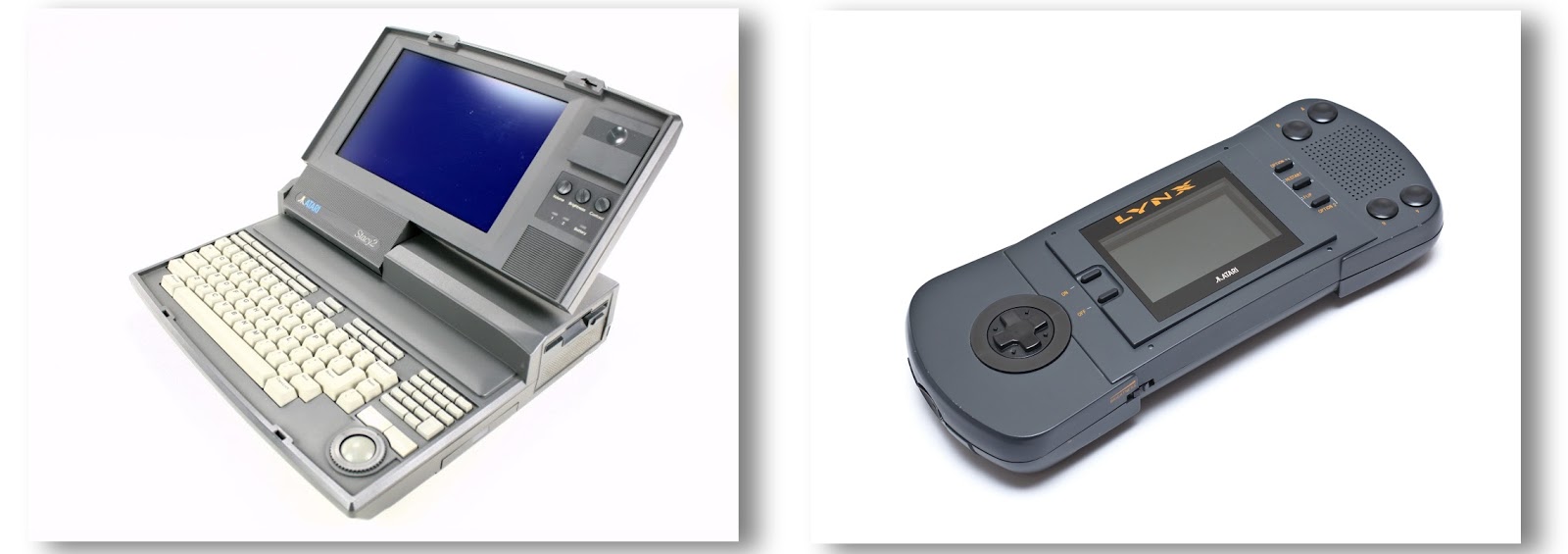
Atari too were experimenting with portable computing, and in 1989 they launched the Portfolio (that we already covered) plus the Atari Stacy and Atari Lynx. The Stacy (styled STacy by Atari) was a portable version of the Atari ST which had proved a hit in the mid-80s but was now fading. However, the Stacy found a successful niche with musicians who liked the portability and the excellent MIDI support, even though Atari gave up on making it battery powered quite late into development and ended up gluing the battery compartment shut. At the other end of the scale was the Atari Lynx was a handheld gaming platform that was advanced for its day but struggled against the Nintendo Gameboy... however even today the Lynx has its fans and now and again new games appear for it.

Atari Stacy (1989) and Atari Lynx (1989)
Like Atari, Zenith Data Systems had been a pioneer of early microcomputers and they too were keen to jump on board the portable computer bandwagon. The Zenith MinisPORT (launched in 1989) was one of the smallest DOS-compatible computers made to that date, and it featured a highly unusual 2” floppy disk drive in order to keep the size down.

Zenith MiniSPORT (1989)
Sega was another stalwart of the gaming industry, in 1989 they launched the Sega Mega Drive (also known as the Genesis) that proved to be a massive hit in Europe and North and South America – although officially replaced by the Sega Saturn in 1995 the popularity of the Mega Drive continued. 30 years later and Sega revisited the platform with the Sega Mega Drive Mini. Skip another generation from the Saturn and you get the 1999 Sega Dreamcast. The Dreamcast was an advanced machine with excellent 3D support, but it couldn’t compete against Sony’s Playstation 2 and it was Sega’s last mainstream games console.

Saga Mega Drive aka Genesis (1989) and Dreamcast (1989)

Back to 1989 again and we find a computing oddity in the SAM Coupé – an unusual machine that was compatible with the Sinclair ZX Spectrum with various enhancements such as a proper keyboard, floppy disk and more memory. It was a niche success against 16 and 32-bit rivals and it still has a dedicated following today. Don’t confuse the SAM Coupé with the Cozy Coupe though, this little plastic car for children was launched in 1979 and it would technically be one of the world’s best-selling cars if it was actually a real car.
--
SAM Coupé (1989) and Cozy Coupe (1979)


Looping round one last time to 1989, and Motorola launched their iconic MicroTAC series of phones. This flip-phone design was much more compact than the DynaTAC that preceded it, and many versions of the MicroTAC were made for all the disparate analogue and digital networks of the early 1990s. The design evolved over the years, and versions of the MicroTAC stayed in production until 1996. One of the MicroTAC’s spiritual successors might be the tiny Ericsson T28, the world’s smallest mobile phone when it was launched in 1999 weighing just 83 grams. Ultimately both the MicroTAC and T28 started a trend for mobile phones to be smaller and lighter, which is something we seem to have lost along the way..

Motorola MicroTAC (1989) and Ericsson T28 (1999)


That’s it for 2019. Next year we look to cover diverse topics such as the Acorn Atom, Epson MX-80, Squarial and Pac-Man plus many other things. See you on the other side!

Image credits

Honeywell 316: Scott Beale via Flickr
GRiDPAD: Association WDA via Flickr
Atari Stacy: Perfect Circuit Audio via Wikimedia Commons
Atari Lynx: Pete Slater via Flickr
Zenith MiniSPORT: Kris Davies via Wikimedia Commons
Sega Mega Drive: Barité Videojuegos via Flickr
Sega Dreamcast: Evan-Amos via Wikimedia Commons
SAM Coupé: Simon Owen via Wikimedia Commons
Cozy Coupe: Nick via Flickr
Motorola MicroTAC: Redrum0486 via Wikimedia Commons
Ericsson T28: The Norwegian Telecom Museum via Wikimedia Commons