Showing posts with label March. Show all posts

Tuesday, 28 March 2023

Camputers Lynx (1983)

Introduced March 1983

The Camputers Lynx was a British home computer released in March 1983, slotting into the category of 1980s microcomputers which were pretty good, but not good enough to succeed. The Lynx was a relative powerful computer that boasted some impressive specifications for its time, but it failed to gain widespread popularity due to various factors, including its relatively high price and the dominance of the Sinclair ZX Spectrum and Commodore 64 in the UK home computer market.

Camputers Lynx
Camputers Lynx


The Lynx was designed and manufactured by Camputers Ltd, a UK-based company that was founded in 1976 by a group of computer enthusiasts. The Lynx was the company's first and only product, and it was initially launched as a business computer. However, it was later marketed as a home computer to compete with the best-selling Spectrum and other similar computers.

Inside was a Zilog Z80 processor, which was a popular choice for home computers in the 1980s. The computer had 48KB of RAM (eventually expandable to 192 KB), plus 32KB of ROM with the operating system and BASIC interpreter. The 256 x 248 8-colour display was impressive for the time, but the Lynx’s graphics were conversely extremely slow. Audio capabilities were better than the Spectrum, but not as good as the BBC Micro or Commodore 64.

Undoubtedly, the Lynx was a good-looking machine. It was potentially a more professional system than the Spectrum, and it showed great promise overall but despite significant efforts to market the machine and many upgrades and relaunches, it probably only sold in the tens of thousands – almost all of them in the UK.

The reasons for the failure of the Lynx were also common to other rival systems. The home computer market of the 1980s was becoming very crowded, and the Lynx just didn’t have the software it needed, which combined with the quirky video meant that it wasn’t quite good enough to be a major player.

Camputers quickly failed as a business, going bust in 1984. A subsequent takeover and more than one relaunch attempt also came to nothing. Subsequently the Lynx became something of a cult system, with models in good working condition selling for hundreds of pounds.

It was a good system with its own strengths and weaknesses, but it wasn’t a GREAT system and some of its competitors were. Like the Dragon 32, it might have been a success in different circumstances. In the end it ended up on the heap of “might have been” computers that characterised the early 1980s market.

Image credit:
Retro-activity via Wikimedia Commons - CC BY-SA 3.0


Thursday, 23 March 2023

Xerox Alto (1973)

Released March 1973

The early days of personal computing including a lot of false starts. Ideas that should have propelled their progenitors to dominance often failed to hit the mark. One such company with great ideas but limited success was Xerox.

Still know today for its photocopiers and printers, Xerox decided decades ago that that future of the office was paperless. Because Xerox was very much wedded to paper, the idea of a paperless future would amount to nothing less than extinction. But throughout this part of its history, Xerox was torn between the forward-looking technologists and the backwards-looking pragmatists.

Somewhere out of this internal struggle, the Xerox Alto was born in 1973. It was the first computer system designed from the start to use a graphical user interface, inspired to a large degree by Doug Engelbart’s Mother of All Demos five years previously. Xerox engineers realised that at some point computer systems would move beyond the realm of engineers in white coats to something that anyone could use, based in part around digitising everyday metaphors into skeuomorphic forms.*

Xerox Alto
Xerox Alto

The challenges of building a recognisably modern computer system in 1973 were immense. One major one was the lack of microprocessors – the Motorola 68000, Intel 8086, MOS 6502 and Zilog Z80 were still years away. Instead, Xerox engineers use four Texas Instruments 74181 ALUs  to do the hard work. Added to this was up to 512Kb of RAM and a 606 x 808 pixel monochrome display and a 3-button mouse. One of the most distinctive features was the large 12” portrait display that emulated a piece of paper, but less obvious at the time was the Alto’s Ethernet interface that allowed it to talk to other systems.

A lot of the Alto’s UI comprised of tables and text rather than icons and graphics. Still, it was good enough for preparing documents, drawing pictures, designing integrated circuits and playing games. These were all potentially useful things to do, but the Alto was fearsomely expensive – costing an equivalent of $125,000 in 2023 money.

The Alto was massively ahead of its time – it would take another decade or so for the technologies to start to become affordable. It also wasn’t a sales success, with only around 2000 units shipping, including those used by Xerox themselves.

Despite the small numbers built, the Alto was massively influential. The Apple Lisa and later the Macintosh were directly influenced by the work happening at Xerox, and more indirectly Windows and just about every other graphical user interface was too. For Xerox, the Alto was eventually succeeded by the Star in 1981, but this was only a limited success. Xerox itself was never fully wedded to the idea of the paperless office, and by the mid-1980s the pendulum was swinging back to the predictable markets of photocopies and printers.

Today the Alto exists in a few museums and private collections, it never was the sort of thing you could take home. Sadly the Alto and Star are largely forgotten, despite pioneering many of the technologies we take for granted today. Being first to market does not always means being successful, and that was certainly the case with Xerox...

* We apologise for the overuse of ancient Greek.

Image credits:
Michael Hicks via Wikimedia Commons – CC BY 2.0


Tuesday, 21 March 2023

IBM PC/XT vs Compaq Portable (1983)

Introduced March 1983

The launch of the original IBM PC in 1981 cause a fundamental shift in the desktop computing market. Out of the apparent chaos of a myriad of (mostly) startup companies offering business computers came the biggest player in the market – IBM. The original PC wasn’t the best, most innovative or cheapest product on the market by a long shot, but IBM was a serious player that business had heard of and it was an immediate sales success.

The original IBM PC had some significant shortcomings, in particular there was no hard disk and the limited expansion slots filled up very quickly. The upgraded PC/XT added a 10MB hard drive as standard, plus three extra slots, more RAM (up to 640Kb) and ROM and it upgraded the storage of the floppy drive to a maximum of 360Kb.

It wasn’t a huge upgrade over the original, but it addressed the shortcomings of the previous model well. It was probably the computer that IBM should have launched to begin with, but at over $7500 at launch, the PC/XT was really expensive.

IBM PC/XT
IBM PC/XT


Uniquely for IBM, the architecture of the PC was quite easy to copy. Buying in industry-standard components such as the Intel 8088 processor and making detailed hardware specifications available made it possible for other companies to make PC clones that could be better and cheaper at the same time, and Microsoft could sell you the same operating system – MS-DOS – that the PC ran to ensure compatibility. First out of the door was the Columbia MPC 1600, but more followed.

At about the same time, another trend for “luggable” all-in-one computers was starting, with the CP/M-based Kaypro II being a popular example. Texas-based Compaq Computer Corporation combined both a PC-compatible computer in the convenient form factor of a transportable machine to create the Compaq Portable, their first product.

“Portable” was a stretch, at 13 kilograms or 28 pounds it was not an easy thing to carry. Nonetheless, it could be moved easily without unplugging a vast number of cables and components. With the keyboard clipped into place, the Compaq Portable could fit into the overhead luggage compartments on a plane, or be easily placed into the boot of a car.

Compaq improved on the PC’s architecture in their own way, broadly similar to the PC/XT. There was no hard disk as standard, but users commonly added one. The Portable was also cheaper to get started with than the PC/XT. Despite being something of a niche product, the Compaq Portable sold tens of thousands of units in its first year, and it made Compaq Computer Corporation a very successful rival to IBM in the PC market.

Compaq Portable
Compaq Portable

IBM and Compaq duked it out in the market until the mid-2000s, with IBM eventually selling off its PC business to Lenovo and Compaq merging with HP.

Both machines were the ancestors of most personal computers in use today, crucially demonstrating that the PC platform could evolve over time rather than having to be completely replaced with a new model every couple of years. And although the PC/XT and Portable were not the first PCs, and now very much obsolete, they were highly significant in developing the market we see today.

Image credits:
Dmitry Brant via Wikimedia Commons - CC BY-SA 4.0
ctgreybeard via Flickr - CC BY-SA 2.0


Thursday, 24 March 2022

Nokia 3510 (2002)

Introduced March 2002

It is sometimes said that there are only two things that would survive a nuclear war: cockroaches and old Nokia phones. The Nokia 3510 – launched in 2002 – has the potential to be something that a future cockroach civilisation would unearth and worship as some type of cockroach god.

Maybe in this future roach utopia the 3510 might find itself in an epic Godzilla vs Kong battle with the legendary Nokia 3310, but the 3510 takes the indestructible design of the 3310 including the funky changeable Xpress-on covers and adds polyphonic ringtones, bigger screen, GPRS and a WAP browser. Indeed, the 3510 was once of the very first popular consumer phones to offer GPRS.

Sober or funky, the Nokia 3510 had interchangeable covers


Like the 3310, the 3510 could survive a direct strike from a Tsar Bomba – but it couldn’t quite wrestle the roach god crown from the 3310. But a few months later the 3510i arrived, adding not only a colour screen but also support for Java games. The bugs raised temples in its honour.

Although the 3510 (and 3510i) are primitive by modern standards, they form part of the golden age of mobile phone design where every new handset looked different and new technologies were being introduced at a rapid rate, here with colour screens and Java but also including cameras, Bluetooth, media players, expandable memory and so much more.

XpressOn covers allowed a high degree of personalisation with the 3510i

If you fancy a retro Nokia like this then you’ll be pleased to know that they are as cheap as chips, buy enough of them and you could even make a Nokia Stonehenge for future cockroach archaeologists to puzzle over.

Image credits: Nokia


Wednesday, 23 March 2022

Kaypro II (1982)

Introduced March 1982

A few years after the introduction of the first generation of practical microcomputers, manufacturers started to look at the possibility of having a computer that you could take anywhere rather than have tied to a desk. Perhaps the best known of this first generation of “luggable” microcomputers was the Osborne 1, launched in 1981.

The Osborne had plenty of limitations, not least the tiny screen. The market was ready for something better, and something better certainly turned up with the Kaypro II. It was designed by a company called (at the time) Non-Linear Systems (or just “NLS”), who up until this point had made lab equipment. NLS knew how to make reliable, rugged and portable electronics and they turned this expertise to a microcomputer.

A Kaypro II with several other vintage portables

Running the de-facto standard CP/M operating system and running on a 2.5MHz Z80 CPU with 64Kb of RAM and dual floppy disks, the Kaypro II had highly competitive specs for the era. Built into the high-quality painted aluminium case was a pin sharp 9 inch display which you could comfortably use all the time. The keyboard was also a high-quality design and it clipped firmly into place on the case making a practical if somewhat hefty 13 kilogram computer.

It wasn’t just the hardware that made the computer competitive. The Kaypro II was bundled with an office suite from Perfect Software that included a wordprocessor, spreadsheet and database, plus a version of BASIC that could be compiled into CP/M .com programs. Eventually the bundled programs included the class-leading WordStar wordprocessor and SuperCalc spreadsheet. The bundled software theoretically cost many hundreds of dollars, making the Kaypro II seem more of a bargain. If what you wanted wasn't in the box, then there was a wide range of business and home software available, including the legendary Zork.


Please give this Kaypro II a home

This was a high-quality, reliable, well-designed and inexpensive product and it became quite a success. If you took one home from the store there really wasn’t much you needed to do except plug a few cables in. Everything else was in the box, making this an extremely consumer friendly-product.

It ended up as a popular tool with writers. Arthur C Clarke had one, as did Jerry Pournelle. Although it was always a bit of a niche system, the Kaypro II was enough of a success to make NLS a major player in the early 1980s market.

Curiously, there was never a Kaypro I as such. Aping the rival Apple II, NLS decided on making their first commercial machine another “II”. In 1983 it was followed by the improved Kaypro IV and Kaypro 10 (with a 10Mb hard disk), then in 1984 followed the Kaypro 4 and Kaypro 2X which were confusingly named, and if you thought that was confusing another Kaypro 2 followed in 1985 and the Kaypro 1 in 1986 (because why the heck not call it the “1”). All those Kaypro machines ran CP/M, it took until 1985 for Kaypro (as it changed its name to) to come up with a PC-compatible system with the Kaypro PC and the Kaypro 286i, which was the world’s first AT-compatible system. Kaypro also adapted their luggable boxes with the MS-DOS capable Kaypro 4 Plus 88 and Kaypro 16. Kaypro even managed an early MS-DOS laptop with the slightly peculiar Kaypro 2000 and the qurkly and deeply unreliable CP/M Kaypro Robie. Somewhere along the line NLS changed its name to “Kaypro” as well.

Kaypro went from boom to bust quite quickly. The II was launched after the IBM PC but before it became really popular. It took four years for Kaypro to come up with their own PC, by which time the rapidly-evolving market had moved on. Despite soldiering on for a few years, Kaypro went bankrupt in 1992.

As with almost all microcomputer companies of the era, the success of Kaypro was relatively short-lived. However, they were the first company to come up with a practical and affordable portable computer, furthermore one that required very little work to get it fully operational, with a high-quality build and smart looks. The Kaypro II undoubtedly influence other computer designs of the same and next generation.

Today the Kaypro CP/M portables are somewhat collectable, although many have become separated from the floppy disks that held the software. Most available systems are in the US but some can be found in Europe, but expect to pay several hundred pounds

Image credits:
Diaper via Flickr - CC BY 2.0
Daniel Boulet via Flickr - CC BY-NC 2.0


Sunday, 13 March 2022

LINC (1962)

First delivered in March 1962

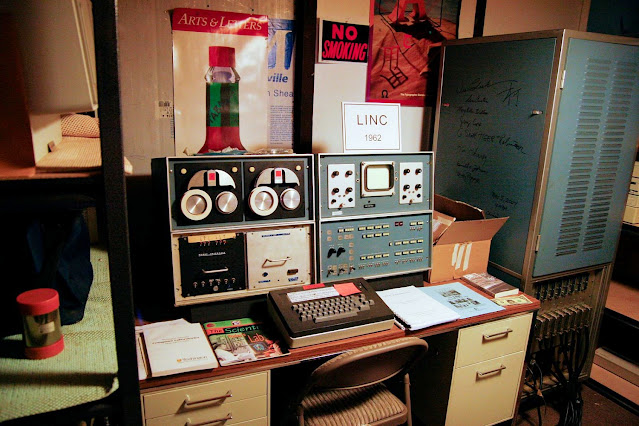
The LINC – short for Laboratory INstrument Computer - was one of the world's very first minicomputers, helping to break the computer out of the corporate machine room and making it available to individual departments, labs and (at a stretch) homes.

Designed at MIT for academic work, most LINC machines were built by Digital Equipment Corporation, who were based in Massachusetts as is MIT. By 1962, DEC had already launched the PDP-1 (another candidate for the world’s first minicomputer) but the LINC was considerably cheaper and more compact.

Based on a 12-bit architecture, one innovation with the LINC was the tape drive (the LINCtape) which could store up to 400Kb and allowed a slow but reliable form of random access storage (somewhat like a very slow disk drive). The LINCtape evolved into DECtape, a common feature on DEC’s PDP line.

Digibarn's LINC system


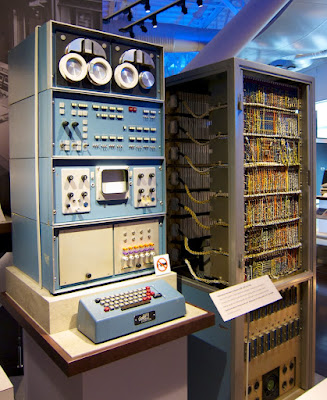
A small CRT could be used for output, and a rather clunky keyboard from Soroban Engineering (responsible for many computer keyboard of the same period) allowed input. Additional output could be made to a teletype, and the LINC could also be controlled by a set of rotary knobs which were essentially a precursor (pun intended) to the mouse.

The key application for the LINC was interfacing with lab equipment through the inbuilt A-to-D (analogue to digital) and D-to-A interfaces. This made the LINC a successful lab machine, although only 50 were built so it didn’t exactly change the world.

LINC exhibit at the Computer History Museum, California


Significantly though, the LINC may be the world’s first home computer. Programmer Mary Allen Wilkes had a LINC system installed in her home, something that would be unfeasible with the 730kg PDP-1. It would take another 15 years or so before home computers became something that you could just go to the local electronics store to buy..

The LINC architecture grew into the PDP-5, PDP-8, PDP-12 and DECmate well into the 1970s. In the end though, the 16-bit PDP-11 and 32-bit VAX architecture (which were unrelated) moved things forward from there.

Image credits:
Jonathan Assink via Flickr - CC BY-ND 2.0
Don DeBold via Flickr – CC BY 2.0


Sunday, 28 March 2021

Nintendo Game Boy Advance (2001)

Introduced March 2001

Nintendo had popularised handheld gaming, first with the simple but fun Game & Watch in 1980, then then Game Boy in 1990 and the Game Boy Color in 1998. By the early noughties, the technology for handheld devices was improving at a rapid rate – and it was into this market that the Game Boy Advance (or “GBA” for short) was born.

The original series of Game Boy devices used a weird Sharp CPU – the LR35902, which was a sort of cross between an Intel 8080 and a Zilog Z80. The new Game Boy Advance used a 32-bit ARM processor of the type that was eventually to become ubiquitous in handheld devices. The weird Sharp CPU was still there though, providing backwards compatibility with earlier Game Boy generations.


Game Boy Advance
Game Boy Advance


Unlike earlier versions, the control buttons were on either side of the 2.9” colour display. But it was the display itself that was divisive – it didn’t have a backlight and was difficult to see in a lot of lighting conditions. Although 2001-era displays weren’t as good as they are today, the Game Boy Advance was a disappointment. However, power requirements were low and the unit would run for up to 15 hours on two AA batteries.

Limitations aside, it was a very successful device with a wide variety of games, including all those written for earlier Game Boy devices plus a large number of others written just for this console. The GBA also came in a wide variety of colours and special editions to tempt people to buy more than one. Less commonly used were adapters and link cables for playing multiplayer games and watching videos.

Game Boy Advance SP
Game Boy Advance SP

Although it was a fundamentally good console, the poor screen held it back. In 2003 Nintendo launched the Game Boy Advance SP in a clamshell design with a front-light which improved matters, but a later revision in 2005 (the AGS-101) included a backlight and it finally made the GBA playable in all environments. The Nintendo DS effectively replaced the GBA and was compatible with most of its games, originally launched alongside the SP it eventually took over. Between all different models of the GBA, total sales were in excess of 80 million. If you want one today, prices vary significantly but an AGS-101 in good condition will start at around £150 but rarer variants can be much more expensive.
 

Image credits:
Evan-Amos via Wikimedia Commons – CC BY-SA 3.0
Evan-Amos via Wikimedia Commons – CC 0


Saturday, 20 March 2021

Nokia 8310 (2001)

Launched March 2001

Twenty years ago mobile phones were becoming very popular, no longer the plaything of yuppies or sales reps the early 2000s saw the beginning of a golden age of handset design. Although primitive by today’s standards, phones of this era were developing rapidly and the space of just a few years saw colour screens, cameras, Bluetooth, multimedia and packet data.

One feature that was highly prized was size – but unlike today when bigger phones are considered better, two decade ago the race was to make things smaller. Into this market came the Nokia 8310, an exquisitely designed but very tiny device that formed part of Nokia’s “perfect” 8000 series of high-end mobile phones.

Nokia 8310
Nokia 8310

Weighing just 84 grams, the 8310 had a brightly-lit monochrome display, but surprisingly it also packed in an FM radio and was the first Nokia phone to feature GPRS. One key feature was the swappable Xpress-on covers which allowed to customise your phone with whatever style you wanted. Some built-in games such as the popular Snake II and the must-have early noughties infra-red port rounded off the feature set. The thing would run for days on a single charge, as would most phones of the time.

It wasn’t cheap, retailing at £400 or so in the UK. This of course just made it rather more exclusive and more desirable, and it ended up being one of Nokia’s iconic designs of the time. These days they are pretty common, and if you want a no-frills retro 2G phone then you can get a good one for about £30 or so. 

Image credit: Nokia

Sunday, 14 March 2021

UNIVAC I (1951)

Introduced March 1951

The immediate post-war years saw the first viable commercial and scientific computers hitting the market, such as the LEO I and Ferranti Mark 1 in the UK and the UNIVAC I in the United States. These huge, heavy, power hungry, expensive and slow computers are very primitive by today’s standards, but they found their niche in corporations and laboratories.


UNIVAC I in use at the US Census Office


Rather like the British LEO I, the UNIVAC I was a business computer made up of around five thousand vacuum tubes, weighed about 8 tons and sucked in 125kW of electricity. Primary memory consisted of 1000 12-character words stored in mercury delay lines (similar to the LEO), but one novel feature the UNIVAC had was magnetic tape drives for secondary storage. These UNISERVO I drives were the first ever commercially available computer tape drives, and they used heavy nickel-plated phosphor bronze tapes. Other rival computers tended to use punched cards, and initially the UNIVAC I lacked this option.

It was an eye-wateringly expensive system, costing the equivalent of around $7 million in today’s money.  This tended to put it out of reach of many universities and into the realm of government departments and large corporations instead. Given the price and complexity of the UNIVAC I, they wouldn’t always go straight to the customer but would instead be used for a while as demonstrators.

UNIVAC I mercury delay line memory


Once such UNIVAC I was bound for the US Atomic Energy Commission, but took a detour to detour to CBS to help predict the results of the 1952 US Presidential Election. Programmed by the legendary computing pioneer Grace Hopper, the UNIVAC had a complex model built up of data from past elections. With a sample of 5.5% of the vote, the UNIVAC came up with a prediction – out of the two candidates of Dwight D Eisenhower and Adlai Stevenson, Eisenhower would win in a landslide. The problem was that the UNIVAC’s prediction was completely at odds with pollsters who were predicting a win for Stevenson. So the UNIVAC’s analysis was downplayed by CBS.

Even if you don’t follow US presidential elections of the 1950s, you’ve probably heard of President Eisenhower and not President Stevenson.. that’s because the UNIVAC turned out to be accurate and Eisenhower did indeed beat Stevenson, by a similar margin to the computer’s prediction. Eisenhower might have won the vote, but the UNIVAC won when it came to the star of the election night count. 


Grace Hopper working on a UNIVAC I console


Demand for UNIVAC machines boomed… but Remington Rand were struggling to build them. So ironically, it was rivals IBM who actually benefitted with their IBM 701 mainframe and its successors as they could build them in the quantity customers wanted. As for Remington Rand, they were taken over by Sperry in 1955 which in turn merged with Burroughs to create Unisys in 1986. Unisys is still around today, and it still makes computer hardware such as the Intel-based ClearPath Forward systems among a muddle of consultancy services and resold products.

Although the UNIVAC I was only a moderate success in sales terms, it is socially significant for its role in the Presidential Election where it offered a glimpse into the future of computing, only seven years after the end of the Second World War. It’s astonishing to think that all this was still more than a quarter of a century before the launch of micros such as the Apple II

Image credits:
U.S. Census Bureau via Wikimedia Commons – Public Domain
Tiia Monto via Wikimedia Commons - CC BY-SA 3.0
Smithsonian Institution via Wikimedia Commons - CC BY 2.0


Saturday, 6 March 2021

Sinclair ZX81 (1981)

Launched March 1981

By early 1981 the microcomputer revolution was well underway, with plenty of options available for people wanting to dip their toe into this new high-tech world. The problem with most of these options was that they were expensive.

In the US, the Commodore VIC-20 was leading the charge on behalf of low-cost computing, but in the UK there had been an even cheaper and more basic computer launched in 1980 in the shape of the Sinclair ZX80 which had been a modest success. But it was Sinclair’s next computer – in the shape of the Sinclair ZX81 – that became the ground-breaking machine that found its way into more than a million homes.

Sinclair ZX81
Sinclair ZX81


On paper, the ZX81 was just a minor upgrade to the ZX80. But crucially, Sinclair had redesigned the electronics completely – where the ZX80 had 21 mostly off-the-shelf chips, the ZX81 had just 4. The difference was a custom-built ULA designed and built by computing pioneers Ferranti. This made the whole design simpler, and critically cheaper. A fully-assembled version cost just under £70, compared to £100 for the ZX80. If you were a real cheapskate you could buy a kit for just £49.95 and assemble it yourself.

The ZX81 was a simple but clever system. Smaller than a sheet of paper, the ZX81 boasted a reasonably powerful Z80 CPU clocked at 3.25MHz but only had a tiny 1Kb of RAM as standard. A truly terrible membrane keyboard also came with all the ZX81 BASIC functions pre-printed onto the keys, making it easier to learn how to program the thing. All you needed was a domestic TV and a cassette player so you could save and load programs, and you’d be away. In a strictly limited sense.

Text was a 32 column by 24 line affair, or a limited 64 x 48 pixel graphics display. There was no colour or sound, and anything displayed on the screen ate into the tiny amount of RAM. Also, the limited hardware meant that the ZX81 had to use a fair chunk of processor cycles to update the image which slowed it down..  you could speed things up by using FAST mode which prioritised speed over the display, which would white out when the computer was thinking.

On the back of the ZX81 was a simple edge connector, which most owners used to attach a notoriously wobbly 16Kb RAM pack, but Sinclair also sold a tiny printer that output onto silver paper. But the edge connector could be used for more, and a small cottage industry sprang up making everything from replacement keyboards, sound generators and even disk interfaces. A wide range of decent quality software appeared on tape, and a number of magazines produced printed BASIC programs that the user could laboriously key in and debug.

It was a good-looking system, designed by Rick Dickinson who had a long association with Sinclair. The comprehensive manual also featured gorgeous cover art by sci-fi artist John Harris. The fabulous design didn’t always make up for variable build quality, but certainly the unboxing experience was something a bit special.

Typical ZX81 configuration with cassette recorder, monochrome TV and manual


Despite its flaws, the ZX81 was a hugely popular system – especially in the UK. However, an attempt to break through into the US market in partnership with Timex (who assembled the ZX81) met with limited success. A number of other clones – some licenced, some illegal – followed in worldwide markets. Enthusiasts continue to develop hardware and software for the ZX81 even today.

The profits from the ZX81 were substantial, putting Sinclair in an excellent position to develop their next machine, the ZX Spectrum. More importantly, the ZX81 introduced millions of people to computers and programming and helped to make those fields popular in the markets the ZX81 succeeded. Today the ZX81 is quite collectable with a thriving trade in software and add-ons, prices for ones in excellent condition can exceed £100 but there are bargains if you hunt around. 

Image credits:
Science Museum Group
- CC BY 4.0
Mike Cattell via Wikimedia Commons - CC BY 2.0


Saturday, 28 March 2020

Sony PlayStation 2 (2000)

Sony PlayStation 2
Launched March 2000

Sony had been something of a late entrant into the games console, coming to market in the early 1990s in what was essentially a grudge match with Nintendo. Both companies had worked together in 1988 to make a CD-ROM add-on to the Nintendo Super NES console which fell apart spectacularly.

Sony became keen to demonstrate its expertise in consumer electronics, and this led to the original PlayStation console launched in 1994. The PlayStation was a successful fifth-generation console that beat Nintendo’s offering by a full year and a half.

Things move on of course, and in 2000 Sony announced the successor to the original PlayStation, imaginatively called the PlayStation 2 (or “PS2”). Based around a heavily customised MIPS RISC processor called the “Emotion Engine” combined with powerful graphics and audio processors, the PlayStation 2 was a massive leap forward from previous generations.

Bundled with an upgrade of the legendary DualShock controller, the PlayStation also had a wide variety of other peripherals that could be used for gameplay. One crucial feature it also came with was an integrated DVD player at a time when these were very uncommon and rather expensive.

Decent games took a little while to become available, but the PlayStation 2 maintained hardware compatibility with the original PlayStation (retconned as the “PS One”). After a few months the number of games started to increase, boosting the popularity of the PS2. The best-selling game on the platform was 2004’s Grand Theft Auto: San Andreas.

It had its flaws – in particular online services on the PS2 were clunky and poorly though-out. But overall it was a well-executed packaging of hardware with a strong suite of software to go with it. Selling over 150 million units plus a staggering 1.5 billion games, the PS2 is – just about – the best-selling video console ever.

Later revisions of the PS2 were smaller and cheaper, but it continued to be popular even after the launch of the PlayStation 3 in 2006... in fact the last PS2 units shipped in January 2013 after being in production for more than 12 years.

The PS2 cemented Sony’s place in the console market, and it was largely responsible for the demise of Sega and a difficult period for Nintendo as well. Ultimately the only thing that really made a stand against Sony was Microsoft’s Xbox platform – between Sony and Microsoft eventually the entire old order of games consoles was swept aside.

Because of the large numbers of PS2s sold, there are quite a lot available for not very much money – usually including a collection of bundled games. There are plenty of buyers guides too if you fancy a bit of low-cost retro gaming.

Image credit: Evan-Amos via Wikimedia Commons

Tuesday, 17 March 2020

Squarial (1990)

A Squarial on display
Available March 1990

Direct-to-customer satellite television started in the late 1970s, but back in the early days it required a big and expensive dish to receive the broadcasts which had the effect of turning your back garden into something that looked like Jodrell Bank.

Although technology improved during the 1980s, by the end of the decade a typical satellite dish for Sky in the UK could still measure 90 centimetres across. Typically painted white, the dishes were regarded as an eyesore and when there were lots of them in an area – for example with blocks of flats and terraced houses – it made the place look like a KGB listening post.

Although Sky was popular in the UK, it gained a reputation for being rather lowbrow. A mix of imported US TV series and cheaply-made shows had a certain appeal, but neighbours might judge you harshly if you attached a massive dish to the side of your house to watch American wrestling.

It became obvious in the 1980s that the market could do with some competition, and through a complex mix of government legislation and business deals the idea of creating a company knows British Satellite Broadcasting (BSB) was born.

After some delays, BSB eventually started broadcasting in March 1990. It attempted to offer a more highbrow mix of shows including original content, high-quality imports and repeats of popular BBC shows... not to mention a bit of science fiction slash soap opera.

Low-level class warfare is a thing in the UK, and indeed the BBC TV show “Keeping Up Appearances” first broadcast in 1990 satirises just that. And for many middle-class people, the idea of sticking up a huge Sky satellite dish seemed frightful. But how could you differentiate that you were a middle-class BSB customer? BSB thought it had a secret weapon… the Squarial.

A Squarial in its natural habitat

The Squarial looked quite unlike other satellite receivers. Just 38 centimetres across, the Squarial was completely flat and inside was a phased array antenna made up of a large number of tiny individual antennae working together. This different technological approach was possible because BSB’s twin Marcopolo satellites had a higher power output than the Astra 1A satellite used by Sky.

It became something of a design icon, and created a significant buzz around BSB’s launch. Squarials started to appear on hundreds of thousands of homes. It looked like a success. But it wasn’t.

The problem that both Sky and BSB were losing huge amounts of money, a staggering $1.5 billion dollars between them (equivalent to about £2.5 billion today). Subscriber numbers were nowhere near the figures that either company needed to be sustainable. So in November 1990 Sky and BSB dropped a bombshell – these two bitter rivals would merge to become British Sky Broadcasting (BskyB).

Although on paper it was a 50/50 merger, in reality Sky was the dominant partner. And although costs could be saved by rationalising the TV channels, in the end it was inevitable that BSkyB would want only one broadcasting system – and that meant using the Astra satellite and not Marcopolo.

By 1992 BSkyB shuttered the service on the Marcopolo satellites, leaving both the Squarial and attached satellite set top boxes obsolete as they were incompatible with the Astra system. Essentially, for all but the most die-hard tinkerers the Squarial and all the rather expensive equipment that came with it ended up as junk. For owners it was like being on the wrong side of the VHS-Betamax war.

But the Squarials lingered – because of the fact that they were mounted in difficult-to-access places it meant that you’d have to pay somebody to take it down. So they lingered and lingered, a testament to making the wrong technological choice and a reminder of high-profile failure. Even today it is still possible to find a forgotten Squarial on the side of a house. For a few tens of pounds you could even acquire one yourself, and see if it really is “smart to be square”.

Image credits: Alex Liivet via Flickr
CC BY 2.0
pauldriscoll via Flickr
CC BY-NC-ND 2.0 


Saturday, 14 March 2020

Kenwood Chef (1950)

Introduced March 1950

Recently we explored a whole bunch of domestic gadgets that are in common use today but actually trace their origins to the Nineteenth Century. One such gadget was the food mixer, tracing its roots back to the 1850s and with electric food mixers coming to market around the turn of the century.

The popularity of such devices grew and in 1950 the British public saw the launch of what is perhaps the most iconic mixer of its type – the Kenwood Chef. Designed (perhaps unsurprisingly) by Kenneth Wood, the original Chef (model A700) came with a variety of attachments that could mix bread, cakes, sausages and even drinks.

Kenwood Chef A700
It wasn’t cheap, the launch price was a little under £20 in 1950s money which is nearly £700 today. Still, it was immensely popular for those who could afford it and it was the sort of thing you could show off to friends and neighbours to make them envious.

Because it was stylish, well-built and versatile the popularity endured, and although over the decades the product has changed and improved in that time, the modern Kenwood Chef is still fundamentally the same as the one from 70 years ago.

Perhaps these days with the rise of pre-prepared foods and takeaways, the food mixer isn’t the must-have appliance that it once was. However, vintage Kenwood Chefs from the 1950s and 1960s have a surprising number of fans, and working ones in good condition can be had for less than £200. If you want a contemporary model then these start at £250 going up to £700 or so, with an even wider range of gadgets you can plug in.

Image credit: Science Museum
CC BY-NC-SA 4.0

Monday, 9 March 2020

Samsung I9000 Galaxy S (2010)

Launched March 2010

Here’s a question: what is the most significant Android smartphone ever? Is it the T-Mobile G1 which was the first on the market, or one of the second-gen phones such as the Motorola DROID or Nexus One which were easily as good as the iPhone. Or perhaps it is the Samsung I9000 Galaxy S – a phone with a feature set so rich that it redefined what a smartphone should be.

The Galaxy S had pretty much every feature dialled up to 11. Starting with the huge (for the time) 4” 480 x 800 pixel AMOLED display, 512MB of RAM, a 1GHz CPU, dedicated GPU, 8 or 16GB of RAM plus a microSD slot, a stereo FM radio, 5 megapixel camera plus a secondary camera on the front… plus of course all the expected features such as 3.5G, WiFi, GPS and by then a huge variety of applications to do just about anything. In terms of features, the Galaxy S blew everything else out of the water.

Samsung I9000 Galaxy S
Sure… it was a pretty bland device in design terms and Samsung’s somewhat iPhone-like TouchWiz skin lead to years of lawsuits. It was quite expensive too… daringly so for an Android phone. Despite this, the original Samsung Galaxy S was a huge success – shipping more than 25 million units.

But there wasn’t just one model – when you took into account all the variants there were over two dozen. Some added 4G support, some replaced the FM radio with TV tuners, a couple even had physical QWERTY keyboards. Some variants replaced the 5 megapixel camera with an 8 megapixel one… or a 3 megapixel one. Screen sizes varied between 3.5 and 4.5 inches and LCD screens made a showing alongside AMOLED. Samsung was willing to customise and tweak the phone in any way the carriers wanted, which was something Apple would never do.

The rest is history – the Galaxy S in now in its 11th generation with the Samsung Galaxy S20 (confusingly the previous version was the S10). Although the Galaxy S does come in about half a dozen main variants, these days the more extreme variations come under different parts of the bewilderingly huge Samsung Galaxy range.

Perhaps the most important legacy is screen size – although tiny for a modern smartphone the 4” display of the original Galaxy S was huge compared with smartphones of the time. Manufacturers proceeded somewhat cautiously, but every time they made the panel bigger it seemed that customers approved. The current S20 has a 6.2” screen on a bezel-less display and the phone one third bigger overall than the original one.

Perhaps because of the bland styling, the Samsung Galaxy S doesn’t seem like a particularly collectable device despite its importance in the evolution of modern smartphones. There are plenty of decent examples for less than £40 and unofficial ports of the more modern Lineage and Replicant OSes exist if you want to tinker.

Image credit: Samsung Mobile


Saturday, 30 March 2019

Acorn System 1 (1979)

Acorn System 1
Launched March 1979

British company Acorn had a history of innovation during the 1980s, with commercial offerings starting with the popular 6502 CPU and eventually ending up with the all-conquering ARM processor which you probably have in your smartphone today.

In March 1979, Acorn launched what was essentially the precursor for their consumer microcomputer range – the Acorn System 1. Following a similar pattern to the KIM-1 and Apple I, the System 1 was a board computer rather like a modern Raspberry Pi. Instead of a single-board design, the System 1 was two boards connected together with a ribbon cable.

At its heart was the ubiquitous 6502 CPU clocked at 1 MHz with just over 1K of RAM. Input was via a 25 key keypad and the System 1 outputted to a small LED display. Data could be saved to a cassette, and it was possible to add expansion hardware too. Aimed primarily at scientists and engineers, the relatively low price of the System 1 also appealed to tech enthusiasts.

The System 1 evolved into the Eurocard-based Systems 2, 3, 4 and 5. Acorn adapted the System 3 into Acorn’s first home system, the Atom. In turn, the Atom was developed into what is probably the definitive Acorn microcomputer, the BBC Micro. And in turn, this led us to the ARM-based Archimedes with the processor that changed the world.

Mighty oaks from little acorns grow.

You’d be hard-pressed to find an original Acorn System 1 today, but replica boards and components are available if you want to build one yourself, or alternatively an emulator is available.

Image credit: Flibble via Wikimedia Commons


Thursday, 28 March 2019

Nokia 3210 (1999)

Nokia 3210
Launched March 1999

Launched twenty years ago, the Nokia 3210 was a hugely popular mobile phone that helped to define what consumers expected from such a thing. Easy to use, cute to look at and quite a lot of fun as well, the 3210 came at a time when the mobile market was really beginning to take off.

One of the most notable features of the 3210 was that it had an internal antenna – one of the very first phones on the market to offer this. This lead to a more elegant design, and it had the practical advantage of not snagging on things like phones with a stick-out bit did.

Although the phone only had a quite small monochrome display, you could easily brighten the 3210 up with changeable covers. There were three pre-installed games including the legendary Snake. There was a ringtone composer for making simple monophonic tunes, and the SMS functionality had a few graphics thrown in for good measure.

On top of that, the 3210 was robust and a single charge could give it enough power for more than a week’s standby time and hours of talktime. A year later the Nokia 3310 tweaked the formula with a more compact design, which was also a huge success.

Both the 3210 and 3310 ended up as iconic devices for the growing consumer market, and today an unlocked 3210 in good condition can cost you about £35 or so.

Image credit: Nokia


Monday, 25 March 2019

TAG Heuer MERIDIIST (2009)

TAG Heuer MERIDIIST
Launched March 2009

A luxury watch can easily cost thousands of pounds, but a good quality luxury watch is a bit of an investment – with a bit of care it should last for decades and be every bit as useful as it was the day you bought it.

Alternatively, you could spend that sort of money on something else. And a decade ago, luxury watchmaker TAG Heuer came up with the idea that you might want to spend a similar amount of cash on a mobile. And because TAG Heuer can also make a pretty decent watch, they decided to use some of that expertise to come up with a phone.

So, starting at about £5600 in today’s money and going up to the equivalent of about £30,000 you could buy yourself a TAG Heuer MERIDIIST. A beautifully engineered and very striking device that also had the unfortunate problem that it was a pile of crap.

OK, we are probably being harsh. It was a beautiful pile of crap. Even a diamond-and-leather encrusted pile of crap. It was, in effect, an exquisitely designed device that gave about as much functionality as a £100 feature phone.

Even for a decade ago, the MERIDIIST looked obsolete. For a fraction of the cost you could have bought an iPhone 3G. With the money you saved... well, you could buy yourself a nice watch. A really nice watch.

Despite it being almost entirely useless, the MERIDIIST did seem to find a market with people who perhaps had more money than sense. These days you can pick one up second-hand for about £600 or so, which is still an expensive way to get hold of a pretty basic feature phone.

Image credits: TAG Heuer

Tuesday, 19 March 2019

Motorola E1000, E680 and E398 (2004)

Launched March 2004

Back in the early 2004, Motorola was on a roll. Their product line was expanding in diversity with a range of promising handsets that marked Moto out as a serious challenger to Nokia’s dominance, and in March 2004 they launched a trio of “E” series handsets focussed on entertainment.

The Motorola E1000 was perhaps the one that had the most market appeal – one of the few 3G phones on the market, the E1000 also came with a 2.3” QVGA display, 1.2 megapixel camera, video calling, expandable memory, multimedia playback, stereo speakers, Bluetooth and even GPS.

Offering almost everything tech-savvy consumers could want the real problem it had was the lack of take-up of 3G devices at all, combined with restrictive practices such as Three’s “walled garden”. But even though the button-up-the side design was just a little bit weird, you have to remember that Nokia’s first widespread attempt at a 3G phone was the completely insane Nokia 7600.


Motorola E1000, E680 and E398

Capable though the E1000 was, one thing it wasn’t was a smartphone. One of Motorola’s other offering at the time was the Motorola E680. This was a Linux-based touchscreen phone which fundamentally is what most people use 15 years later, except that the E680 had a 2.5” QVGA screen (tiny by modern standards) and no high-speed data of any sort. Despite having pretty strong gaming and multimedia capabilities, it was not a success. But then again, Nokia were also struggling to create the future with the Nokia 7700… which was also another weird device.

Although the E680 and E1000 were high-end devices, the funky-looking Motorola E398 was more affordable and was designed to be a capable phone for music and games. Let down by a lacklustre camera and Motorola’s fiddly software the E398 is perhaps best remembered as being the basis for the notorious ROKR E1 launched a year later. And frankly not even Nokia could outdo the disaster that the ROKR became…


Image credits: Motorola and T-Mobile

Sunday, 3 March 2019

Nokia 7610 (2004)

Announced March 2004

The Nokia 7610 was a phone with a rather obvious elephant in the room. Sure, this was a capable Symbian smartphone with a decently-sized 2.1” 176 x 208 pixel display with expandable memory, Bluetooth and a 1 megapixel camera. It had impressive multimedia capabilities, a large library of applications and you could even swap out the covers if you wanted a new look.

But it didn’t really matter how good the phone looked when it came to technical specifications but the 7610’s particular elephant was the keypad. One of the maddest keypads ever to be fitted to a Nokia phone.

Nokia 7610
Sure, Nokia could have arranged the keys in a traditional grid, but that would have been too easy. Clearly influence in part by the batshit insane Nokia 7600 from a few months earlier, the 7610 was all about curves. The asymmetric design of the phone had curves on opposite corners, and this was strongly reinforced by the curvy design of the keyboard.

The keys were all different sizes and laid out in a striking but not particularly obvious way. Presumably designed to be used with a thumb – it was unclear which thumb – the result was an impressive looking mess. Users either loved it or hated it, and it seemed that there was no middle ground. Compared with the preceding and pleasingly chubby Nokia 6600, the 7610 was a bit too radical for its own good.

For years and years, Nokia had a philosophy of not putting all the features they could in any single phone, so although the 7610 was a decently capable smartphone, it didn’t come with 3G support whereas it’s non-smartphone stablemate the 7600 did.

Nokia did address the controversial keypad later in 2004 with the release of the otherwise almost identical Nokia 6670, but somehow they managed to come up with something even uglier than the 7610. Eventually they started to get their act together with the 6680 launched in early 2005 which then morphed into the rather nice Nokia N70 in April 2005. Today a 7610 is a somewhat collectable device, with typical prices for an unlocked one in good condition being about £40 or so.

Image credits: Nokia

Saturday, 17 March 2018

Samsung Galaxy S4 (2013)

Samsung Galaxy S4
Announced March 2013

After three years and four versions, Samsung’s flagship Galaxy S range had become firmly established as the Android device that all other manufacturers had to beat. Launched in March 2013, the Samsung Galaxy S4 is perhaps as close as you can get to an archetypical Samsung smartphone.

Launched in March 2013, the hardware was first class and was easily better than the rival iPhone 5 in every respect. The Galaxy S4 a 5” full HD display, 13 megapixel primary camera, quad or octa-core CPU with 2GB of RAM, expandable memory, 4G LTE support, wireless charging and a whole raft of sensors including a barometer and humidity sensor. Nothing else came close, and the iPhone 5 looked like it was a couple of generations behind.

The operating system was Android 4.2 (Jelly Bean) out of the box, but Samsung did their usual thing of adding a whole bunch of their own software on top, not all of which was terribly useful. This “bloatware” was annoying to many customers at the time, and it is still annoying for Samsung customers five years later.

So the hardware was good, the software bloat was bad… but there was an ugly side to the Galaxy S4 too. No, not its conservative slab-like design (also a feature of Samsung smartphones) but its apparent propensity for catching fire, made worse by apparent attempts to cover the problem up. These problems didn’t go away either, eventually leading to the catastrophic launch of the Galaxy Note 7 in 2016.

In terms of industrial design the Galaxy S4 has all the charm of a microwave oven, but even five years on the hardware is still pretty powerful. Smartphone tinkerers can pick up a decent used one for about €100 and then upgrade it to the more modern LineageOS 14.1 (based on Android 7.1.2)

Video

We made a video when the Galaxy S4 launched exploring some more of its features and comparing it to the previous models, if you want a further trip down memory lane.