Showing posts with label Commodore. Show all posts

Wednesday, 24 August 2022

Commodore 64 (1982)

Released August 1982

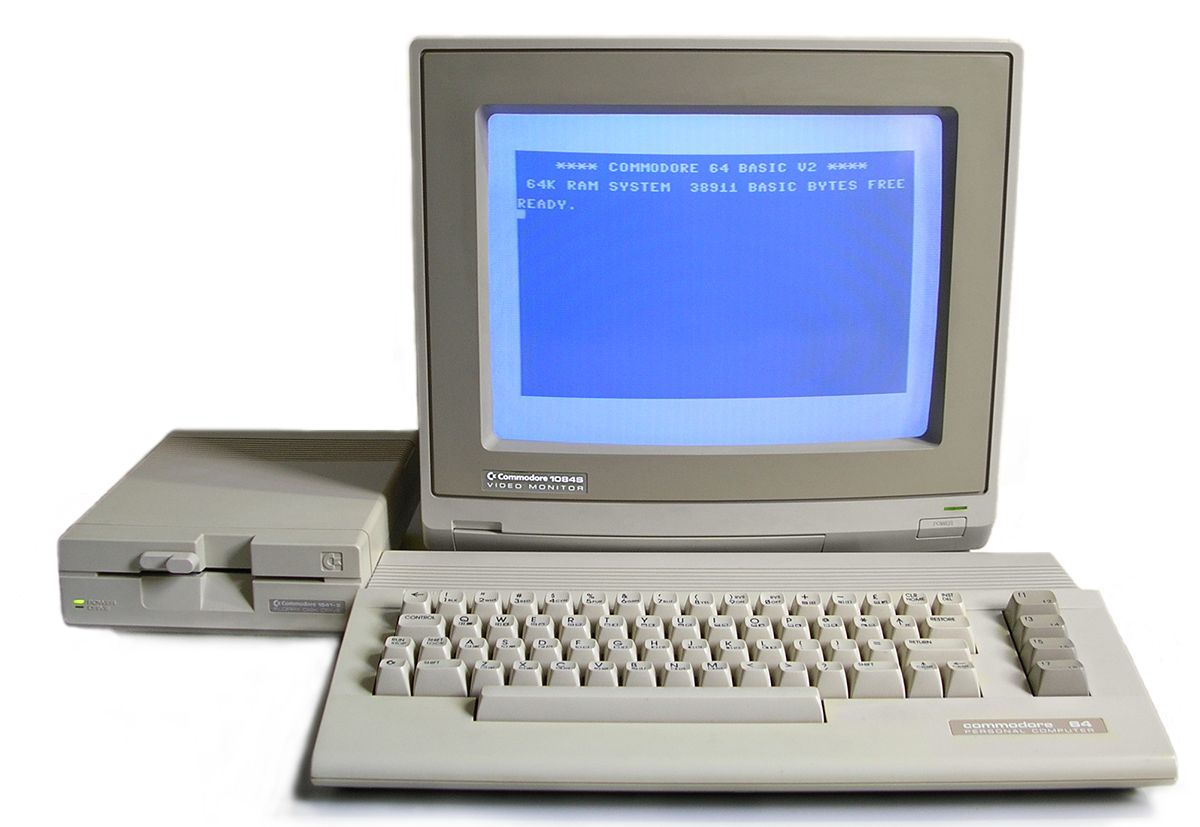
This – ladies and gentlemen – is the big one as far as 8-bit computers go. The biggest-selling single model of computer of all time, and a system that had success worldwide and is still remembered fondly today. I give you… the Commodore 64.


Commodore 64 original "breadbin" case


At first glance, the C64 is difficult to tell apart from the previous year’s VIC-20 as it shipped in a near-identical case at first. Inside though this was a much more powerful machine, running on a MOS Technology 6510 CPU, essentially a custom version of the popular 6502. The “64” in the Commodore 64 name comes from the amount of available RAM. The C64 used clever paging techniques where the CPU can page between ROM and RAM and rearrange most of the computer’s internal memory map to maximise available memory. This sophisticated scheme gave programmers much more RAM to play with than the competition who mostly used a flat memory configuration where ROM and RAM had to share the same space.

Graphics were a huge improvement over the VIC-20, with 320 x 200 pixels in 16 colours plus sprites, controlled by the MOS VIC-II graphics processor. Another MOS chip, the 6581 sound generator, gave multichannel sound. There was a built-in joystick port. By default the C64 shipped with a tape drive, or you could add on an incredibly slow floppy disk or the IEEE 488 serial bus which also supported printing. The hardware was subject to constant revision which sometimes produced compatibility problems.

Software support was excellent, with around 10,000 titles produced during the lifetime of the machine. Initially some of this shipped on a ROM cartridge, but this had a limit of just 16Kb so eventually tape became more common for complex games. In terms of games, few platforms even game close to the C64.

Excellent software and hardware made it an attractive proposition, but Commodore were keen to make this as affordable as possible. The initial launch price of $595 continually dropped, reaching $300 by 1983 (with cheaper deals available if you shopped around), easily undercutting the Atari 400/800, Apple II and crucially the Texas Instruments TI-99/4A.

There was a lot of bad blood between Commodore and Texas Instruments... TI had nearly bankrupted Commodore in the 1970s during the pocket calculator wars. Commodore boss Jack Tramiel wanted revenge, firstly the low-end VIC-20 piled on the pressures and the price-cutting on the Commodore 64 forced Texas to sell their system at a huge loss in order to compete. Not only did this force Texas to crash out of the home computer market, but it also inadvertently started a huge shake-out in the home computer market too.

If you were a teenager in the UK at the time, you would probably have had endless playground arguments comparing the Commodore 64, Sinclair ZX Spectrum and BBC Microcomputer. The argument could never be won because – in retrospect – all three platforms were really good and had their own strengths and weaknesses… but try telling kids that.

Sales were strong throughout the 80s, but competition grew tougher. Commodore attempted to diversify the C64-based offerings, notably with the luggable Commodore SX-64 (the first colour portable computer), the wedgy Commodore 64C and Commodore 128 plus an unsuccessful attempt at a games console with the Commodore 64GS.
Commodore 64C in the "wedge" case

At least 12 million Commodore 64 units were shipped up until 1994, only stopping when Commodore folded that same year. Over 12 years of production, the C64 was a massively influential machine – even today. Modern clones such as The C64 carry the torch, or used systems can typically be had for a few hundred pounds. Alternatively there are software emulators available. There's no doubt that even 40 years after launch, the C64 still has its fans.

Image credits:
Evan-Amos via Wikimedia Commons – CC0
Bill Bertram via Wikimedia Commons - CC BY-SA 2.5


Monday, 11 January 2021

Commodore VIC-20 (1981)

Launched January 1981

Microcomputers had been on a rollercoaster ride since the launch of the holy trinity of the Commodore PET, Apple II and Tandy TRS-80 in 1977. These early computers were expensive and limited in capabilities, so take-up was somewhat limited – especially in the home. But if there was one machine that finally brought the micro into living rooms and bedrooms all over the world, it was probably the Commodore VIC-20.

Commodore VIC-20


Selling more than a million units in its first year of production, the VIC-20 was based on the familiar (and Commodore-owned) MOS Technology 6502 CPU combined with a graphics-and-sound chip called the VIC which MOS had designed but had yet to find a market for.

Graphics were a fairly blocky 176 x 184 pixels in a maximum of 16 colours, with a fairly ungainly text resolution of 22 x 23 characters (at a time when business computers would have up to 80 columns)
Sound was a slightly more impressive three channels plus a noise generator. A tiny 5Kb of RAM left just 3.5Kb for BASIC applications, but it could be expanded to 32Kb.

BASIC itself was a cut-down version of the one in the PET – a smaller codebase was needed because of the limited ROM and RAM in the VIC-20. Unfortunately this meant that the VIC-20 lacked any commands to control graphics or sound in BASIC which had to be done through a series of POKES and PEEKS. The later VIC Super Expander cartridge helped, but BASIC programs written using it could only be used by people owning the expander cartridge.

Everything was packaged in an attractive and durable single box costing a shade less than $300 which would need to be connected to a domestic TV set (via an external modulator) or composite video monitor… which wasn’t included in the price. Nor included was the almost-essential “datasette” cassette drive needed for storage, but even taking all this into consideration the price was a steal compared to the previous generation of computers. And in a bare-minimum configuration you could use the family TV and a software cartridge plugged into the back.

It was an expandable system – floppy disks and joysticks being a common option, but the built-in serial port and CBM-488 bus allowed a variety of other add-ons including the sub-$100 VICMODEM which sold over a million units.

VIC-20 plus peripherals


About a year-and-a-half later, the VIC-20’s successor was launched – the Commodore 64. Almost identical in exterior design, the C64 was a much more complex and expensive beast. The VIC continued to be sold alongside the C64, by the time it was discontinued in January 1985 (four years after launch) it was priced at less than $100.

The VIC-20 cemented Commodore as one of the key players in the early 80s microcomputer market, but of course that position wouldn’t last. Today a Commodore VIC-20 in very good condition can sell for up to £400, the VIC-compatible floppy disk units are much in demand and can also sell for hundreds of pounds. Alternatively, the Linux-based THEC64 includes a VIC-20 emulation mode in convincing replica hardware for much less.

Image credits:
Science Museum Group - CC BY 4.0
Marcin Wichary / MagentaGreen via Wikimedia Commons -  CC-BY-2.0


Monday, 28 December 2020

2020: things that didn’t quite make the cut

This year we’ve covered gadgets and inventions from the 1800s and up. But there are plenty of other things that had anniversaries this year that we didn’t mention.

One of the most important inventions debuted in 1810 – the tin can. A key product of the industrial revolution, the tin can answered many of the millennia-old questions about how to preserve foodstuffs. More reliable and palatable than salting, drying, pickling and a variety of other methods this humble tin can meant food security for growing populations in the 19th, 20th and 21st centuries.

Also hailing from the nineteenth century was celluloid, a versatile class of materials that were pioneered in billiard balls in 1870, and then found their way into many other products from toys to films. However, celluloid’s habit of bursting into flames means that it is rarely used as a material today.

Canned food in a store in Hong Kong, Easter brooch with celluloid flowers


Somewhat related to celluloid is cellophane, a lightweight and flexible material that lent its properties to Scotch Tape, introduced in 1930. Also from 1930 – and perhaps a little bit more edible – is the Hostess Twinkie cake bar. Allegedly, Twinkies last forever – but eat a decade-old box at your own risk.

Vintage scotch tape container, Twinkie cake bars

Fast forward to 1960 and the white heat of technology forges something even more high-tech than sticky tape and cake bars, with the laser. Don’t ask me to explain how these things work, they just do. Pew pew.

Visible lasers being demonstrated


People who remember the home computers of the 1980s probably remember the Commodore VIC-20 – but it had an immediate predecessor in the shape of the VIC-1001 which was sold successfully in Japan only. The main difference between the two is that the VIC-1001 supports Japanese Katakana characters.

Commodore VIC-1001


By 1990 of course things were really getting more advanced. The Sega Game Gear was an 8-bit handheld console that carved a significant market for itself. Another 8-bit games machine, the Commodore 64 Games System (or simply the C64GS) was a more traditional console based closely on the legendary Commodore 64 home computer. The C64GS held great promise with the potential of a huge games library, but it failed to deliver in a spectacular way.

Sega Game Gear, Commodore 64 Games System

In the same year, the Macintosh Classic breathed a bit more life into a familiar format at a sub-$1000 price point, but the 68000 processor was getting a bit long in the tooth by then. More powerful, but three times the cost, was the 68030-based Macintosh IIsi which was much more forward-looking.

Apple Macintosh Classic, Macintosh IIsi

Handheld gadgets continued to develop, and in 2000 the Sharp J-SH04 was launched in Japan which was the world’s first recognisable camera phone, with a rear-facing 0.11 megapixel camera. It wasn’t great, but it set a pattern that other early camera phones improved on.  

Sharp J-SH04


That’s it for 2020, a difficult year for many people. Let’s hope that 2021 will be better. A big shout out to all those key workers, healthcare professionals and everybody trying to be socially responsible (or even just managing to keep themselves sane) this year. 

Image credits:
Canned food in a store in Hong Kong: Bairgae Daishou 33826 via Wikimedia Commons - CC BY-SA 4.0
Easter brooch with celluloid flowers: Pinke via Flickr – CC BY-NC 2.0
Vintage scotch tape container: Improbcat via Wikimedia Commons – CC BY-SA 3.0
Twinkie cake bars: Photog Bill via Flickr - CC BY-NC-ND 2.0
Visible lasers being demonstrated: US Navy via Wikimedia Commons – Public domain
Commodore VIC-1001: Thomas Conté via Flickr - CC BY-SA 2.0
Sega Game Gear: James Case via Flickr - CC BY 2.0
Commodore 64 Games System: Thomas Conté via Wikimedia Commons - CC BY-SA 2.0
Macintosh Classic: Christian Brockmann via Wikimedia Commons – CC0
Macintosh IIsi: Benoît Prieur via Wikimedia Commons - CC BY-SA 4.0
Sharp J-SH04: Morio via Wikimedia Commons - CC BY-SA 3.0


Wednesday, 11 January 2017

Commodore PET (1977)

Early model Commodore PET
Announced January 1977

Throughout the mid-1970s there were the seeds of a revolution were being sown. After 1975 hobbyist microcomputers such as the Altair 8800 were being offered to the public. After that, relatively low-cost microprocessors such as the Zilog Z80 and the MOS Technology 6502 had been developed into basic systems and board such as the Apple I and KIM-1, but these still were still strictly for hobbyists and engineers.

But 1977 saw the first systems that businesses or consumers could buy and use out-of-the-box. Professionally designed and fully functional, these early commercial offerings sparked the revolution that had been brewing for a few years. This year saw the launch of three highly significant systems in the US - the Commodore PET, Apple II and Tandy TRS-80.

The Commodore PET was announced at CES in January 1977, although the first units didn't ship until October and production levels didn't really meet until early 1978. In terms of announcement date, the PET beat its Tandy and Apple rivals, but those those systems actually shipped to consumers earlier.

The name PET stood for "Personal Electronic Transactor", and it was strikingly designed in an all-metal case with an integrated chiclet keyboard and data cassette recorder. Perched on top was a trapezoid-shaped 9" CRT display, giving the whole thing a look reminiscent of a Mesoamerican pyramid.

Commodore was no startup company - founded in 1954 it had started with typewriters before moving into adding machines and electronic calculators. Founded by industry legend Jack Tramiel, Commodore had bought Chuck Peddle's MOS Technology to secure supplies of the 6502 processor for use in calculator products. Peddle convinced Tramiel that a microcomputer was the way forward, and since Commodore was being hit by a slump in fortunes after a collapse in the calculator market, the company changed direction.

Early PETs featured a 1 MHz 6502 CPU, with RAM options ranging from 4KB to 32KB. Storage was a built in data cassette ("datasette") next to the keyboard, which did mean that on early versions the keyboard was a cramped affair. Over time a wide range of upgrades became available, including floppy and hard disks, printers, plotters and the PET's IEEE-488 interface could talk to a variety of scientific and engineering equipment too.

Later model Commodore PETs
Over the five years of production there were various upgraded models, with better keyboards, bigger screens, more RAM and better graphics. Along the way the cute "PET" name was dropped and the machines took on the name "CBM" (for Commodore Business Machines), but it didn't stop people calling them "PETs".

The PET sold very strongly into schools and colleges, thanks to its sturdy construction and reliability. However, the poor graphics capabilities meant that it didn't sell well in the booming home market, so Commodore followed up the PET with the successful VIC-20 in 1980 and the legendary Commodore 64 in 1982, both based on the 6502 processor. The 64 sold in millions and is the biggest selling computer model of all time.

Prices today for these machines varies from next-to-nothing up to €1000 or so, depending on model and condition. Although the PETs themselves were highly reliable, disk drives were always less common and more fragile and can be hard to find today. Alternatively, if you fancy a virtual PET rather than a physical one the VICE emulator emulates pretty much all 8-bit Commodore machines and runs on a wide variety of platforms, including Windows, Mac and even Android smartphones.

Thursday, 14 April 2016

MOS Technologies KIM-1 (1976)

Launched April 1976

These days, single-board computers such as the Raspberry Pi and Arduino are all the rage. These small and inexpensive devices are ideal for hobbyist and industrial application, but of course this is not a new idea. Forty years ago one of the most important single-board computers was launched: the MOS Technologies KIM-1.

MOS Technologies had produced low-cost 6502 processor the previous year, but (as today) the problem was getting it into the hands of people who could actually DO something with it. So, the KIM-1 was produced as a basic bare-boned system that people could adapt, at the relatively affordable price of $295 (equivalent to around $1050 today).

It was a primitive device. The 8-bit 6502 CPU came with 1K of RAM, a small LED display, and a hexadecimal keypad. It had a couple of expansion ports and pair of serial interfaces, which meant that it could be paired with a teletype for output or a cassette recorder. Later independently-produced expansion modules included a video board.
afasfda

The design was adapted and expanded by other manufacturers too, and the KIM-1 and its derivatives became a significant success and helped to establish the 6502 as one of the key processors of the late 1970s and early 1980s. In the end, MOS Technologies ended up being bought up by Commodore, and the ideas behind the KIM-1 were expanded and eventually developed into the Commodore PET.

In Europe, the KIM-1 is a very rare device indeed. They are occasionally available in the US with prices ranging between $300 to $1000, with a typical price of around $700. Of course, in order to get it the best out of it you would need a whole pile of obsolete equipment to go with it, or alternatively you can bamboozle yourself with this Javascript KIM-1 emulator.

Image credits [1] [2]

Thursday, 23 July 2015

Commodore Amiga (1985)

Commodore Amiga 1000 (1985)
Launched July 2005

Launched 30 years ago this month, the Commodore Amiga was an early 32-bit computer that featured dedicated graphics and sound chipsets and is widely regarded as the first multimedia computer. It was also a highly expandable system running on an efficient operating system, and as such it was one of the key contenders in late 1980s and early 1990s home computing.

Starting off with the original Amiga 1000, the popular Amiga 500 followed on in 1987 and continued on through several models until Commodore's bankruptcy in 1996. Afterwards other Amiga models appeared from other manufacturers with different processors and upgraded operating systems, but these were strictly niche products for Amiga fans looking for an upgrade. The currently-available derivative is the AmigaONE X1000.

Easily outclassing everything else on the market, the Amiga launched at a time when the IBM PC was taking the lion's share of the market. Nonetheless, it was a successful product for its time and is fondly remembered by owners.

In a wider context, the Amiga showed the value of adding dedicated hardware for multimedia where before all processing would have to be done by the main CPU. Effectively the Amiga line was the first widely available system to feature a dedicated GPU, something that is commonplace today in smartphones and tablets.

As an aside, the Commodore name has been revived several times, and the company currently bearing the name is in the process of launching the Commodore PET smartphone, named after Commodore's influential 1970s computer line.