Showing posts with label Consoles. Show all posts

Sunday, 1 January 2023

2022 – things that didn’t quite make the cut

We covered quite a bit of retro tech this year, but there are a few things we didn’t talk about that are still worth a mention.

Let’s start with the automotive world. One of the more unusual vehicles to ever be produced in quantity is the DUKW (colloquially called the “Duck”), a six-wheel drive amphibious vehicle designed during World War II and manufactured by General Motors from 1942 to 1945. Excelling in amphibious attacks and traversing beaches, the DUKW could carry supplies or troops in a wide variety of environments. 21,000 of these machines were built, and some are still in use as tourist attractions today.

Where the DUKW was a bit of a barge, the Volkswagen Phaeton – introduced in 2002 – was a different type of barge. A large luxury car, sharing some of its DNA with Bentleys, the Phaeton was a rare entry into the luxury car market for the Volkswagen marque. Elegant and very understated, the Phaeton was a very discrete vehicle which gained some fans, but most luxury buyers were not interested and it wasn’t a sales success even though production continued until 2016. Today, the Phaeton is an extremely inexpensive buy for what it is, but it can be prone to enormous garage bills if it goes wrong.

From real-world cars to a fictional one – the Knight Industries Two Thousand (or “KITT” for short) was one of the stars of the 1982 TV Show “Knight Rider”. Based on a Pontiac Trans Am, KITT featured its own AI system which was capable of self-driving, speech recognition and synthesis, in-car communications (all of which are available today) and… errr… well a load of stuff that frankly isn’t. 23 KITT cars were made for filming, but most of these were destroyed. A handful of originals survive, but you are most likely to come across a replica.

DUKW, Volkswagen Phaeton, KITT Replica

Computers and cars came together in a different way with the 1982 Namco game, Pole Position. One of the first 16-bit arcade games, Pole Position offered unrivalled gameplay for a racing game, usually coming in a sit-down version with a proper steering wheel, pedals and gear shifter. The highest-grossing game of 1983, the game was officially ported to post microcomputer platforms of the time with many unofficial clones. 

Gaming was big in 1982, one mostly forgotten console that was launched that year was the ColecoVision. Selling strongly at launch due the bundled Donkey Kong game, this Z80-based system faded quickly and was out of production by 1985. Quite collectable today, a ColecoVision in good condition with games and accessories can cost you several hundred pounds.

Games consoles became popular in the 1980s, but the very first console was the Magnavox Odyssey launched in 1972. The basic but playable games were enhanced with accessories such as cards, dice and screen overlays. 350,000 Odyssey systems were sold over three years, today these are also very collectable with prices ranging from hundreds to thousands of pounds.

Pole Position, ColecoVision, Magnavox Odyssey

Taking another step backwards, 1962 saw the world’s first computer-controlled factory running on the Ferranti Argus industrial computer platform. Argus was originally designed for military applications, but it found its true strength in running as an industrial controller. Development continued into the 1980s, seeing use in everything from oil production to telecommunications, and importantly also in controlling nuclear power stations where they are still in use today.

Another technology designed originally for military use was the frequency-hopping spread spectrum. The concept was originally patented in 1942 as a way of preventing radio-guided torpedoes from being jammed by the enemy. A paper tape in the torpedo and guidance system allowed the radio frequency to change in a predetermined way, avoiding enemy jamming. This technology eventually found itself into Bluetooth and WiFi communications. Although this all sounds very dry, the inventor was Austrian-born actress Hedy Lamarr, who in addition to being one of the greatest actresses of her era was also a talented inventor.

While we are on the subject of war and weapons, the Gatling Gun was the world’s first widely-used machine gun, in service from 1862 with the US Army and finding its way into use worldwide until the early 20th century. The Gatling Gun marked the beginning of industrialised warfare and a technological arms race that continues to this day.

1970s Ferranti Argus system, Hedy Lamarr, Gatling Gun

120 years later, 1982 saw another technological race as the computer systems evolved rapidly in every market from home users to research institutions. One of the leading companies of the time was Digital Equipment Corporation (usually known as “DEC” or just “Digital”). The DEC Rainbow was an attempt to compete for the same market as the IBM PC, running on both a Zilog Z80 and Intel 8088 processor, the Rainbow could run either CP/M or MS-DOS. Despite the “Rainbow” name, the machine was monochrome only by default, outputting to a monitor very similar to a VT220. Despite the support of one of the biggest names in the industry, it was not a success except for the iconic LK201 keyboard which was widely emulated.

Where the Rainbow was an attempt to create a new microcomputer from scratch, the DEC Professional was an attempt to shrink the PDP-11 into a desktop package. Although a promising idea, poor execution and market indifference let to its failure.

One of the more advanced machines of the time was the DISER Lilith, launched commercially in 1982 after being used as a research platform for a couple of years. Unusually, the Lilith ran Modula-2 and has a large portrait graphical display. Based in part on work done on the Xerox Alto, the Lilith was probably too advanced to be a sales success but remained influential, especially the mouse design which later influenced the first mice designed by Logitech.

If PDP-11s and the Lilith just weren’t powerful enough and you had very, very deep pockets you migth consider the Cray X-MP, launched in 1982 at an approximate starting price of $15 million. For that you got not only the fastest computer in the world, but also one of the most remarkable looks with a central processor core that looked like nothing else – complete with padded seats. The X-MP was a success, and there were a number of successors. Today, Cray is part of Hewlett Packard Enterprise.

DEC Rainbow, DEC Professional running as a VAX Conole, Lilith Prototype, Cray X-MP

The X-MP was a niche but successful product, as was the Bloomberg Terminal which was originally launched in December 1982. A specialist system aimed at stock market traders, the original terminal was a simple device that could connect to any type of financial data that Bloomberg could make available. Several generations followed, built on custom hardware and software. Today the Bloomberg terminal is still available, but the latest generation will cost you around $2000 per month.

Aimed at a rather broader market – which it failed to reach – the Jupiter Ace also ended up being popular with a very specific niche. Somewhat similar to the ZX81 in terms of hardware, the Ace had the unusual feature of running Forth as a programming language instead of BASIC. Forth was very well suited to simple computers, however it turned out that most customers wanted to learn BASIC instead. Despite making a splash at launch, sales were low and production ended in 1984. Today the Ace is very collectable with good examples selling for £1500 or even more.

1982 was a good year for computer systems that might have hit the big time had circumstances been different. The Sord M5 is one of those, an elegant Japanese system running on a Z80 with 16Kb of RAM, colour graphics and sound plus a cartridge slot. The M5 sold well in Japan, and saw some popularity in the UK (as the CGL M5) and Czechoslovakia. Locally-produced derivatives of the M5 also sold well in South Korea. Although it showed promise, by the time it hit the shops the market was becoming crowded and it didn’t last long. Working M5s in good condition can sell for £500 or more, and cartridges are worth around £50 to £100 or so.

2010s Bloomberg Terminal, Jupiter Ace, Sord M5

Not all computing innovations are welcome. The world’s first computer virus – Elk Cloner – was also invented in 1982 by Rick Skrenta. This boot sector virus infected Apple II floppy disks, although it usually did no real harm.

One other technology product to come to market in 1982 was the CD player. The world’s first model was the Sony CDP-101 launched in Japan in October. In the rest of the world, the Philips CD100 was the first available model. Sales were slow at first due to the cost, but by the late 1990s and early part of the 2000s the CD player became the most popular medium for music.

Elk Cloner, Sony CDP-101

A decade later, 1992 was a pretty good year for technology too. This was the year that Windows 3.1 launched, a significant upgrade to the first usable version of Windows – Windows 3.0 launched in 1990 – version 3.1 added more polish and stability. For many people, Windows 3.1 was their very first experience of Microsoft Windows.

Perhaps not many Windows machines of that era are memorable, but the IBM ThinkPad launched in 1992 had a reputation for good design, robustness and reliability. A strong seller for IBM, especially to corporate customers, the ThinkPad line was eventually acquired by Lenovo in 2005 and is still made today.

An ideal peripheral to complement your Windows-based laptop might be the HP LaserJet 4. An exceptionally reliable laser printer, it was also more compact than previous models, easier to maintain, faster and gave better quality printouts. The LaserJet 4 was capable of producing over a million pages during its individual lifetime, and although parts did wear out they could be easily replaced. It was easy to connect to a LAN via an optional network card, or you could use a parallel cable. Although seemingly obsolete today, aftermarket spares kits are still available indicating that there are still LaserJet 4 series printers still in use.

Windows 3.1 box, IBM ThinkPad, HP LaserJet 4

Not every computer of the time was a Windows or Intel-based computer. The Atari Falcon030 was the final evolution of the once-popular Atari ST line. Based on a Motorola 68030 CPU with a Motorola 56001 DSP supporting sound and graphics, the Falcon030 made a good games machine, was excellent for music and MIDI interfacing and came with a wide variety of expansion options. However, Atari was struggling and the Falcon030 was dropped just a year later. Around the same time Atari was working on the Falcon040, a 68040 power version. The Falcon is another collectable system, with prices for a good example being well in excess of £1000.

DEC was also coming up with innovative products in 1992. The DEC Alpha 21064 CPU was a powerful RISC processor designed for workstations and more powerful systems. Capable of much faster performance than Intel’s rival CPUs, the Alpha architecture saw some success in the 1990s but it faded away after DEC was bought out, first by Compaq and then by HP.

Atari Falcon030, DEC Alpha 21064

Another decade later to 2002, and mobile phones were becoming popular, and some of these were beginning to blur the line between a phone and a computer with the introduction of smartphones. The Sony Ericsson P800 was a Symbian-based device with a stylus-driven touchscreen and a camera, which is effectively one of the ancestors of modern smartphones today. Due to the high price and complexity, it didn’t sell in huge numbers but it did appeal to those who could see the advantage of having a computer in your pocket.

If you wanted something simpler and more robust, you could try the rubbery Nokia 5100. A weird-looking thing by modern standards, the 5100 comes from a golden age of phone design where every new model had its own distinctive looks. The 5100's key selling point was its robustness, although most Nokia phones of that era seemed pretty indestructible. 

Technology was coming to other more mundane devices as well. The Roomba is an autonomous robot vacuum cleaner, first introduced in 2002. Capable of cleaning a floor by itself and then returning to its dock to recharge, the Roomba is more of a pet than a domestic appliance – sometimes needing rescuing when it has gotten itself stuck on something. Twenty years of development have made Roombas even smarter.

Sony Ericsson P800, Nokia 5100, 2002-era Roomba

Finally… well, a different sort of invention altogether. 120 years ago in 1902, the Teddy Bear was invented. Named after President Theodore Roosevelt, the teddy became the most popular type of soft toy of all time. Go and cuddle one right now.

1903 Teddy Bear
1903 Teddy Bear

Image credits:
DUKW: 270865 via Flickr - CC BY-ND 2.0
VW Phaeton: Greg Gjerdingen via Wikimedia Commons - CC BY 2.0
KITT Replica: Interceptor73 via Wikimedia Commons - CC BY 2.0
Namco Pole Position: Steve McFarland via Flickr - CC BY-NC 2.0
ColecoVision: Georges Seguinia via Wikimedia Commons - CC BY-SA 3.0
Magnavox Odyssey: Jesmar via Wikimedia Commons - CC BY-SA 3.0
Ferranti Argus 700: Rain Rabbit via Flickr - CC BY-NC 2.0
Hedy Lamarr: MGM via Wikimedia Commons – CC0
Gatling Gun: Max Smith via Wikimedia Commons – CC0
DEC Rainbow 100: David Alcubierre via Flickr - CC BY-SA 2.0
DEC Professional running as VAX Console: Michael L. Umbricht via Wikimedia Commons - CC BY-SA 4.0
Prototype Lilith: Tomislav Medak via Flickr - CC BY 2.0
Cray XMP: Rama via Wikimedia Commons - CC BY-SA 2.0 FR
2010s Bloomberg Terminal: E.W. Scripps School of Journalism - CC BY-NC 2.0
Jupiter Ace: Soupmeister via Flickr - CC BY-SA 2.0
Sord M5: Staffan Vilcans via Flickr - CC BY-SA 2.0
Elk Cloner: Richard Skrenta via Wikimedia Commons – CC0
Sony CDP-101: Museo Nazionale Scienza e Tecnologia Leonardo da Vinci via Wikimedia Commons - CC BY-SA 4.0
Microsoft Windows 3.1: Darklanlan via Wikimedia Commons – CC0
IBM ThinkPad: Jarek Piórkowski via Flickr - CC BY-NC 2.0
HP LaserJet 4: DuffDudeX1 via Wikimedia Commons – CC0
Atari Falcon030: Wolfgang Stief via Flickr – CC0
DEC Alpha 21064: Dirk Oppelt via Wikimedia Commons - CC BY-SA 3.0
Sony Ericsson P800: Sony Ericsson Press Release
Nokia 5100: Nokia Press Release
Roomba: Larry D Moore via Wikimedia Commons - CC BY 4.0
1903 Teddy Bear: Tim Evanson via Flickr - CC BY-SA 2.0


Saturday, 20 November 2021

Microsoft Xbox (2001)

Launched November 2001

Microsoft is a software company. It’s right there in the name. On the uncommon occasions that Microsoft has ventured into hardware, the results have been decidedly mixed from the failure of the Zune and KIN devices to the slow-burn success of the Surface to the best goddam computer mice ever made and I will die on that hill.

The Xbox line is certainly one of Microsoft’s more successful products, with a history spanning 20 years. But why does it even exist?


Original Microsoft Xbox (2001)


Back in 2001 there were three major players duking it out in the games console market. Sony’s PlayStation 2 was the boss… fighting against it was the Sege Dreamcast and Nintendo GameCube. These companies had been fighting it out for years, and although Sega had the head start with these sixth-gen consoles, it was Sony who was taking the biggest share of the market. The PS2 was more than just a simple games console, crucially it was a low-cost way of playing DVDs and music and the hardware was extremely capable. The Sega and Nintendo rivals were similarly versatile.

For Microsoft the concern was that this new generation of games console might start to compete with PCs for home users. The hardware was as good as or much better than contemporary Windows boxes, and prices in the $200 to $300 dollar range made them financially competitive too. Sure, Windows-based PCs were a popular platform for games as well, but you couldn’t always guarantee that your PC would be able to play the latest and greatest games if it was a few years old.

With the Xbox, Microsoft had the idea of taking the technologies and components that Windows already used. Underneath, the Xbox used a heavily modified version of Windows 2000 (the somewhat forgotten predecessor to Windows XP) and utilised the DirectX technology that Microsoft had built into Windows for gaming – DirectX giving the console the “X” in “Xbox”. Inside was a standard PC-style DVD drive and hard disk plus a customised version of the 733 MHz Intel Pentium III processor and an Nvidia GPU for graphics, combined with what seems today like a very modest 64MB of RAM.

The Intel CPU was a bit of a surprise for AMD who had originally been engaged to come up with a processor. In fact AMD would have to wait for the 3rd-gen Xbox – the Xbox One – before they supplied both the CPU and GPU, which they still do. The hardware overall was competitive, but the system itself was bulky because of the non-bespoke components. Even the original Xbox game controllers looked bulky and clumsy compared to the competition.

When launched, it was something of a success, helped a lot by the availability of HALO to play on it. The Xbox was also much stronger in terms on online gaming than rivals, coming in at a time when always-on broadband connections were starting to become popular. In the Microsoft-Sony-Sega-Nintendo race, the Xbox eventually came in second place in sales terms… way behind the PlayStation 2 and a little ahead of the GameCube.

Standard PC components added to the bulk

Although it was a successful platform, Microsoft failed to make any money on the hardware – in the end they lost billions – but this was part of a bigger strategy including selling many of the games themselves and providing subscription services. In the end, games consoles didn’t take over from PCs… but to a large extent smartphones did. Probably in the end, Microsoft’s foray into gaming was unnecessary, but today’s ninth-generation consoles essentially leave just Sony and Microsoft standing.


Although obsolete by today’s standards, special edition Xboxes or ones with a large selection of games can sell for hundreds of pounds. There’s also a healthy modding scene for those who want to get more out of the hardware. Even twenty years on, the original Xbox has its fans.

Image credits:
Evan-Amos via Wikimedia Commons - CC0
Swaaya via Wikimedia Commons - CC BY-SA 3.0


Sunday, 28 March 2021

Nintendo Game Boy Advance (2001)

Introduced March 2001

Nintendo had popularised handheld gaming, first with the simple but fun Game & Watch in 1980, then then Game Boy in 1990 and the Game Boy Color in 1998. By the early noughties, the technology for handheld devices was improving at a rapid rate – and it was into this market that the Game Boy Advance (or “GBA” for short) was born.

The original series of Game Boy devices used a weird Sharp CPU – the LR35902, which was a sort of cross between an Intel 8080 and a Zilog Z80. The new Game Boy Advance used a 32-bit ARM processor of the type that was eventually to become ubiquitous in handheld devices. The weird Sharp CPU was still there though, providing backwards compatibility with earlier Game Boy generations.


Game Boy Advance
Game Boy Advance


Unlike earlier versions, the control buttons were on either side of the 2.9” colour display. But it was the display itself that was divisive – it didn’t have a backlight and was difficult to see in a lot of lighting conditions. Although 2001-era displays weren’t as good as they are today, the Game Boy Advance was a disappointment. However, power requirements were low and the unit would run for up to 15 hours on two AA batteries.

Limitations aside, it was a very successful device with a wide variety of games, including all those written for earlier Game Boy devices plus a large number of others written just for this console. The GBA also came in a wide variety of colours and special editions to tempt people to buy more than one. Less commonly used were adapters and link cables for playing multiplayer games and watching videos.

Game Boy Advance SP
Game Boy Advance SP

Although it was a fundamentally good console, the poor screen held it back. In 2003 Nintendo launched the Game Boy Advance SP in a clamshell design with a front-light which improved matters, but a later revision in 2005 (the AGS-101) included a backlight and it finally made the GBA playable in all environments. The Nintendo DS effectively replaced the GBA and was compatible with most of its games, originally launched alongside the SP it eventually took over. Between all different models of the GBA, total sales were in excess of 80 million. If you want one today, prices vary significantly but an AGS-101 in good condition will start at around £150 but rarer variants can be much more expensive.
 

Image credits:
Evan-Amos via Wikimedia Commons – CC BY-SA 3.0
Evan-Amos via Wikimedia Commons – CC 0


Sunday, 15 November 2020

Super Nintendo Entertainment System (1990)

 Introduced November 1990 (Japan)

The best-selling 16-bit gaming console, the Super Nintendo Entertainment System (or just “SNES”) ruled the roost in the early 1990s, despite an epic battle with the Sega Mega Drive. Relatively late to the market, one of the key reasons for the success of the SNES was better games and good marketing.

Nintendo SNES (PAL Version)

Models varied throughout the world with different cases between North America, Japan and Europe with imcompatible cartridge slots and region locking in both hardware and software. In Japan the console was called the “Super Famicom”. At its heart was an unusual 16-bit development of the venerable 6502 processor called the Ricoh 5A22 – the previous generation Nintendo Entertainment System used another 6502 derivative, this time the Ricoh 2A03.

A wide range of colour graphics modes, an impressive audio subsystem called S-SMP (made by Sony) and ergonomically designed controllers made the SNES a capable hardware platform. But with games consoles, that’s just one of the ingredients you need for success.

What the SNES did have was games... lots of games. Super Mario, Mario Kart, Donkey Kong, Final Fantasy, Street Fighter, Mortal Kombat, SimCity and many more games were available. Many games were only available on Nintendo platforms, some (such as Mortal Kombat) were available of several. Nintendo did insist of elements of graphic violence being removed from games, which made them more family-friendly but ultimately probably lost them sales.

Depending on market, the SNES was around for about a decade and sold an astonishing 49 million units compared to the Mega Drive’s 32 million or so. A few revisions were made to the hardware, along with quite a lot of hardware expansions that had a limited audience, but ultimately the success of the SNES continued well into the 32-bit console era.

There’s a healthy retro gaming community around the SNES – used units are inexpensive, although game cartridges – especially rare ones – can be worth much more that the systems themselves. In 2017, Nintendo released the Super NES Classic Edition – a modern take on the classic console. There are also emulators and other reimagined versions out there – even after 30 years, the SNES still has the power to captivate gamers.

Image credit: JCD1981NL via Wikimedia Commons - CC BY 3.0

Tuesday, 15 September 2020

Amstrad GX4000 (1990)

Introduced September 1990

During the late 1980s Amstrad had been on a roll. The Amstrad CPC range had taken a respectable share of the home computing market, the cheap all-in-one PCW wordprocessor had been a remarkable success for small businesses and home users, the PC-compatible PC1512 and PC1640 had sold in huge quantities and Amstrad had bought out arch-rival Sinclair to produce their own take on the iconic ZX Spectrum micro.

Not everything had been a success. The deeply strange portable PCs – the PPC 512 and PPC 640 – proved to be a high-profile flop. Worse still, the next-generation PC2000 series which had been launched to great acclaim ended up as a disaster with a batch of faulty hard drives significantly damaging Amstrad’s reputation.

Amstrad’s success had been built on offering quality devices at bargain prices, typically by exploring ways to drive down costs. The CPC computers were a good example, a home computer, monitor and storage device starting at £399, all inclusive. Amstrad leveraged their relationships with makes of TV tubes and cassette players to give them a price advantage, the inclusion of the cheap-but-capable Z80 processor drove down costs further. Amstrad chose to use the CPC platform for their next venture.


Amstrad GX4000

The Amstrad GX4000 was essentially a games console version of the CPC. Stripped of the cassette drive, TV and keyboard, the GX4000 used cartridges and hooked up to a domestic TV. Still running a Z80 with 64Kb of RAM the console was modestly specified even by 1990’s standards… but at just £99 it was really cheap.

It was an elegantly packaged device, with two slightly creaky games controllers attached and video output via RF, SCART or and Amstrad DIN connector for a CPC monitor. You could add a light gun or an analogue joystick took, but expansion options were pretty limited. Still, it was pretty capable for an 8-bit platform and the related CPC had a huge variety of good quality games available for it. So, it should have been a success? Not exactly.

By 1990 the 8-bit era that had dominated the 1980s was at an end. 32-bit home computers such as the Commodore Amiga had been established for some time, and the games console market itself was in the process of moving to 16-bit platforms such as the Sega Megadrive. But technological obsolescence had never been a problem for Amstrad - a company that shipped CP/M computers well into the 1990s – where instead they were interested in value-for-money. And the GX4000 certainly seemed to have that.

But the GX4000 was a massive failure, and perhaps the key problem was games. CPC games on cassette cost a few pounds where a GX4000 cartridge for the same game cost £25 (a quarter of the price of the console). Only a couple of games were available at launch, and a combination of manufacturing delays and high costs means that just 27 games of varying quality were launched. The 8-bit CPC platform that the GX4000 ran on wasn’t something that gamers could be excited about either.

Perhaps if the GX4000 had been released a few years earlier with more (and cheaper) games plus better designed hardware, it might have been a success. As it was, the GX4000 was discontinued in 1991 having sold just 15,000 units. Of course, that makes this console quite collectable today with prices for ones in good condition going for up to £200 which would be a lot more than was paid for it in the first place..

Image credit:
Evan-Amos via Wikimedia Commons - Public Domain


Friday, 7 August 2020

Mattel Intellivision (1980)

Introduced 1980

Games consoles have been through several waves of being “a thing” to being “not a thing” and back to being “a thing” again. The Mattel Intellivision – launched to the general public in 1980 – was released nearly at the top of the wave… which unfortunately meant that it was all going to be downhill for this interesting console.

The Intellivision had been tested in Mattel’s home market of California at the end of 1979, and in 1980 it was ready for release across the United States. More sophisticated than the Atari VCS, the Intellivision was designed as more than a games console and Mattel hoped that… well, it could be an intelligent television (hence the name).

Original Mattel Intellivision

It was unusual in several ways. Firstly, the processor was quite unlike anything else that rivals had. The General Instrument (GI) CP1610 was a 16-bit processor with an instruction set closely based on the venerable PDP-11 which was hardly an obvious choice compared to the then-common MOS 6502 and Zilog Z80. A dedicated sound chip and graphics far superior to the Atari VCS certainly caused a splash when it was launched.

One notable hardware feature was the complicated gaming pad with a control pad and 14 buttons. The controllers took some practice to use, and while they were useful for complicated games they were a pain for games where a simple joystick would have worked better. Indeed, unlike other consoles many of the games actually required you to read the instructions before you started.

It was competitively priced at $299 (about $900 in today’s money), it had a reasonable amount of games and better graphics and sound than the Atari. After a somewhat slow start, the Intellivision started to sell strongly – shifting more than three million units up to 1983.

The Intellivision was always meant to be an expandable system, with a “Keyboard Component” which included a 6502 processor, extra RAM and a cassette drive. This add-on was meant to turn the Intellevision into a videotext-capable microcomputers. However, the project was badly delayed and was a high-profile failure resulting in fines from the FTC. Only a few thousand were sold, and most of those were bought back by Mattel when the project was cancelled – making it an exceptionally rare component today. Instead an add-on called the “Entertainment Computer System” was created which was much cheaper and less ambitious. A voice synthesiser called “Intellivoice” was also launched but had only a few games launched for it before that too was cancelled. An online service called PlayCable was trialled but cancelled.

Add-on woes aside, the Intellivision was selling well – and not just under the Mattel name. Bandai, Sears, Tandy, GTE and Sharp had their own versions. A cosmetically updated Intellivision II was launched in the US and Brazil in 1983 which was cheaper to make and less bulky. Mattel had plans for the Intellivision III and IV which would have been progressively better…

Intellivsion II

..but then in 1983 the bottom fell out of the console market. There were too many different consoles on the market, margins were getting very thin and competition from cheaper and more powerful microcomputers led to a disastrous market crash. Up until that point Mattel Electronics had been profitable and had continued to grow in terms of staff and investment – but suddenly it started posting enormous losses.

Mattel Electronics collapsed over six month period in late 1983, and Mattel sold on the remains for just $20 million in early 1984. But that wasn’t the end of the story. New owners INTV Corporation launched the INTV System III along with some unreleased Mattel games and a few they created themselves, the System III continued in production until 1990.

You might think that the story of this slightly weird games console would end there, but it didn’t. In 2014 the Intellivision Flashback was launched, packaging many popular games into a more modern hardware platform while retaining the same esoteric controller. Scheduled for release in October 2020 is the Intellivision Amico which reimagines the Intellivision concept on modern hardware.

Intellivsion Amico

Today the Intellivision is quite collectable, with prices varying widely usually depending on the number of packaged games – prices in the US commonly start at less than $100 and go up to $500 or so. Alternatively the upcoming Amico is slated to be $249, although that will be a very different experience to the original. Either way this 40 year old game system still seems to have its fans today..

Nicolas Nova via Flickr - CC BY-NC 2.0
Andy Simmons via Flickr - -CC BY-ND 2.0
Intellivision Entertainment


Wednesday, 1 April 2020

Nintendo Game & Watch (1980)

Nintendo Game & Watch - original "Ball" game
Launched April 1980

Legend has it that one day Nintendo engineer Gunpei Yokoi was observing a Japanese worker playing with a pocket calculator when he suddenly had an idea to take the basic components of a calculator and turn them into a handheld game.

It wasn’t an entirely new idea. Mattel’s rudimentary Auto Race game in 1976 was arguably the first, with the Coleco Electronic Quarterback machine of 1978 also proved popular. Both of those games were bulky and used simple LED displays, however technology had moved on and by the end of the 1970s inexpensive LCD displays were appearing all over the place – including in a range of low-cost and very portable pocket calculators. There were even pocket calculator game books which – with some effort – could make these little gadgets more entertaining.

Yokoi’s design took the LCD display, but instead of having it display numbers it could display a series of predefined graphics instead. Inside was a 4-bit Sharp calculator battery, and power was provided by button cells which kept the size and weight down. This was launched as the Nintendo Game & Watch (as it also included a clock).

The first game was simply called “Ball” and it was a simple enough game where you had to throw and catch a ball, but many more followed. Each game required its own hardware, typically with “A” and “B” variants with different gameplay. At first the games had a single screen and simple control buttons, but dual screen ones followed and in 1982 a handheld version of Donkey Kong also introduced the now ubiquitous D-pad controller. Screens also got bigger and layer ones had coloured sections printed onto the display to give a bit more visual interest.
Rare Super Mario Bros Game & Watch

Dozens of different versions came to market over the next decade or so with games titles many of which featured the Mario Brothers and Donkey Kong, plus a whole lot of Disney characters and ports of arcade games. Nintendo placed a lot of emphasis on gameplay because of the strictly limited hardware, which had the effect of making the games both addictive and relatively inexpensive.

Millions of Game & Watch devices were sold, but in the end technology had moved on. Yokoi had also designed the Nintendo Game Boy, using lessons learned from the Game & Watch but in a much more flexible package where new games could be loaded on with a cartridge.

In fact Gunpei Yokoi had been a prolific designer of products for Nintendo, starting with successful toys such as the Ultra Hand in the 1960s. Not all the products were successful, but his design philosophy of (roughly translated) “lateral thinking with seasoned technology” is still an important part of the way Nintendo designs products – in other words, using existing and inexpensive technologies in innovative ways rather than pursuing the highest technology available. Yokoi left Nintendo in 1996 to form his own company, but he was killed in a car accident in October 1997. However, his influential legacy lives on.

Today Game & Watch devices are very collectable, with rare items such as the yellow Super Mario Bros (YM-901) selling for thousands of pounds, with more common or later ones such as Donkey Kong 3 selling for less than £100.

Image credits:
masatsu via Flickr - CC BY-SA 2.0
SturmjƤger via Wikimedia Commons - CC BY-SA 3.0

Saturday, 28 March 2020

Sony PlayStation 2 (2000)

Sony PlayStation 2
Launched March 2000

Sony had been something of a late entrant into the games console, coming to market in the early 1990s in what was essentially a grudge match with Nintendo. Both companies had worked together in 1988 to make a CD-ROM add-on to the Nintendo Super NES console which fell apart spectacularly.

Sony became keen to demonstrate its expertise in consumer electronics, and this led to the original PlayStation console launched in 1994. The PlayStation was a successful fifth-generation console that beat Nintendo’s offering by a full year and a half.

Things move on of course, and in 2000 Sony announced the successor to the original PlayStation, imaginatively called the PlayStation 2 (or “PS2”). Based around a heavily customised MIPS RISC processor called the “Emotion Engine” combined with powerful graphics and audio processors, the PlayStation 2 was a massive leap forward from previous generations.

Bundled with an upgrade of the legendary DualShock controller, the PlayStation also had a wide variety of other peripherals that could be used for gameplay. One crucial feature it also came with was an integrated DVD player at a time when these were very uncommon and rather expensive.

Decent games took a little while to become available, but the PlayStation 2 maintained hardware compatibility with the original PlayStation (retconned as the “PS One”). After a few months the number of games started to increase, boosting the popularity of the PS2. The best-selling game on the platform was 2004’s Grand Theft Auto: San Andreas.

It had its flaws – in particular online services on the PS2 were clunky and poorly though-out. But overall it was a well-executed packaging of hardware with a strong suite of software to go with it. Selling over 150 million units plus a staggering 1.5 billion games, the PS2 is – just about – the best-selling video console ever.

Later revisions of the PS2 were smaller and cheaper, but it continued to be popular even after the launch of the PlayStation 3 in 2006... in fact the last PS2 units shipped in January 2013 after being in production for more than 12 years.

The PS2 cemented Sony’s place in the console market, and it was largely responsible for the demise of Sega and a difficult period for Nintendo as well. Ultimately the only thing that really made a stand against Sony was Microsoft’s Xbox platform – between Sony and Microsoft eventually the entire old order of games consoles was swept aside.

Because of the large numbers of PS2s sold, there are quite a lot available for not very much money – usually including a collection of bundled games. There are plenty of buyers guides too if you fancy a bit of low-cost retro gaming.

Image credit: Evan-Amos via Wikimedia Commons

Saturday, 28 December 2019

2019: things that didn’t quite make the cut

This year we’ve covered products debuting in 1959, 1969, 1979, 1989, 1999, 2004, 2009 and 2014. Here are a few of the things we missed.

It being Christmas and all a good place to start would be the Honeywell Kitchen Computer from 1969. Appearing in the Neiman Marcus Christmas Catalog of the same year, the so-called Kitchen Computer actually a Honeywell 316 minicomputer in a desktop case which was designed for laboratory environments, however the imaginative folks at Neiman Marcus thought the pedestal would make a great chopping board while the wife of the household used it to retrieve recipes. A great idea, but the Honeywell 316 was totally unsuited to that role and total sales of the Kitchen Computer were approximately nil, but the myth still persists even to this day.

Although a kitchen is a difficult and unwelcoming environment for a computer, GRiD Systems Corporation made computers that travelled into space. In 1989 they launched the GRiDPAD, the world’s first tablet computer. While not as friendly as a modern tablet, this MS-DOS machine sold relatively high numbers with a price ticket of about $3000 for one with software.


Honeywell 316 aka "Kitchen Computer" (1969) and GRiDPAD (1989)

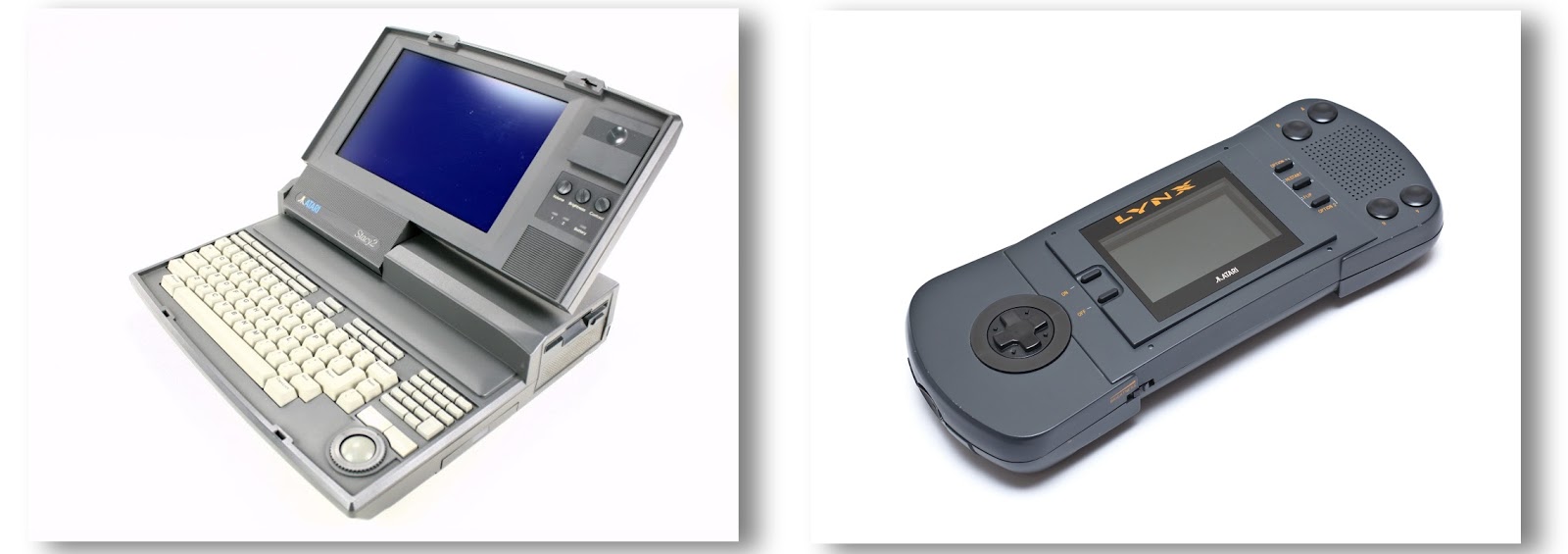
Atari too were experimenting with portable computing, and in 1989 they launched the Portfolio (that we already covered) plus the Atari Stacy and Atari Lynx. The Stacy (styled STacy by Atari) was a portable version of the Atari ST which had proved a hit in the mid-80s but was now fading. However, the Stacy found a successful niche with musicians who liked the portability and the excellent MIDI support, even though Atari gave up on making it battery powered quite late into development and ended up gluing the battery compartment shut. At the other end of the scale was the Atari Lynx was a handheld gaming platform that was advanced for its day but struggled against the Nintendo Gameboy... however even today the Lynx has its fans and now and again new games appear for it.

Atari Stacy (1989) and Atari Lynx (1989)
Like Atari, Zenith Data Systems had been a pioneer of early microcomputers and they too were keen to jump on board the portable computer bandwagon. The Zenith MinisPORT (launched in 1989) was one of the smallest DOS-compatible computers made to that date, and it featured a highly unusual 2” floppy disk drive in order to keep the size down.

Zenith MiniSPORT (1989)
Sega was another stalwart of the gaming industry, in 1989 they launched the Sega Mega Drive (also known as the Genesis) that proved to be a massive hit in Europe and North and South America – although officially replaced by the Sega Saturn in 1995 the popularity of the Mega Drive continued. 30 years later and Sega revisited the platform with the Sega Mega Drive Mini. Skip another generation from the Saturn and you get the 1999 Sega Dreamcast. The Dreamcast was an advanced machine with excellent 3D support, but it couldn’t compete against Sony’s Playstation 2 and it was Sega’s last mainstream games console.

Saga Mega Drive aka Genesis (1989) and Dreamcast (1989)

Back to 1989 again and we find a computing oddity in the SAM CoupĆ© – an unusual machine that was compatible with the Sinclair ZX Spectrum with various enhancements such as a proper keyboard, floppy disk and more memory. It was a niche success against 16 and 32-bit rivals and it still has a dedicated following today. Don’t confuse the SAM CoupĆ© with the Cozy Coupe though, this little plastic car for children was launched in 1979 and it would technically be one of the world’s best-selling cars if it was actually a real car.
--
SAM CoupƩ (1989) and Cozy Coupe (1979)


Looping round one last time to 1989, and Motorola launched their iconic MicroTAC series of phones. This flip-phone design was much more compact than the DynaTAC that preceded it, and many versions of the MicroTAC were made for all the disparate analogue and digital networks of the early 1990s. The design evolved over the years, and versions of the MicroTAC stayed in production until 1996. One of the MicroTAC’s spiritual successors might be the tiny Ericsson T28, the world’s smallest mobile phone when it was launched in 1999 weighing just 83 grams. Ultimately both the MicroTAC and T28 started a trend for mobile phones to be smaller and lighter, which is something we seem to have lost along the way..

Motorola MicroTAC (1989) and Ericsson T28 (1999)


That’s it for 2019. Next year we look to cover diverse topics such as the Acorn Atom, Epson MX-80, Squarial and Pac-Man plus many other things. See you on the other side!

Image credits

Honeywell 316: Scott Beale via Flickr
GRiDPAD: Association WDA via Flickr
Atari Stacy: Perfect Circuit Audio via Wikimedia Commons
Atari Lynx: Pete Slater via Flickr
Zenith MiniSPORT: Kris Davies via Wikimedia Commons
Sega Mega Drive: BaritƩ Videojuegos via Flickr
Sega Dreamcast: Evan-Amos via Wikimedia Commons
SAM CoupƩ: Simon Owen via Wikimedia Commons
Cozy Coupe: Nick via Flickr
Motorola MicroTAC: Redrum0486 via Wikimedia Commons
Ericsson T28: The Norwegian Telecom Museum via Wikimedia Commons

Thursday, 14 September 2017

Atari VCS / 2600 (1977)

Launched September 1977

1977 was the dawn of home computing, with the Apple II, Commodore PET and TRS-80 Model I all being launched within months of each other. But another early computing pioneer also found success in the same year, and that was Atari.

Launched in September 1977, the Atari Video Computer System (“VCS”) was an early second generation console that came after the 1970s wave of single purpose games machines that could typically play Pong and nothing else. Based around a cut-down version of the 6502 CPU called the 6507, the Atari VCS was designed from the start to be a highly flexible system that could play a wide variety of games.

Atari VCS "Heavy Sixer" (1977)

One key thing that made the VCS easy to use was the cartridge system. Instead of struggling to load a game from tape or splashing out on a very expensive floppy disk drive, the VCS loaded in games from cartridges instead. Although it wasn’t the first cartridge console on the market, the VCS was the first one to be a real success.

Games included the ubiquitous Pong, Space Invaders, Breakout, Pitfall, Centipede, Defender and later on a poorly received version of Pac-Man and the infamous E.T. Despite the VCS’s fairly crude colour graphics and sound and the relatively high price of the cartridges themselves, the VCS and many of its games went on to sell in huge numbers.

Atari 2600 ad (1982)
Priced at just $199 at launch, including a game and two joysticks, the VCS represented impressive value for money. Cartridges were relatively expensive, typically coming in at $20 or more. However the cartridges were easy to use… and crucially for Atari, almost impossible to pirate.

The original VCS models were made in Sunnyvale, California and are known as “heavy sixers” because they have six switches on the top and a more solid construction than the later “light sixers” built in Hong Kong. Further revisions followed, with the fake wood panel surviving until 1982, but the VCS name was changed to 2600 in 1980. In one form or another, the VCS / 2600 remained in production until 1992, giving the console a staggering 15 year run with almost unchanged hardware, selling 30 million units in the US alone.

Despite ending production, the VCS / 2600 remained popular, and in 2004 a modern interpretation was made called the Atari Flashback which is currently in its eighth generation. A top-of-the-range Flashback with an HDMI connector and a huge number of games costs around €170, an original 2600 console can cost from next to nothing up to several hundred euro depending on exact model, condition and bundled games with consoles quite commonly available.

In 1983 a crash in the video games market led to Atari being sold by its then parent company, Warner Communications, and it split into two. On part of it was bought by Jack Tramiel (who founded rivals Commodore) and which later went on to make home computers including the Atari ST. The company’s name and assets have changed hands many times over the years, but “Atari” still exists as a gaming brand today.

Image credits:

Tuesday, 22 September 2015

Nintendo Game Boy (1990)

Launched September 1990 (Europe)

This month marks the 25th anniversary of the launch of the Nintendo Game Boy in Europe. This relatively simple 8-bit device proved to be hugely popular and the Game Boy turned out to be a game changer.

The Game Boy wasn't the first hand-held gaming console, but it hit the sweet spot when it came to technical features, design, prices and software. By today's standards the Game Boy seems primitive - it had a 8-bit CPU with a 2.6" monochrome display and loaded games in with a cartridge - and even in 1990 it wasn't exactly high-tech. But the Game Boy retailed for just $90 in the US, which made it very affordable.

The hardware comprised of a Sharp LR35902 processor clocked at 4.2 MHz (a sort-of-cross between an Intel 8080 and Zilog Z80), a pitiful 8Kb of RAM (plus 8Kb of video memory), a 160 x 144 pixel display that could display four shades of.. errr.. green and a slot that could take a cartridge of up to 8MB.

The Game Boy had simple but elegant controls ("START", "SELECT", "A" and "B") housed in an unfussy and cleanly designed box. Power was provided by four AA batteries which could give between 15 to 30 hours play time.

Perhaps the killer application that the Game Boy had was the bundled Tetris game, but there were quite a wide range of other games available too (helped by the fact that Europe had to wait a year for the Game Boy after Japan and the US). Although cartridges were relatively expensive, it was at least a simple solution. A very popular later series of games were based around PokƩmon characters.

The Game Boy series continued until 2008, selling a massive 200 million units overall. Although mobile gaming would have probably happened even without the Game Boy, it is likely that this little device raised people's expectations and helped to create demand for the vibrant market that we have today.

Today, an original Game Boy in working order will set you back between €35 to €70 or more depending on condition and the number of games it comes with. Thankfully, rechargeable batteries are a lot better than they were 25 years ago!


Image source