Showing posts with label 1960s. Show all posts

Sunday, 1 January 2023

2022 – things that didn’t quite make the cut

We covered quite a bit of retro tech this year, but there are a few things we didn’t talk about that are still worth a mention.

Let’s start with the automotive world. One of the more unusual vehicles to ever be produced in quantity is the DUKW (colloquially called the “Duck”), a six-wheel drive amphibious vehicle designed during World War II and manufactured by General Motors from 1942 to 1945. Excelling in amphibious attacks and traversing beaches, the DUKW could carry supplies or troops in a wide variety of environments. 21,000 of these machines were built, and some are still in use as tourist attractions today.

Where the DUKW was a bit of a barge, the Volkswagen Phaeton – introduced in 2002 – was a different type of barge. A large luxury car, sharing some of its DNA with Bentleys, the Phaeton was a rare entry into the luxury car market for the Volkswagen marque. Elegant and very understated, the Phaeton was a very discrete vehicle which gained some fans, but most luxury buyers were not interested and it wasn’t a sales success even though production continued until 2016. Today, the Phaeton is an extremely inexpensive buy for what it is, but it can be prone to enormous garage bills if it goes wrong.

From real-world cars to a fictional one – the Knight Industries Two Thousand (or “KITT” for short) was one of the stars of the 1982 TV Show “Knight Rider”. Based on a Pontiac Trans Am, KITT featured its own AI system which was capable of self-driving, speech recognition and synthesis, in-car communications (all of which are available today) and… errr… well a load of stuff that frankly isn’t. 23 KITT cars were made for filming, but most of these were destroyed. A handful of originals survive, but you are most likely to come across a replica.

DUKW, Volkswagen Phaeton, KITT Replica

Computers and cars came together in a different way with the 1982 Namco game, Pole Position. One of the first 16-bit arcade games, Pole Position offered unrivalled gameplay for a racing game, usually coming in a sit-down version with a proper steering wheel, pedals and gear shifter. The highest-grossing game of 1983, the game was officially ported to post microcomputer platforms of the time with many unofficial clones. 

Gaming was big in 1982, one mostly forgotten console that was launched that year was the ColecoVision. Selling strongly at launch due the bundled Donkey Kong game, this Z80-based system faded quickly and was out of production by 1985. Quite collectable today, a ColecoVision in good condition with games and accessories can cost you several hundred pounds.

Games consoles became popular in the 1980s, but the very first console was the Magnavox Odyssey launched in 1972. The basic but playable games were enhanced with accessories such as cards, dice and screen overlays. 350,000 Odyssey systems were sold over three years, today these are also very collectable with prices ranging from hundreds to thousands of pounds.

Pole Position, ColecoVision, Magnavox Odyssey

Taking another step backwards, 1962 saw the world’s first computer-controlled factory running on the Ferranti Argus industrial computer platform. Argus was originally designed for military applications, but it found its true strength in running as an industrial controller. Development continued into the 1980s, seeing use in everything from oil production to telecommunications, and importantly also in controlling nuclear power stations where they are still in use today.

Another technology designed originally for military use was the frequency-hopping spread spectrum. The concept was originally patented in 1942 as a way of preventing radio-guided torpedoes from being jammed by the enemy. A paper tape in the torpedo and guidance system allowed the radio frequency to change in a predetermined way, avoiding enemy jamming. This technology eventually found itself into Bluetooth and WiFi communications. Although this all sounds very dry, the inventor was Austrian-born actress Hedy Lamarr, who in addition to being one of the greatest actresses of her era was also a talented inventor.

While we are on the subject of war and weapons, the Gatling Gun was the world’s first widely-used machine gun, in service from 1862 with the US Army and finding its way into use worldwide until the early 20th century. The Gatling Gun marked the beginning of industrialised warfare and a technological arms race that continues to this day.

1970s Ferranti Argus system, Hedy Lamarr, Gatling Gun

120 years later, 1982 saw another technological race as the computer systems evolved rapidly in every market from home users to research institutions. One of the leading companies of the time was Digital Equipment Corporation (usually known as “DEC” or just “Digital”). The DEC Rainbow was an attempt to compete for the same market as the IBM PC, running on both a Zilog Z80 and Intel 8088 processor, the Rainbow could run either CP/M or MS-DOS. Despite the “Rainbow” name, the machine was monochrome only by default, outputting to a monitor very similar to a VT220. Despite the support of one of the biggest names in the industry, it was not a success except for the iconic LK201 keyboard which was widely emulated.

Where the Rainbow was an attempt to create a new microcomputer from scratch, the DEC Professional was an attempt to shrink the PDP-11 into a desktop package. Although a promising idea, poor execution and market indifference let to its failure.

One of the more advanced machines of the time was the DISER Lilith, launched commercially in 1982 after being used as a research platform for a couple of years. Unusually, the Lilith ran Modula-2 and has a large portrait graphical display. Based in part on work done on the Xerox Alto, the Lilith was probably too advanced to be a sales success but remained influential, especially the mouse design which later influenced the first mice designed by Logitech.

If PDP-11s and the Lilith just weren’t powerful enough and you had very, very deep pockets you migth consider the Cray X-MP, launched in 1982 at an approximate starting price of $15 million. For that you got not only the fastest computer in the world, but also one of the most remarkable looks with a central processor core that looked like nothing else – complete with padded seats. The X-MP was a success, and there were a number of successors. Today, Cray is part of Hewlett Packard Enterprise.

DEC Rainbow, DEC Professional running as a VAX Conole, Lilith Prototype, Cray X-MP

The X-MP was a niche but successful product, as was the Bloomberg Terminal which was originally launched in December 1982. A specialist system aimed at stock market traders, the original terminal was a simple device that could connect to any type of financial data that Bloomberg could make available. Several generations followed, built on custom hardware and software. Today the Bloomberg terminal is still available, but the latest generation will cost you around $2000 per month.

Aimed at a rather broader market – which it failed to reach – the Jupiter Ace also ended up being popular with a very specific niche. Somewhat similar to the ZX81 in terms of hardware, the Ace had the unusual feature of running Forth as a programming language instead of BASIC. Forth was very well suited to simple computers, however it turned out that most customers wanted to learn BASIC instead. Despite making a splash at launch, sales were low and production ended in 1984. Today the Ace is very collectable with good examples selling for £1500 or even more.

1982 was a good year for computer systems that might have hit the big time had circumstances been different. The Sord M5 is one of those, an elegant Japanese system running on a Z80 with 16Kb of RAM, colour graphics and sound plus a cartridge slot. The M5 sold well in Japan, and saw some popularity in the UK (as the CGL M5) and Czechoslovakia. Locally-produced derivatives of the M5 also sold well in South Korea. Although it showed promise, by the time it hit the shops the market was becoming crowded and it didn’t last long. Working M5s in good condition can sell for £500 or more, and cartridges are worth around £50 to £100 or so.

2010s Bloomberg Terminal, Jupiter Ace, Sord M5

Not all computing innovations are welcome. The world’s first computer virus – Elk Cloner – was also invented in 1982 by Rick Skrenta. This boot sector virus infected Apple II floppy disks, although it usually did no real harm.

One other technology product to come to market in 1982 was the CD player. The world’s first model was the Sony CDP-101 launched in Japan in October. In the rest of the world, the Philips CD100 was the first available model. Sales were slow at first due to the cost, but by the late 1990s and early part of the 2000s the CD player became the most popular medium for music.

Elk Cloner, Sony CDP-101

A decade later, 1992 was a pretty good year for technology too. This was the year that Windows 3.1 launched, a significant upgrade to the first usable version of Windows – Windows 3.0 launched in 1990 – version 3.1 added more polish and stability. For many people, Windows 3.1 was their very first experience of Microsoft Windows.

Perhaps not many Windows machines of that era are memorable, but the IBM ThinkPad launched in 1992 had a reputation for good design, robustness and reliability. A strong seller for IBM, especially to corporate customers, the ThinkPad line was eventually acquired by Lenovo in 2005 and is still made today.

An ideal peripheral to complement your Windows-based laptop might be the HP LaserJet 4. An exceptionally reliable laser printer, it was also more compact than previous models, easier to maintain, faster and gave better quality printouts. The LaserJet 4 was capable of producing over a million pages during its individual lifetime, and although parts did wear out they could be easily replaced. It was easy to connect to a LAN via an optional network card, or you could use a parallel cable. Although seemingly obsolete today, aftermarket spares kits are still available indicating that there are still LaserJet 4 series printers still in use.

Windows 3.1 box, IBM ThinkPad, HP LaserJet 4

Not every computer of the time was a Windows or Intel-based computer. The Atari Falcon030 was the final evolution of the once-popular Atari ST line. Based on a Motorola 68030 CPU with a Motorola 56001 DSP supporting sound and graphics, the Falcon030 made a good games machine, was excellent for music and MIDI interfacing and came with a wide variety of expansion options. However, Atari was struggling and the Falcon030 was dropped just a year later. Around the same time Atari was working on the Falcon040, a 68040 power version. The Falcon is another collectable system, with prices for a good example being well in excess of £1000.

DEC was also coming up with innovative products in 1992. The DEC Alpha 21064 CPU was a powerful RISC processor designed for workstations and more powerful systems. Capable of much faster performance than Intel’s rival CPUs, the Alpha architecture saw some success in the 1990s but it faded away after DEC was bought out, first by Compaq and then by HP.

Atari Falcon030, DEC Alpha 21064

Another decade later to 2002, and mobile phones were becoming popular, and some of these were beginning to blur the line between a phone and a computer with the introduction of smartphones. The Sony Ericsson P800 was a Symbian-based device with a stylus-driven touchscreen and a camera, which is effectively one of the ancestors of modern smartphones today. Due to the high price and complexity, it didn’t sell in huge numbers but it did appeal to those who could see the advantage of having a computer in your pocket.

If you wanted something simpler and more robust, you could try the rubbery Nokia 5100. A weird-looking thing by modern standards, the 5100 comes from a golden age of phone design where every new model had its own distinctive looks. The 5100's key selling point was its robustness, although most Nokia phones of that era seemed pretty indestructible. 

Technology was coming to other more mundane devices as well. The Roomba is an autonomous robot vacuum cleaner, first introduced in 2002. Capable of cleaning a floor by itself and then returning to its dock to recharge, the Roomba is more of a pet than a domestic appliance – sometimes needing rescuing when it has gotten itself stuck on something. Twenty years of development have made Roombas even smarter.

Sony Ericsson P800, Nokia 5100, 2002-era Roomba

Finally… well, a different sort of invention altogether. 120 years ago in 1902, the Teddy Bear was invented. Named after President Theodore Roosevelt, the teddy became the most popular type of soft toy of all time. Go and cuddle one right now.

1903 Teddy Bear
1903 Teddy Bear

Image credits:
DUKW: 270865 via Flickr - CC BY-ND 2.0
VW Phaeton: Greg Gjerdingen via Wikimedia Commons - CC BY 2.0
KITT Replica: Interceptor73 via Wikimedia Commons - CC BY 2.0
Namco Pole Position: Steve McFarland via Flickr - CC BY-NC 2.0
ColecoVision: Georges Seguinia via Wikimedia Commons - CC BY-SA 3.0
Magnavox Odyssey: Jesmar via Wikimedia Commons - CC BY-SA 3.0
Ferranti Argus 700: Rain Rabbit via Flickr - CC BY-NC 2.0
Hedy Lamarr: MGM via Wikimedia Commons – CC0
Gatling Gun: Max Smith via Wikimedia Commons – CC0
DEC Rainbow 100: David Alcubierre via Flickr - CC BY-SA 2.0
DEC Professional running as VAX Console: Michael L. Umbricht via Wikimedia Commons - CC BY-SA 4.0
Prototype Lilith: Tomislav Medak via Flickr - CC BY 2.0
Cray XMP: Rama via Wikimedia Commons - CC BY-SA 2.0 FR
2010s Bloomberg Terminal: E.W. Scripps School of Journalism - CC BY-NC 2.0
Jupiter Ace: Soupmeister via Flickr - CC BY-SA 2.0
Sord M5: Staffan Vilcans via Flickr - CC BY-SA 2.0
Elk Cloner: Richard Skrenta via Wikimedia Commons – CC0
Sony CDP-101: Museo Nazionale Scienza e Tecnologia Leonardo da Vinci via Wikimedia Commons - CC BY-SA 4.0
Microsoft Windows 3.1: Darklanlan via Wikimedia Commons – CC0
IBM ThinkPad: Jarek Piórkowski via Flickr - CC BY-NC 2.0
HP LaserJet 4: DuffDudeX1 via Wikimedia Commons – CC0
Atari Falcon030: Wolfgang Stief via Flickr – CC0
DEC Alpha 21064: Dirk Oppelt via Wikimedia Commons - CC BY-SA 3.0
Sony Ericsson P800: Sony Ericsson Press Release
Nokia 5100: Nokia Press Release
Roomba: Larry D Moore via Wikimedia Commons - CC BY 4.0
1903 Teddy Bear: Tim Evanson via Flickr - CC BY-SA 2.0


Friday, 30 December 2022

Chocolate, Cheese, Ice-Cream and Fizzy Drink. Oh my.

This year sees the anniversary of several well-known food brands, and a few lesser-known ones. It turns out that some have been around for longer than you might imagine… others, not so much.

Philadelphia Cream Cheese started off life in 1872 in where else, but… errr… New York State. As sometimes happens, Philadelphia was an accident. In an attempt to make a crumbly French-style cheese known as Neufchâtel, too much cream was added which had the happy effect of making it easy to spread. Cream Cheese was born, and the Philadelphia brand became a success that is still widely enjoyed around the world today – although it has had many different owners during that time, today it is owned by Kraft.

Philadelphia Cream Cheese

A rather more polarising thing to spread on bread is Marmite. Introduced in 1902, this intensely savoury spread is made from yeast extract. More than something to put on your toast (or in a stew or casserole), Marmite also gives rise to a saying in British English that something is a “bit Marmite”, which means that people will either love it or hate it. The distinctive Marmite jars are shipped worldwide, and today the brand is owned by Unilever.

Marmite and toast
Marmite and toast

Yeast extract is a key ingredient in Twiglets, another British snack, introduced in 1932. Starting off life as a way to use up leftover dough, these unusual twig-shaped snacks are very savoury and are traditionally eaten at Christmas. Again, the brand has had a few owners and it is today a product of Jacobs, part of United Biscuits.

Two bags of Twiglets

The Mars Bar was invented in the same year – 1932 – by the British arm of Mars Incorporated. A worldwide success – with slightly different ingredients according to market – the British Mars Bar contains nougat and caramel coated in milk chocolate. The flavour of the bar is quite distinctive and has found its way into many authorised spin-off products. Somewhat less authorised in the artery-clogging deep-fried Mars Bar found in Scotland.

Partially-eaten Mars Bar

1932 was a good year for snacks. The Terry’s Chocolate Orange is another British product with strong sales around Christmas. Shaped like an orange, it consists of 20 segments of chocolate infused with orange oil, giving it a distinctive texture and taste. In order to separate the segments it needs to be hit on a hard surface first, giving way to the long-running advertising slogan “tap it and unwrap it”.  Traditionally made from milk chocolate, other varieties are available plus a chocolate bar. The Terry’s company has had several different owners over the years, including Kraft, but is now owned by Carambar and made in France.

Terry's Chocolate Orange

Skip forward thirty years to 1962 and another iconic chocolate product was created by British firm Rowntree. After Eight mints are very thin chocolate mints, containing a fondant filling and traditionally served in a small box with each chocolate in an individual sleeve. Unlike many chocolate products marketed at young people, After Eights were marketed to adults as an upmarket product that could be eaten after dinner with coffee. Today the product is owned by Nestlé and made in Germany.

Box of After Eight mints

Switching back to cheese from chocolate and moving away from big corporations, we come to Stinking Bishop. This aromatic (some might say “smelly”) soft cheese was originally developed in 1972 by Charles Martell. Produced from the milk of rare Old Gloucester cows, the distinctive smell comes from the cheese being washed with a locally-produced perry (pear wine) made with the Stinking Bishop pear. The “stinking” part of the name came from the nickname of the ill-tempered farmer who grew them. The cheese itself would have remained obscure, but it ends up as a key plot device in the 2005 movie Wallace & Gromit: The Curse of the Were-Rabbit. As a product it remains stubbornly unavailable in supermarkets, but can be found at cheese specialists, delicatessens and some high-end retailers.

Stinking Bishop cheese

One thing that goes nicely with a nice piece of cheese is some nice bread. One of the best-known types of bread worldwide is ciabatta. You might think that this is a traditional Italian product, but in fact it was only developed in 1982. This white bread is notable for its inclusion of olive oil, giving it a unique texture and taste. The bread was developed in response to the success of the French baguette which was taking over the Italian market, and became a worldwide success in its own right… one that you wouldn’t think was just 40 years old.

Slices of ciabatta
Slices of ciabatta

Something that sounds Italian but isn’t, Viennetta is a brand of ice-cream also introduced in 1982. Consisting of layers of rippled ice-cream with very thin layers of chocolate in between, the Viennetta is a high-distinctive looking product. Despite the name, Viennetta was developed in the UK by Walls and the brand is now owned by Unilever.

A very small Viennetta


Another brand that isn’t as old as you might think is Diet Coke, introduced in 1982 and the perfect thing to wash down some high-calorie ice-cream. Although the Coca-Cola Company had made a sugar-free cola since 1963 under the “Tab” brand, they wanted to keep the “Coke” name associated with their flagship product only. However, the success of rival Diet Pepsi led to a change of plans and Diet Coke was born. Diet Coke has a slightly different taste from normal Coca-Cola,  and in 2005 the company also introduced Coca-Cola Zero which has a taste closer to the original. Diet Coke (and similar products) are widely available, and are one of the few drinks you can reliably find if you want to avoid sugar.

Quite a lot of Diet Coke

Of course, other types of food are also available and you might want to balance out all the fat and processed ingredients with something healthy like a salad (invented some time in antiquity) and maybe a nice glass of water…

Image credits:
Philadelphia: POSt18 via Wikimedia Commons – CC0
Marmite: Rhino Neal via Flickr – CC BY-NC-ND 2.0
Twiglets: Adam Kuban via Flickr - CC BY-NC-ND 2.0
Mars Bar: Asim18 via Wikimedia Commons – CC0
Terry’s Chocolate Orange: Brett Jordan via Flickr - CC BY 2.0
After Eight Mints: Like_the_Grand_Canyon via Flickr - CC BY-NC 2.0
Stinking Bishop: Stephen Boisvert via Flickr - CC BY 2.0
Ciabatta: tuhfe via Flickr - CC BY 2.0
Vienneta: cyclonebill via Flickr - CC BY-SA 2.0
Diet Coke: Niall Kennedy via Flickr - CC BY-NC 2.0


Sunday, 13 March 2022

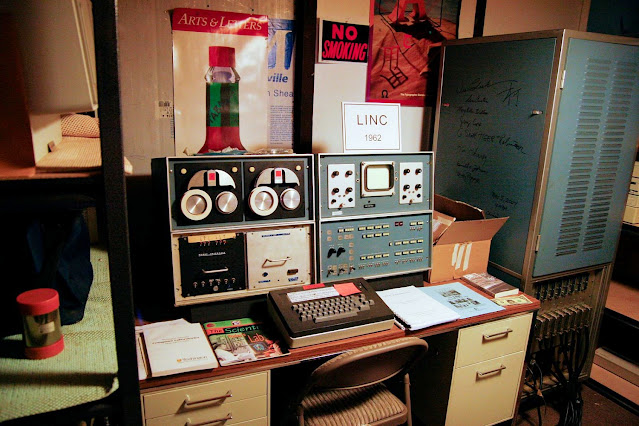
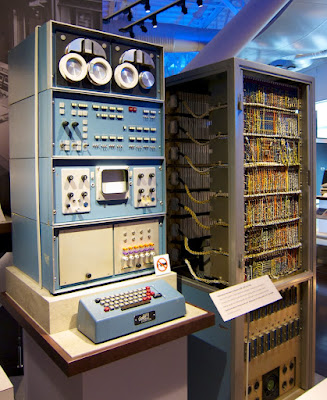
LINC (1962)

First delivered in March 1962

The LINC – short for Laboratory INstrument Computer - was one of the world's very first minicomputers, helping to break the computer out of the corporate machine room and making it available to individual departments, labs and (at a stretch) homes.

Designed at MIT for academic work, most LINC machines were built by Digital Equipment Corporation, who were based in Massachusetts as is MIT. By 1962, DEC had already launched the PDP-1 (another candidate for the world’s first minicomputer) but the LINC was considerably cheaper and more compact.

Based on a 12-bit architecture, one innovation with the LINC was the tape drive (the LINCtape) which could store up to 400Kb and allowed a slow but reliable form of random access storage (somewhat like a very slow disk drive). The LINCtape evolved into DECtape, a common feature on DEC’s PDP line.

Digibarn's LINC system


A small CRT could be used for output, and a rather clunky keyboard from Soroban Engineering (responsible for many computer keyboard of the same period) allowed input. Additional output could be made to a teletype, and the LINC could also be controlled by a set of rotary knobs which were essentially a precursor (pun intended) to the mouse.

The key application for the LINC was interfacing with lab equipment through the inbuilt A-to-D (analogue to digital) and D-to-A interfaces. This made the LINC a successful lab machine, although only 50 were built so it didn’t exactly change the world.

LINC exhibit at the Computer History Museum, California


Significantly though, the LINC may be the world’s first home computer. Programmer Mary Allen Wilkes had a LINC system installed in her home, something that would be unfeasible with the 730kg PDP-1. It would take another 15 years or so before home computers became something that you could just go to the local electronics store to buy..

The LINC architecture grew into the PDP-5, PDP-8, PDP-12 and DECmate well into the 1970s. In the end though, the 16-bit PDP-11 and 32-bit VAX architecture (which were unrelated) moved things forward from there.

Image credits:
Jonathan Assink via Flickr - CC BY-ND 2.0
Don DeBold via Flickr – CC BY 2.0


Thursday, 29 July 2021

IBM Selectric (1961) and IBM Datamaster (1981)

Introduced July 1961 and July 1981

Remember typewriters? You know, the obsolete technology that existed before the obsolete technology called word processors? Somewhere after people wrote stuff down by hand? No? Oh well, the IBM Selectric probably isn’t for you.

By 1961, typewriters were clunky, slow and inflexible… but businesses everywhere relied on them. IBM had a different vision of what a typewriter could be, and the Selectric was much more feature rich than most of the machines on the market at the time.

Early IBM Selectric Typewriter

One obvious different was the print head – instead of having an individual arm with each letter laid out in a complex mechanical arrangement, the Selectric had a “golf ball” print head which would rotate to find the letter you wanted. On the Selectric, the head moved from left to right rather than the paper moving from right to left. Crucially, if the operator wanted to change the font they would just stop typing and swap in a different print head.

A quite complex electromechanical arrangement made all this work, and to get the best out of the Selectric required either experience or training. But it was faster, more reliable and more flexible than traditional devices and IBM took a large share of the business market.

New versions with more features followed, although the Selectric units were incompatible with each other. Some had correcting ribbons, wordprocessing features and even local storage. Variants of the Selectric could be used as computer printers. By the time the brand was retired in 1986, IBM had sold more than 13 million Selectric devices.

20 years further on, IBM found itself on the cusp of a larger revolution. Business computers had been getting smaller, more powerful and – crucially – cheaper, which was becoming a possible threat for IBM’s large computer business.

IBM wanted its own microcomputer and had started working on creating a unit based on an Intel processor, which was a major design break for IBM who had previously used their own PALM CPUs in their machines. The results of this unconventional effort by IBM is probably not the computer that first springs to mind – the IBM PC – but instead the IBM System/23 Datamaster.

IBM Datamaster
IBM Datamaster

The Datamaster used many of the same or similar elements that would be seen in the PC, including the Intel CPU, expansion bus and keyboard. Instead of the PC’s now-familiar modular design, the Datamaster was an all-in-one box (not dissimilar to the original Mac) designed to be set up by people with no technical experience. It was also IBM’s cheapest computer to date.

Unfortunately for the Datamaster, it had been stuck in development hell and took a very long time to come to market. As it was being readied for launch, the team behind it were also finalising the IBM PC which was launched the very next month. The PC had learned many lessons from the Datamaster, keeping what was good and throwing out what wasn’t. The PC changed the world, the Datamaster found modest sales in die-hard IBM shops.

The Selectric was arguably the ultimate electric typewriter, and while the Datamaster wasn’t the ultimate microcomputer it paved the way for what arguably evolved into one. Both devices are quite collectable, although the Datamaster is much rarer than the Selectric. Out of the two, the Selectric might still be of more practical use... and your children may well never have seen anything quite like a typewriter before.

Image credits:
Marcin Wichary via Flickr – CC BY 2.0
Steve Lodefink via Flickr - CC BY 2.0


Tuesday, 6 July 2021

Renault 4 (1961)

Introduced July 1961

One of world’s most successful single models of car, the Renault 4 sold over eight million units in 33 years of production. It was an enduring success, utilising several technologies which were novel in the 1960s but commonplace in later years.

Although the Renault 4 is shaped like a small station wagon or estate car, it was actually the world’s first mass-produced hatchback. It was also front-wheel drive, at a time when almost everything else on the road was rear wheel drive. Indeed, the engine was in the front as well when rear-engined cars were still a thing.

Renault 4
Renault 4


The design was modern by early 1960s standards, and the target market was people who up until then had been buying the Citroën 2CV. Despite the rival 2CV having been introduced in 1948, it was still a strong seller due to its practicality and simplicity. However, the Renault 4 offered more power, more comfort and lower maintenance costs.

Unlike modern cars, the Renault 4 is built on an independent chassis with the body being placed on top. The chassis provided all the structural strength, allowing more windows and thinner pillars in the car itself giving better visibility. A range of engines were available – the smallest was in the Renault 3 (fundamentally the same car as the Renault 4), giving 22 horsepower. The Renault 4 had up to 32 horsepower. The rival 2CV thrashed around on just 12 horsepower at the time.

It was a practical car, and comfortable too. Although it maybe lacked the charm of the 2CV, it went on to be a massive sales success worldwide. Licence-built versions of the Renault 4 were made in such diverse countries as Argentina, Ireland, Morocco, Australia, Mexico and Yugoslavia. There was a popular van ("fourgonnette") version, plus a pickup and dozens of quirky custom versions made by converters and enthusiasts.

Renault 4 fourgonnette

After the Renault 4’s launch came a host of other front-wheel drive hatchbacks, both from Renault and other manufacturers. The 4 lingered on though, with French production going on until 1992 (and until 1994 in Slovenia). Eventually it was replaced with the first-generation Twingo which successfully built upon the 4’s design philosophy – becoming a modern classic in its own right.

Today the Renault 4 is a rare sight on British roads – much rarer than the rival 2CV – with prices starting at just a few thousand pounds for a slice of Gallic charm. 

Image credits:
Spline Splinson via Wikimedia Commons – CC BY 2.0
Gzzz via Wikimedia Commons – CC BY-SA 3.0


Monday, 28 December 2020

2020: things that didn’t quite make the cut

This year we’ve covered gadgets and inventions from the 1800s and up. But there are plenty of other things that had anniversaries this year that we didn’t mention.

One of the most important inventions debuted in 1810 – the tin can. A key product of the industrial revolution, the tin can answered many of the millennia-old questions about how to preserve foodstuffs. More reliable and palatable than salting, drying, pickling and a variety of other methods this humble tin can meant food security for growing populations in the 19th, 20th and 21st centuries.

Also hailing from the nineteenth century was celluloid, a versatile class of materials that were pioneered in billiard balls in 1870, and then found their way into many other products from toys to films. However, celluloid’s habit of bursting into flames means that it is rarely used as a material today.

Canned food in a store in Hong Kong, Easter brooch with celluloid flowers


Somewhat related to celluloid is cellophane, a lightweight and flexible material that lent its properties to Scotch Tape, introduced in 1930. Also from 1930 – and perhaps a little bit more edible – is the Hostess Twinkie cake bar. Allegedly, Twinkies last forever – but eat a decade-old box at your own risk.

Vintage scotch tape container, Twinkie cake bars

Fast forward to 1960 and the white heat of technology forges something even more high-tech than sticky tape and cake bars, with the laser. Don’t ask me to explain how these things work, they just do. Pew pew.

Visible lasers being demonstrated


People who remember the home computers of the 1980s probably remember the Commodore VIC-20 – but it had an immediate predecessor in the shape of the VIC-1001 which was sold successfully in Japan only. The main difference between the two is that the VIC-1001 supports Japanese Katakana characters.

Commodore VIC-1001


By 1990 of course things were really getting more advanced. The Sega Game Gear was an 8-bit handheld console that carved a significant market for itself. Another 8-bit games machine, the Commodore 64 Games System (or simply the C64GS) was a more traditional console based closely on the legendary Commodore 64 home computer. The C64GS held great promise with the potential of a huge games library, but it failed to deliver in a spectacular way.

Sega Game Gear, Commodore 64 Games System

In the same year, the Macintosh Classic breathed a bit more life into a familiar format at a sub-$1000 price point, but the 68000 processor was getting a bit long in the tooth by then. More powerful, but three times the cost, was the 68030-based Macintosh IIsi which was much more forward-looking.

Apple Macintosh Classic, Macintosh IIsi

Handheld gadgets continued to develop, and in 2000 the Sharp J-SH04 was launched in Japan which was the world’s first recognisable camera phone, with a rear-facing 0.11 megapixel camera. It wasn’t great, but it set a pattern that other early camera phones improved on.  

Sharp J-SH04


That’s it for 2020, a difficult year for many people. Let’s hope that 2021 will be better. A big shout out to all those key workers, healthcare professionals and everybody trying to be socially responsible (or even just managing to keep themselves sane) this year. 

Image credits:
Canned food in a store in Hong Kong: Bairgae Daishou 33826 via Wikimedia Commons - CC BY-SA 4.0
Easter brooch with celluloid flowers: Pinke via Flickr – CC BY-NC 2.0
Vintage scotch tape container: Improbcat via Wikimedia Commons – CC BY-SA 3.0
Twinkie cake bars: Photog Bill via Flickr - CC BY-NC-ND 2.0
Visible lasers being demonstrated: US Navy via Wikimedia Commons – Public domain
Commodore VIC-1001: Thomas Conté via Flickr - CC BY-SA 2.0
Sega Game Gear: James Case via Flickr - CC BY 2.0
Commodore 64 Games System: Thomas Conté via Wikimedia Commons - CC BY-SA 2.0
Macintosh Classic: Christian Brockmann via Wikimedia Commons – CC0
Macintosh IIsi: Benoît Prieur via Wikimedia Commons - CC BY-SA 4.0
Sharp J-SH04: Morio via Wikimedia Commons - CC BY-SA 3.0


Saturday, 7 November 2020

DEC PDP-1 (1960)

First unit shipped November 1960

In 1960, the Massachusetts firm Digital Equipment Corporation (typically known as “DEC” or just “Digital”) was just three years old. Founded by two ex-MIT engineers, DEC’s earliest products were small computing modules on cards that could be used in labs, the design of which was based on work originally done at MIT.

The company advanced quickly, and in 1959 it announced a minicomputer based on these modules, which they called the PDP-1. “PDP” stood for “Programmable Data Processor” – according to legend this was because DEC was afraid that IBM might sue if they called it a “computer”, but in reality it seems that this approach was because computer companies were regarded as high-risk for investors, where lab equipment companies were less so.

DEC PDP-1
DEC PDP-1

Although clever and flexible in approach, the modules still consisted of individual transistors and other components soldered to a board. This meant that the overall system was quite large (weighing hundreds of kilograms). It was 36-bit computer with the equivalent of just 9.2Kb of memory, mass storage was provided by paper tape and output could be to a printer or weird circular CRT that had basically been transplanted from a radar system.

Prices started at $130,000 for a basic system (around a million dollars today) which made it a feasible purchase for well-funded labs, universities and tech-oriented companies. It was essentially a single-user system until the development of timesharing OSes such as the one from BBN. As a comparison, an IBM 7090 mainframe computer of the same era cost around $2.9 million ($20 million today), and although the PDP-1 was much less powerful it was much more flexible and it could be programmed to do things that were impossible on a tightly buttoned-down mainframe.

Things that you couldn’t do on a mainframe but could do on a PDP-1 included playing synthesised music and a key early video game – Spacewar!. A precursor of much later video games such as Asteroids, the game used the Type 30 vector display of the PDP-1 to show two opposing spacecraft fighting each other around the gravitational field of a sun. The Type 30’s long persistent phosphor added to the space-age gameplay and of course it became a major reason for people to book time on their department’s PDP-1 for (ahem) “research”.

Spacewar!
Spacewar!

DEC were still a fledgling company, and although the PDP-1 was a success it only shipped 53 units. However, just five years later DEC was growing quickly and the 12-bit PDP-8 launched in 1965 shipped an astonishing 50,000 units over its lifetime, and five years after that the 16-bit PDP-11 eventually shipped 600,000 units. As an aside, DEC also made 36-bit and 32-bit computers in the 60s and 70s, to add to the confusion.

The architecture used in the PDP-1 turned out to be a dead end, ending in 1970 with the PDP-15. However, it helped start a revolution in small-scale computing which – after nearly two decades – allowed everybody who wanted one to have a computer on their desk. Unfortunately for DEC, they never could successfully transition from minis to micros, but that is another story.

Image credits:
M.Hawksey via Flickr – CC BY 2.0
Kenneth Lu via Flickr – CC BY 2.0


Monday, 13 April 2020

RS-232 (1960)

Mouse using a serial interface
Introduced 1960

Known to many as just a “serial interface”, RS-232 is a surprisingly old communications standard that was once everywhere and even today it refuses to die. A simple way to connect a computer with a peripheral or other computer, the RS-232 interface could be used – with a bit of effort – to connect just about anything to just about anything.

The RS-232 interface is a “serial” interface because it transmits data one bit at a time in two directions, compared with contemporary “parallel” interfaces that typically transmitted 8 bits at a time in one direction.

The standard defines one end as the DTE (Data Terminal Equipment – e.g. a computer) and the other as the DCE (Data Circuit-terminating Equipment – e.g. a printer) connected together using a cable with 3 or more wires and terminated using 25-way D-type connectors. The number of wires in use varied depending on how many features you wanted to use, and many implementations ditched the large 25-way connector for something smaller, typically a 9-way connector on a PC.
--
RS-232 Breakout Box

Connecting DCE-to-DCE or DTE-to-DTE would require a special cable, and indeed it was possible to make custom cables quite easily depending on your needs, or you could simply use one of many adapters between different types of connector or equipment. Typical transfer speeds could vary between 50 baud (bits per second) to 9600 baud, 19200 baud or even higher.

A typical early use of RS-232 would be to connect a terminal to large computer system, or in later days a PC to a printer, modem or mouse. Indeed, on the PC the serial port lingered into the 2000s until the more versatile but fundamentally similar Universal Serial Bus (USB) became the de facto standard for connecting things together.

Because most computers either had a built-in serial interface or one available as an add-on, if you had (or made) the right cable then you could transfer files between utterly different and usually completely incompatible systems. The first challenge was to acquire a copy of an application such as Kermit and apply it to both systems, but once you had that it was a reasonably trouble-free way of moving data about.

Although RS-232 interfaces are less common than they used to be, they can still be found on industrial and laboratory equipment, communications gear and even home entertainment systems. But perhaps the RS-232’s most peculiar lasting legacy is this song

Image credits:
Konstantin Lanzet via Wikimedia Commons
MdeVicente via Wikimedia Commons - CC0 1.0


Spitting Image - RS232 Interface Lead 


Saturday, 28 December 2019

2019: things that didn’t quite make the cut

This year we’ve covered products debuting in 1959, 1969, 1979, 1989, 1999, 2004, 2009 and 2014. Here are a few of the things we missed.

It being Christmas and all a good place to start would be the Honeywell Kitchen Computer from 1969. Appearing in the Neiman Marcus Christmas Catalog of the same year, the so-called Kitchen Computer actually a Honeywell 316 minicomputer in a desktop case which was designed for laboratory environments, however the imaginative folks at Neiman Marcus thought the pedestal would make a great chopping board while the wife of the household used it to retrieve recipes. A great idea, but the Honeywell 316 was totally unsuited to that role and total sales of the Kitchen Computer were approximately nil, but the myth still persists even to this day.

Although a kitchen is a difficult and unwelcoming environment for a computer, GRiD Systems Corporation made computers that travelled into space. In 1989 they launched the GRiDPAD, the world’s first tablet computer. While not as friendly as a modern tablet, this MS-DOS machine sold relatively high numbers with a price ticket of about $3000 for one with software.


Honeywell 316 aka "Kitchen Computer" (1969) and GRiDPAD (1989)

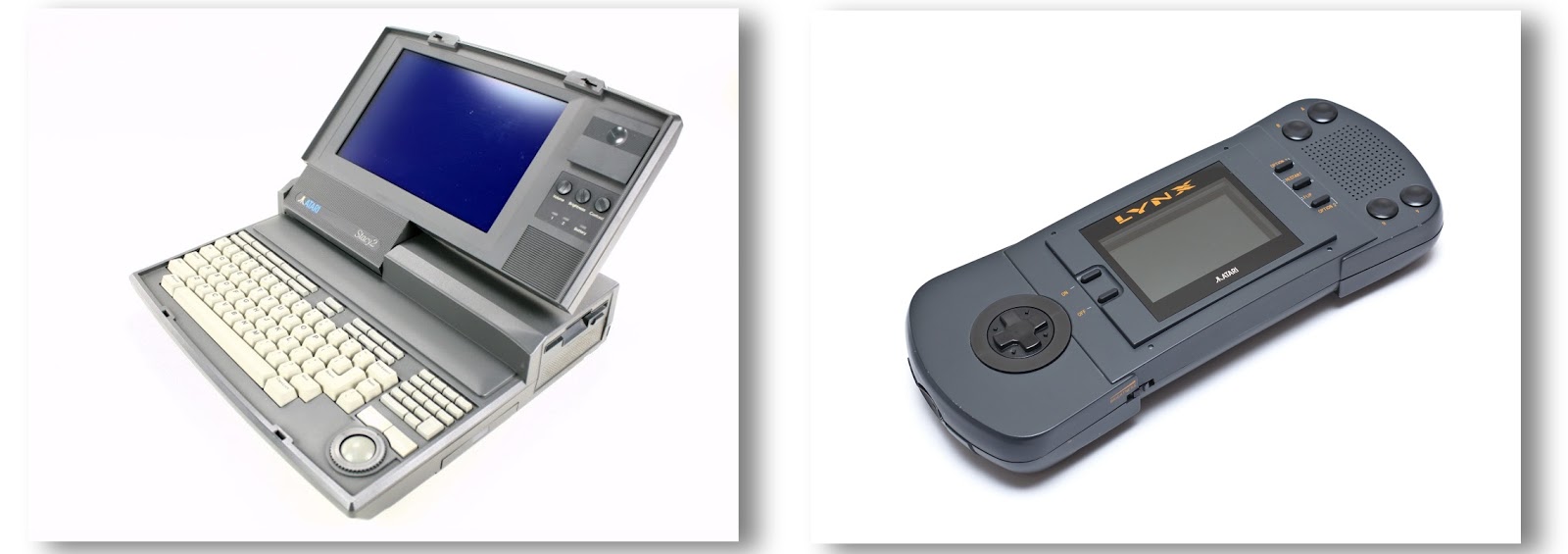
Atari too were experimenting with portable computing, and in 1989 they launched the Portfolio (that we already covered) plus the Atari Stacy and Atari Lynx. The Stacy (styled STacy by Atari) was a portable version of the Atari ST which had proved a hit in the mid-80s but was now fading. However, the Stacy found a successful niche with musicians who liked the portability and the excellent MIDI support, even though Atari gave up on making it battery powered quite late into development and ended up gluing the battery compartment shut. At the other end of the scale was the Atari Lynx was a handheld gaming platform that was advanced for its day but struggled against the Nintendo Gameboy... however even today the Lynx has its fans and now and again new games appear for it.

Atari Stacy (1989) and Atari Lynx (1989)
Like Atari, Zenith Data Systems had been a pioneer of early microcomputers and they too were keen to jump on board the portable computer bandwagon. The Zenith MinisPORT (launched in 1989) was one of the smallest DOS-compatible computers made to that date, and it featured a highly unusual 2” floppy disk drive in order to keep the size down.

Zenith MiniSPORT (1989)
Sega was another stalwart of the gaming industry, in 1989 they launched the Sega Mega Drive (also known as the Genesis) that proved to be a massive hit in Europe and North and South America – although officially replaced by the Sega Saturn in 1995 the popularity of the Mega Drive continued. 30 years later and Sega revisited the platform with the Sega Mega Drive Mini. Skip another generation from the Saturn and you get the 1999 Sega Dreamcast. The Dreamcast was an advanced machine with excellent 3D support, but it couldn’t compete against Sony’s Playstation 2 and it was Sega’s last mainstream games console.

Saga Mega Drive aka Genesis (1989) and Dreamcast (1989)

Back to 1989 again and we find a computing oddity in the SAM Coupé – an unusual machine that was compatible with the Sinclair ZX Spectrum with various enhancements such as a proper keyboard, floppy disk and more memory. It was a niche success against 16 and 32-bit rivals and it still has a dedicated following today. Don’t confuse the SAM Coupé with the Cozy Coupe though, this little plastic car for children was launched in 1979 and it would technically be one of the world’s best-selling cars if it was actually a real car.
--
SAM Coupé (1989) and Cozy Coupe (1979)


Looping round one last time to 1989, and Motorola launched their iconic MicroTAC series of phones. This flip-phone design was much more compact than the DynaTAC that preceded it, and many versions of the MicroTAC were made for all the disparate analogue and digital networks of the early 1990s. The design evolved over the years, and versions of the MicroTAC stayed in production until 1996. One of the MicroTAC’s spiritual successors might be the tiny Ericsson T28, the world’s smallest mobile phone when it was launched in 1999 weighing just 83 grams. Ultimately both the MicroTAC and T28 started a trend for mobile phones to be smaller and lighter, which is something we seem to have lost along the way..

Motorola MicroTAC (1989) and Ericsson T28 (1999)


That’s it for 2019. Next year we look to cover diverse topics such as the Acorn Atom, Epson MX-80, Squarial and Pac-Man plus many other things. See you on the other side!

Image credits

Honeywell 316: Scott Beale via Flickr
GRiDPAD: Association WDA via Flickr
Atari Stacy: Perfect Circuit Audio via Wikimedia Commons
Atari Lynx: Pete Slater via Flickr
Zenith MiniSPORT: Kris Davies via Wikimedia Commons
Sega Mega Drive: Barité Videojuegos via Flickr
Sega Dreamcast: Evan-Amos via Wikimedia Commons
SAM Coupé: Simon Owen via Wikimedia Commons
Cozy Coupe: Nick via Flickr
Motorola MicroTAC: Redrum0486 via Wikimedia Commons
Ericsson T28: The Norwegian Telecom Museum via Wikimedia Commons