Saturday, 28 December 2019

2019: things that didn’t quite make the cut

This year we’ve covered products debuting in 1959, 1969, 1979, 1989, 1999, 2004, 2009 and 2014. Here are a few of the things we missed.

It being Christmas and all a good place to start would be the Honeywell Kitchen Computer from 1969. Appearing in the Neiman Marcus Christmas Catalog of the same year, the so-called Kitchen Computer actually a Honeywell 316 minicomputer in a desktop case which was designed for laboratory environments, however the imaginative folks at Neiman Marcus thought the pedestal would make a great chopping board while the wife of the household used it to retrieve recipes. A great idea, but the Honeywell 316 was totally unsuited to that role and total sales of the Kitchen Computer were approximately nil, but the myth still persists even to this day.

Although a kitchen is a difficult and unwelcoming environment for a computer, GRiD Systems Corporation made computers that travelled into space. In 1989 they launched the GRiDPAD, the world’s first tablet computer. While not as friendly as a modern tablet, this MS-DOS machine sold relatively high numbers with a price ticket of about $3000 for one with software.


Honeywell 316 aka "Kitchen Computer" (1969) and GRiDPAD (1989)

Atari too were experimenting with portable computing, and in 1989 they launched the Portfolio (that we already covered) plus the Atari Stacy and Atari Lynx. The Stacy (styled STacy by Atari) was a portable version of the Atari ST which had proved a hit in the mid-80s but was now fading. However, the Stacy found a successful niche with musicians who liked the portability and the excellent MIDI support, even though Atari gave up on making it battery powered quite late into development and ended up gluing the battery compartment shut. At the other end of the scale was the Atari Lynx was a handheld gaming platform that was advanced for its day but struggled against the Nintendo Gameboy... however even today the Lynx has its fans and now and again new games appear for it.
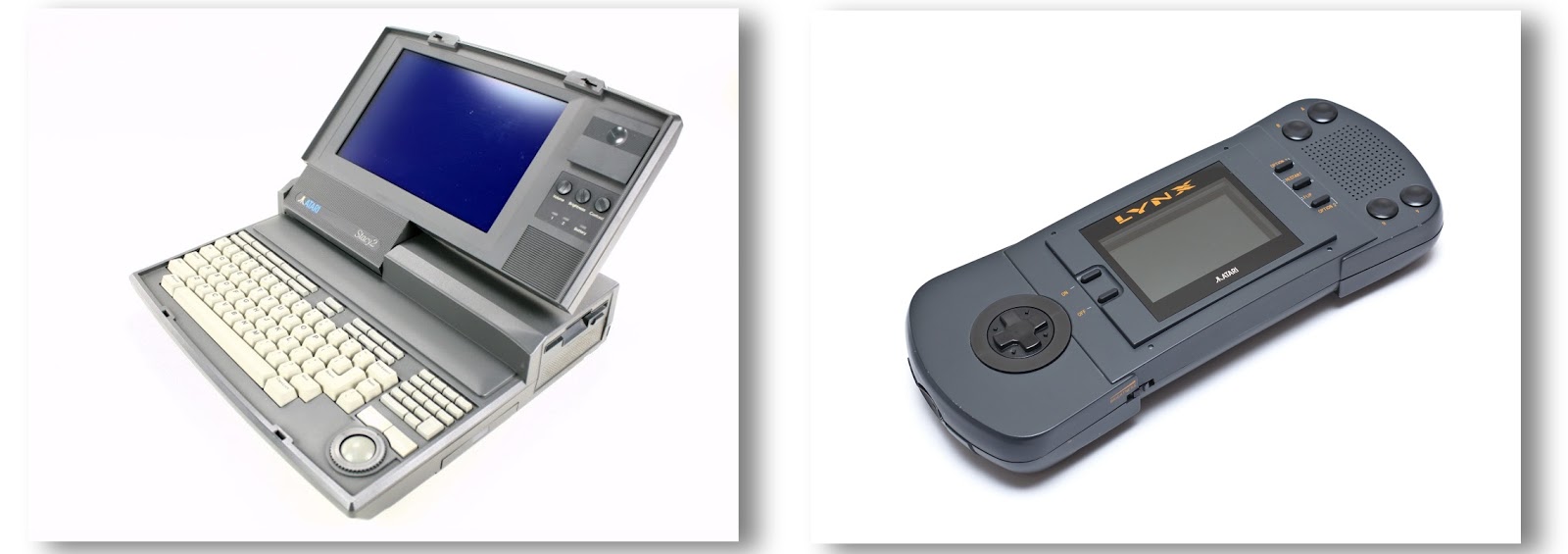
Atari Stacy (1989) and Atari Lynx (1989)
Like Atari, Zenith Data Systems had been a pioneer of early microcomputers and they too were keen to jump on board the portable computer bandwagon. The Zenith MinisPORT (launched in 1989) was one of the smallest DOS-compatible computers made to that date, and it featured a highly unusual 2” floppy disk drive in order to keep the size down.

Zenith MiniSPORT (1989)
Sega was another stalwart of the gaming industry, in 1989 they launched the Sega Mega Drive (also known as the Genesis) that proved to be a massive hit in Europe and North and South America – although officially replaced by the Sega Saturn in 1995 the popularity of the Mega Drive continued. 30 years later and Sega revisited the platform with the Sega Mega Drive Mini. Skip another generation from the Saturn and you get the 1999 Sega Dreamcast. The Dreamcast was an advanced machine with excellent 3D support, but it couldn’t compete against Sony’s Playstation 2 and it was Sega’s last mainstream games console.

Saga Mega Drive aka Genesis (1989) and Dreamcast (1989)

Back to 1989 again and we find a computing oddity in the SAM Coupé – an unusual machine that was compatible with the Sinclair ZX Spectrum with various enhancements such as a proper keyboard, floppy disk and more memory. It was a niche success against 16 and 32-bit rivals and it still has a dedicated following today. Don’t confuse the SAM Coupé with the Cozy Coupe though, this little plastic car for children was launched in 1979 and it would technically be one of the world’s best-selling cars if it was actually a real car.
--
SAM Coupé (1989) and Cozy Coupe (1979)


Looping round one last time to 1989, and Motorola launched their iconic MicroTAC series of phones. This flip-phone design was much more compact than the DynaTAC that preceded it, and many versions of the MicroTAC were made for all the disparate analogue and digital networks of the early 1990s. The design evolved over the years, and versions of the MicroTAC stayed in production until 1996. One of the MicroTAC’s spiritual successors might be the tiny Ericsson T28, the world’s smallest mobile phone when it was launched in 1999 weighing just 83 grams. Ultimately both the MicroTAC and T28 started a trend for mobile phones to be smaller and lighter, which is something we seem to have lost along the way..

Motorola MicroTAC (1989) and Ericsson T28 (1999)


That’s it for 2019. Next year we look to cover diverse topics such as the Acorn Atom, Epson MX-80, Squarial and Pac-Man plus many other things. See you on the other side!

Image credits

Honeywell 316: Scott Beale via Flickr
GRiDPAD: Association WDA via Flickr
Atari Stacy: Perfect Circuit Audio via Wikimedia Commons
Atari Lynx: Pete Slater via Flickr
Zenith MiniSPORT: Kris Davies via Wikimedia Commons
Sega Mega Drive: Barité Videojuegos via Flickr
Sega Dreamcast: Evan-Amos via Wikimedia Commons
SAM Coupé: Simon Owen via Wikimedia Commons
Cozy Coupe: Nick via Flickr
Motorola MicroTAC: Redrum0486 via Wikimedia Commons
Ericsson T28: The Norwegian Telecom Museum via Wikimedia Commons

Wednesday, 11 December 2019

Tangerine Microtan 65 (1979)

Tangerine Microtan 65
Introduced December 1979

As the 1970s drew to a close US computer manufacturers were dominating the market with fully-featured but expensive systems such as the Apple II and Atari 800. Where these systems were popular in the US market, British consumers had rather less to spend on these new-fangled machines and many hobbyists were tinkering with simple board computers such as the Acorn System 1 instead.

Although board computers were inexpensive, they were also very limited. Although it was usually possible to add a few peripherals, they still couldn’t do the sorts of things that the new American microcomputers could.

Into this market stepped the British-based Tangerine Computer Systems with the Microtan 65. This was a 6502-based single board computer with just 1Kb of RAM, 1Kb of ROM with a simple OS called the monitor, a video output and a hexadecimal keypad. But the system itself was highly expandable, with the first step being the TANEX expansion board that added a cassette and serial interface, plus the option of more RAM and up to five EPROMs.

However, expansion could go on and on with more boards for more memory, disk controllers, printers, better graphics and more. All of these could be slotted into a 19” rack-mountable case to make a microcomputer that could be used for business, home or scientific or engineering purposes. And although the price of all these components added up, you only needed to buy what you were going to use.

The result was a technically capable and scalable system that was successful enough for Tangerine to look at creating a follow-on model. Initially they looked at creating a CP/M compatible Z80-based machine that was developed for HH Electronics, named the HH Tiger. Despite an elegant design, the Tiger was not a success and is largely forgotten if it was even noticed at all.

Tangerine’s next hit was the Oric-1, another 6502 machine made very much in the mould of the very popular Sinclair ZX Spectrum. This machine and its successor – the Oric Atmos – proved very popular in the UK and some other European markets. But that is a story for another time.

Ultimately the Microtan 65 could have been the start of a huge revolution in personal computing, but it didn’t quite make it. Forty years later the Microtan 65 is a hard thing to find for collectors, but our research indicates that a well-specified system might cost you something in the region of £1500.

Image credit: Ian Dunster via Wikimedia Commons


Monday, 25 November 2019

Galaxian (1979)

Introduced November 1979

Galaxian was launched at a time when arcade games were becoming really popular – and profitable. Following the trail laid by 1978’s Space Invaders was Namco’s Galaxian. Despite there only being about a year and a half between these two products, Galaxian was a huge improvement.

Fundamentally the concept of the game was pretty similar to Space Invaders – the player controlled a spaceship at the bottom of the screen which could move left or right and fire. Arranged in neat rows at the top were hostile aliens that the player had to wipe out. But Galaxian was a much richer gaming experience.

The most obvious improvement that this game was in colour, unlike the monochrome Space Invaders that used plastic strips to give the *illusion* of colour. And instead of the aliens slowly shuffling their way across and down the screen, the enemies in Galaxian swooped down shooting, either singly or in a group. Combine that with simple but well-polished sound effects and it all added up to a game that made Space Invaders look primitive.

Inside was a Zilog Z80 processor which really was next-generation stuff compared to the old Intel 8080 in Space Invaders, plus of course electronics components were improving all the time which helped enormously. It wasn’t just hardware though, Galaxian was also efficiently coded to squeeze as much out of the hardware as it could.

Namco found that it had a huge hit on its hands, first in Japan and then in North America after partnering with Midway (who had previously partnered with Taito on Space Invaders). Galaxian went on to be one of the definitive arcade games of the early 1980s and it was eventually ported to many other platforms. The official follow-on – Galaga – was an even bigger hit, and Namco themselves continue on to this day having merged with Bandai in 2006 to create Bandai Namco.


Wednesday, 13 November 2019

Asteroids (1979)

Introduced November 1979

1979 was a landmark year for Atari – the launch of the popular 400 and 800 computers, the Lunar Lander arcade game and the continued success of the VCS games console meant that Atari was very much becoming a cornerstone technology company of the late 70s and early 80s.

Asteroids Gameplay (click to enlarge)
--
Asteroids Cabinet
The next step in the story was the Atari Asteroids arcade game. Based on the same basic hardware as Lunar Lander, Asteroids was a much more playable game. In case you’ve never seen any of the many versions of Asteroids that followed the 1979 classic, the basic idea is to blast large chunks of rocks into smaller chunks and then destroy them completely using a small spaceship that can move about the screen. Flying saucers will also appear and attempt to shoot the player to give it an extra degree of complexity. Although not strictly following the laws of physics, the game has a fair approximation which gives it an atypical gameplay for an arcade machine.

Like Lunar Lander, this was a vector graphics games powered by a 6502 with some rudimentary sounds hard-wired in. Although the controls were different (with five buttons to rotate left and right, fire, thrust and hyperspace).

The game was an enormous success, raking in tens of millions of dollars for both Atari and the arcade operators. Demand for the games was so great that Atari cannibalised some of their Lunar Lander boxes to meet it, and it became the most popular arcade machine in the world… for a while.

Sequels, spin-offs and clones followed on just about every console and computer system known to mankind. Forty years later it is still a popular game, although the days of CRT machines with vector graphics are long gone. If you want the original thing, they are pretty hard to come by and most of those available seem to be in the US with a price of $1500 or so for the classic cabinet version and around $500 for the cocktail table variant.

Image credits:
Michael F. via Flickr
killbox via Flickr

Sunday, 3 November 2019

Atari 400 / 800 (1979)

Atari 800 (1979)
Introduced November 1979

In the late 1970s the microcomputer revolution had been kicked off by the holy trinity of the PET, Apple II and TRS-80 which all launched in 1977. Then – as now – two years is a long time in technology and even those these computers well selling well in in 1979 there were better machines coming along.

Atari was an established player in the consumer electronics market since the early 1970s, but although they were eager to capitalise on the new microprocessors launching in the later part of that decade they had taken a different path with the Atari VCS (later called the 2600) launched at the same time as rivals were launching home computers instead.

The Atari VCS was a significant hit, however Atari’s own engineers though that it would have a very limited lifespan (although in fact it was in production in one form or another for 15 years). Development of an improved version based on the VCS architecture started immediately after the product was launched.

When the Atari 400 and 800 were launched two years later it turned out that the VCS had evolved into something very much more advanced. Based on the popular 6502 processor, both the 400 and 800 were fully-featured microcomputers much like the competition, but they also came with a convenient cartridge slot like a games console… which most of the competition did not.

During the design phase it was envisaged that the 400 and 800 would be quite different computers, but in the end they were fundamentally the same. The main differences were that the 400 had 16KB of RAM, a single cartridge slot and a membrane keyboard compared to the 800’s 48KB of RAM, two cartridge slots and a traditional mechanical keyboard.
Atari 400 showing cartridge slot (1979)

At launch the 800 was priced at $1000 with the 400 coming in at $550. Because you had to add a monitor plus some sort of storage (i.e. a cassette or disk drive) then it could add up to being quite an expensive system. However, the hardware was much more sophisticated than earlier rivals.

Featuring two graphics support chips (ANTIC and CTIA) plus another I/O chip that handled sound and everything else (POKEY) plus four joystick ports and a serial expansion bus, these 8-bit Ataris were easily more capable than the first-generation of microcomputers they were up against. They made excellent games machines, but they were also capable of doing everything that any other contemporary microcomputer would do.

FCC regulations of the time basically mandated that the whole computer be hidden inside a cast aluminium block, making the Atari 400 and 800 especially sturdy. These regulations also led to the development of a novel serial bus (called SIO) that allowed components to be daisy-chained to a single interface port on the computer itself. This solution was ahead of its time and is conceptually similar to the way USB peripherals work, but it had the disadvantage of making plug-in devices much more expensive.
Atari 130XE (1985)

Still, the advanced features of the device made the Atari 400 and 800 very popular, but high production costs meant that Atari made little – if any – profit from them at the beginning. A brutal price war in the early 1980s hit hard, but Atari fought on with the cheaper but more sleek "XL" line (notably the 600XL and 800XL). The 8-bit Atari range had an unexpected boost with the fall of the Iron Curtain in the late 1980s which led to huge sales success in these emerging markets due to the low-cost nature of these computers with even cheaper “XE” machines (the 65XE, 130XE and 800XE) plus a games console based directly on the same architecture (XEGS).

In all there were three generations of the Atari 800 and its siblings, with production lasting until 1992 – the same year that Atari finally pulled the VCS games console. The popular Atari ST – based on the Motorola 68000 – was launched in 1985, giving the company a new lease of life into the 1990s.

Today the Atari 800 is more readily available than the 400 for collectors, with prices varying between tens and hundreds of pounds depending on condition and peripherals. The later 800XL is much more common and tends to be cheaper. Alternatively various emulators are available if you want to try it that way instead.

Image credits:
Bilby via Wikimedia Commons
Rama & Musée Bolo via Wikimedia Commons
Multicherry via Wikimedia Commons

Wednesday, 30 October 2019

Marks and Spencer Chicken Kiev (1979)

Marks and Spencer Chicken Kiev, 2019
Introduced October 1979

Today we are looking at the technological marvel of the Marks and Spencer Chicken Kiev. This may seem weirdly specific, but we’re not just talking about any Chicken Kiev… we are talking about a product that helped to change the way we eat.

Originally a French-inspired piece of Russian cuisine from the early 19th century the definitive recipe for the Chicken Kiev is thought to originate from the Continental Hotel in (unsurprisingly) the city of Kiev. This breadcrumb-coated chicken breast filled with garlic butter became popular throughout the former Russian empire and it eventually escaped to the west via the Yar restaurant in Chicago in the 1930s. From there it spread to other English-speaking countries and became a popular restaurant dish.

After the Second World War (which incidentally destroyed much of the Continental Hotel) the growing ownership of freezers in the US led to the growth of what would eventually be called the “TV Dinner”. Like many other things the idea of a pre-cooked frozen dinner crossed the Atlantic to the UK. But what these foods gained in convenience they tended to sacrifice in taste – and they certainly weren’t something that you would serve to guests.

By the late 1970s food technology was developing quickly. The decade had already given us the Pot Noodle a couple of years earlier, but British retailer Marks and Spencer was working on something altogether classier.

Young product developer Cathy Chapman was working with restaurateur John Docker to create a range of chilled (rather than frozen) meal based on popular restaurant choices. First out of the gate was the Chicken Kiev, modelled closely after the restaurant version including having a little bone sticking out of it.

Despite misgivings from M&S management, the Chicken Kiev was a huge success. Priced at £1.99 per portion in 1979 (nearly £10 today) it certainly wasn’t cheap, but it did have the advantage of being a very tasty and somewhat technically complicated dish that you could prepare in your own home with virtually no culinary skills whatsoever. For extra sophistication, you could wash it down with a bottle of Hirondelle.

The humble M&S Chicken Kiev marked a change in the way food was packaged and sold, and the concept soon spread to other western supermarkets. Today it’s possible to create a quite sophisticated meal even if you can’t reliably boil an egg. This change in food technology certainly broadened our horizons, but tended to come at a cost – these prepackaged foods are often designed for taste rather than healthy eating, and in their wake they tend to leave a lot of packaging which needs to be dealt with too.

You are unlikely to come across any 40-year-old vintage Chicken Kievs – and if you do, give them a wide berth – but food packaging itself it a niche collectable. Marks and Spencer sell a few different versions of Chicken Kiev today at different price points. The ones pictured were £3 for two, which is a lot cheaper than they were in 1979. I ate them for my tea. Very nice they were too.

Image credit: Shritwod via Wikimedia Commons

Sunday, 20 October 2019

PalmOne Treo 650 (2004)

PalmOne Treo 650
Announced October 2004

The history of the mobile phone market is a bit like the history of the world itself, with empires rising and falling and new superpowers emerging and sweeping the old orders away.

One of these old orders was Palm – which due to its Byzantine history was at the time called PalmOne. Palm pretty much owned the PDA market in the 1990s with the Palm Pilot, but they’d missed out on the emergent “wireless PDA” (or as we would call it “smartphone”) market in the early noughties. This led to Palm buying out a company called Handspring, who made wireless PDAs based on Palm’s own operating system – this enabled Palm to get into the market in 2003 with the Handspring Treo 600, followed by the improved PalmOne Treo 650 in 2004.

It seems a bit alien compared to a modern smartphone with the large keyboard and relatively small screen, plus a stick-out antenna which was old-fashioned even in 2004. The 2.4” 320 x 320 pixel TFT touchscreen display was very advanced for its time, and Palm OS 5.4 was a highly usable and sophisticated software platform which included good support for corporate email too.

Bluetooth, expandable memory and a decent multimedia player rounded off the specification, but unlike modern smartphones there was no high-speed data (it was GSM-only) and no GPS. Still, it was competitive for the time.

It was a valiant effort by Palm - but RIM, HTC and Nokia were all established in the “wireless PDA” market by the time Palm came along. Ultimately the Treo sold well to fans of existing Palm Pilots, but it only had limited success outside its existing market base. The Palm OS platform refused to go down without a fight, and it soldiered on for another three years with the Palm Centro being the last of the line.

Prices for the Treo 650 and 600 vary a lot, with decent ones starting at £50 and going up to £200 for ones in mint condition. If you collect interesting old phones you should probably have at least one running Palm OS, and the Treo 650 is certainly a good candidate.


Image credit: Palm